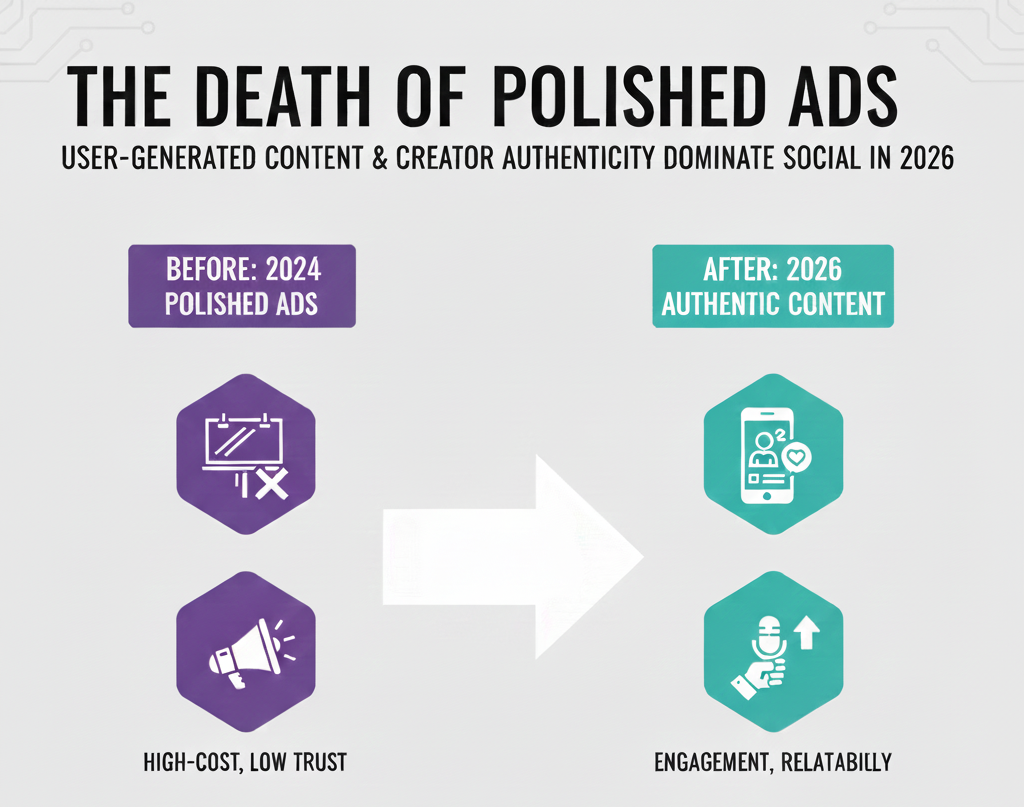
Polished, high-production ads are losing ground to raw, authentic content created by users and creators. In 2026, **user-generated content (UGC)** and genuine creator endorsements drive higher engagement, trust, and conversions on social platforms, as consumers increasingly favor peer recommendations over brand messaging.[1][2]
The Shift Toward Authenticity: Why Consumers Distrust Polished Ads
Consumers in 2026 crave relatability over perfection. **93% of marketers** report that UGC outperforms traditional branded content, highlighting a clear preference for authentic voices.[1][2] This stems from trust: **6 in 10 consumers** view UGC as the most authentic form of marketing, far surpassing scripted ads.[1]
Shoppers echo this sentiment. **40%** say UGC is extremely or very important in purchase decisions, edging out product comparisons (39%) and videos (37%). Meanwhile, **13%** would abandon an online purchase without UGC, underscoring its role as social proof.[1] For Gen Z, **13%** cite UGC as the top influence in social media buys, trailing only influencers (32%) and discounts (26%).[1]
This distrust of polish isn’t new but has accelerated. Brands’ glossy productions feel inauthentic amid economic pressures and ad fatigue, pushing platforms like Instagram—where **28% of ecommerce marketers** see the most engaging UGC—to the forefront.[1]
UGC’s Superior Performance: Data That Proves the Point
Numbers don’t lie. **82% of consumers** are more likely to buy from brands using UGC, and **55% of shoppers** hesitate without it.[1] Visual UGC tops trust rankings at **33%**, ahead of professional shots (24%) and influencer content (18%).[1] Ecommerce marketers overwhelmingly agree: **81%** find it more impactful than pro photos, and **85%** see it as cost-effective.[1]
Performance metrics amplify this. UGC ads deliver **4x higher click-through rates** and **50% lower cost-per-click (CPC)** compared to traditional creatives.[2] Websites with UGC see **29% higher web conversions**, fueled by peer trust.[2] In emails, **50% of marketers** use UGC, boosting click-through rates significantly.[1]
Investment follows suit. **67% of retailers** plan to increase UGC spending this year, with **86% of brands** believing it enhances ad effectiveness.[1] The UGC market, valued at $4.45 billion in 2024, is projected to hit **$18.6 billion by 2031** at a 27% CAGR, signaling a structural shift.[2]
| Metric | UGC Impact | Source |
|---|---|---|
| Marketer-reported outperformance | 93% | [1][2] |
| Consumer purchase likelihood increase | 82% | [1] |
| CTR uplift vs. traditional ads | 4x | [2] |
| Conversion rate increase | 29% | [2] |
| Market growth projection (2031) | $18.6B | [2] |
Creator Authenticity: The Human Edge Over AI and Polish
Creators bridge UGC and influence, embodying authenticity. **Influencer-led ads** achieve nearly **2x higher click-through rates** and **25% lower CPC** than brand content.[3] Micro-influencers (10k-100k followers) boast **3.8% Instagram engagement**, dwarfing celebrities’ 1%.[3]
**70% of consumers** now expect UGC before buying—double last year’s figure—with **62%** citing reviews and comments as the top trust driver.[3][6] Gen Z amplifies this: **55%** want brand features on social, and **80%** share or would share purchases.[1] **Influencer ROI** hits **$5.78 per $1 spent**.[3]
Brands lag: only **16%** have dedicated UGC strategies, a gap ripe for exploitation.[2] Platforms aid this—**44% of B2B buyers** note growing UGC roles in decisions.[1]
Real-World Examples: Brands Winning with UGC and Creators
Glossier built an empire on UGC, reposting customer selfies for organic growth. In 2026, brands like Duolingo thrive on chaotic, creator-driven TikToks, blending humor and authenticity for viral reach.
Skims leverages creator hauls; **Instagram leads UGC engagement at 28%**, followed by Facebook (23%) and TikTok (19%).[1] E.l.f. Cosmetics uses micro-influencer UGC for **600% ROI** in campaigns.[2] These cases show UGC’s efficiency: AI UGC production takes **16 minutes** vs. 2-3 weeks traditionally.[2]
Even as AI content mainstreams—with **97% of leaders** stressing AI skills—human authenticity endures.[4] Consumers detect AI polish, preferring raw creator videos.
Challenges and Strategies for 2026 Adoption
Not all smooth. With **84 UGC platforms** available, selection overwhelms.[1] **77% of consumers** submit UGC for rewards, so incentivize via contests.[1] Whitelist creator content for ads to ensure compliance.[2]
Half of shoppers want UGC on sites and social.[1] Integrate via social listening for untagged mentions.[2] B2B? **44%** see rising peer review impact.[1]
Future-proof: As social users hit **5.66 billion** (68% global population), with **70% using social for research**, UGC positions brands centrally.[3][5]
Conclusion
2026 marks polished ads’ decline, with UGC and creator authenticity commanding social. Backed by stellar ROI, trust, and growth, brands ignoring this risk obsolescence. Embrace raw content—your audience already has.
References
- https://backlinko.com/ugc-statistics
- https://archive.com/blog/ugc-content-creation-time-savings-statistics
- https://thunderbit.com/blog/social-media-marketing-stats
- https://sproutsocial.com/insights/social-media-trends/
- https://wearesocial.com/us/blog/2025/10/digital-2026-global-overview-report/
- https://powerdigitalmarketing.com/blog/social-media-trends-2026/
About the Author
InsightPulseHub Editorial Team creates research-driven content across finance, technology, digital policy, and emerging trends. Our articles focus on practical insights and simplified explanations to help readers make informed decisions.