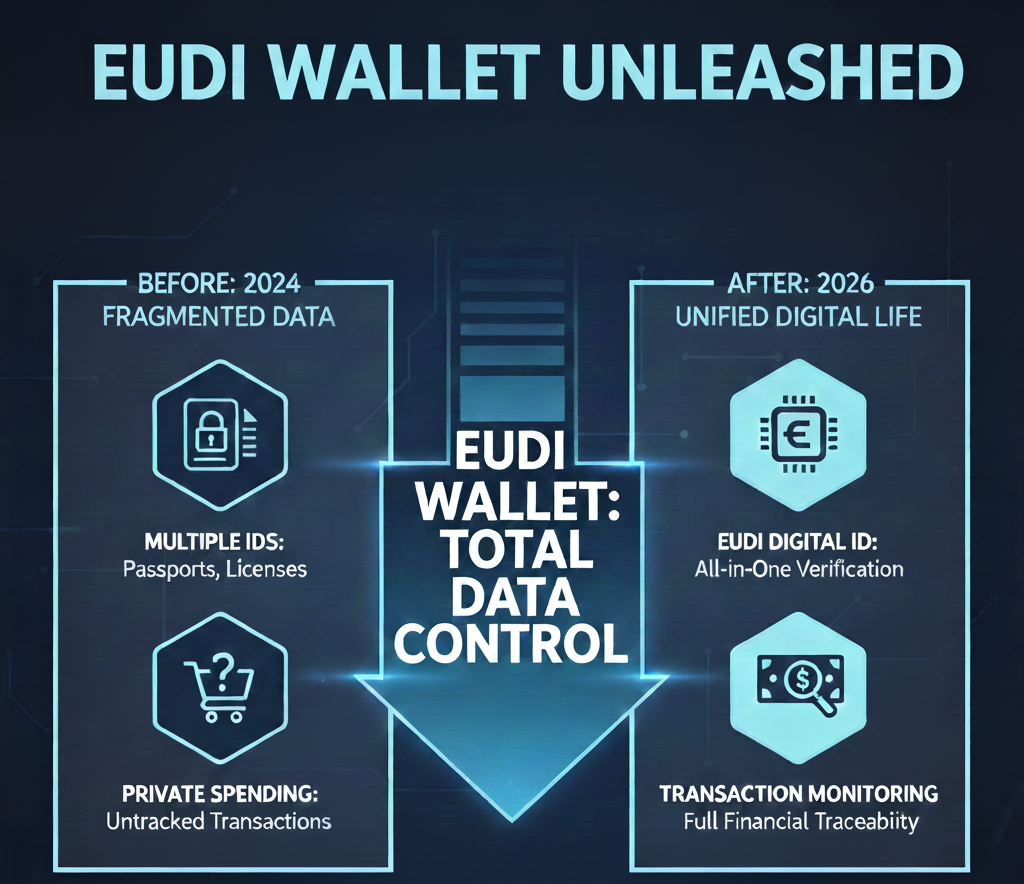
By the end of 2026, approximately 450 million Europeans will gain access to a unified digital identity wallet that fundamentally reshapes how citizens authenticate themselves, access services, and control their personal data[1]. The European Digital Identity (EUDI) Wallet, mandated under the eIDAS 2.0 regulation formally adopted in March 2024, represents one of the most ambitious digital infrastructure projects in European history. Unlike the sensationalized framing of “tracking every transaction,” the EUDI Wallet is actually designed with privacy-preserving mechanisms that give users unprecedented control over what information they share. This article explores what the EUDI Wallet actually is, how it works, the realistic timeline for implementation, and what both citizens and businesses need to know.
Understanding the EUDI Wallet: A New Standard for Digital Identity
The EUDI Wallet is not a financial app or a surveillance tool. Rather, it is a secure digital container that stores verified credentials—your digital identity, driving license, professional qualifications, educational diplomas, and other personal attributes[2]. Think of it as a digital equivalent of your physical wallet, but with cryptographic security and selective disclosure capabilities that traditional documents cannot offer.
The framework addresses critical shortcomings in the original 2014 eIDAS regulation. Existing national eID schemes are fragmented, difficult to use across borders, and rely on static, one-off identity checks[1]. The EUDI Wallet introduces a common legal and technical framework across all EU Member States, enabling citizens to prove specific attributes without revealing unnecessary personal information[1].
For example, if a service needs to verify that you are over 18, the wallet can confirm this fact using zero-knowledge proof mechanisms without sharing your actual birth date[2]. This selective disclosure feature is central to the wallet’s privacy-by-design philosophy and directly contradicts narratives about comprehensive transaction tracking.
Key Timeline: When Does This Actually Launch?
The implementation roadmap is aggressive but clearly defined. The European Digital Identity Framework entered into force on 20 May 2024[1]. The first implementing acts for the wallet were published on 4 December 2024, entering into force approximately 20 days later[1].
The critical deadline is late December 2026, when each EU Member State must make at least one EUDI wallet available to citizens[1]. However, mandatory acceptance by businesses follows a staggered timeline. Regulated private-sector relying parties and very large online platforms must accept the wallet when users choose it by late December 2027[1].
Despite these clear deadlines, implementation challenges persist. As of January 2026, no production-ready EUDI Wallets exist, and technical hurdles remain significant[3]. Cross-border interoperability presents the most complex challenge, with regulatory uncertainty around key compliance questions still unresolved[3]. Some EU Member States, such as Bulgaria, have not yet begun work due to insufficient national legislation[4].
What Can You Actually Do With the EUDI Wallet?
The wallet enables several high-impact use cases expected to go live in 2026 and beyond:
Financial Onboarding and KYC Verification: Banks and fintechs can perform high-assurance Know Your Customer (KYC) checks rapidly. Verified identity and attribute data from the wallet streamline customer onboarding, reduce fraud risk, and support Anti-Money Laundering (AML) and PSD2/PSD3 compliance requirements[1].
Cross-Border Public Services: Citizens can access e-services in any EU Member State using the same wallet, whether applying for benefits, filing tax forms, or registering for healthcare[1]. This directly addresses the original cross-border goals of eIDAS and reduces fragmentation across national systems.
Digital Document Signing: The wallet supports qualified electronic signatures and seals with full legal effect, enabling contract signing and formal application submission[1]. Users can also sign on behalf of companies using authorisation credentials.
Travel and Credentials: Pilots since 2023 have tested EUDI wallet use cases including travel, education, payments, social security, and digital driving licenses[1]. These real-world trials inform the final specifications.
Privacy and Data Control: The Reality vs. the Narrative
The sensationalized framing of the EUDI Wallet as a surveillance mechanism misses the fundamental architecture. The wallet is built on decentralized identity principles using zero-knowledge proof mechanisms[2]. Users maintain full control over their credentials and decide which attributes to share with which services[2].
The regulation explicitly mandates that Member States provide citizens with full control over their data while accessing online services, eliminating unnecessary data sharing[2]. Service providers are required to follow agreed verification procedures and maintain evidence of how identity checks were performed, creating accountability rather than opacity[1].
The wallet’s design ensures that no single entity—not the EU, not national governments, not service providers—can track all your transactions. Each service receives only the specific credentials you choose to share. This is fundamentally different from centralized surveillance systems.
What Businesses Need to Do Now
Organizations must prepare for mandatory acceptance requirements. From the moment national wallets go live, banks, telecoms, utilities, transport providers, and large online platforms will need to support wallet-based identification and authentication[1]. For many, this becomes a legal obligation one year after wallets are made available, particularly where strong customer authentication is required[1].
Recommended preparation steps include:
- Review identity and access management stacks, API gateways, consent flows, and logging infrastructure to ensure wallet integration capability[1]
- Identify which services will need to accept the EUDI wallet and plan technical integration for credential requests and verification[1]
- Map user journeys where EUDI login can replace or complement existing authentication methods[1]
- Update risk and compliance frameworks to rely on verified credentials[1]
- Coordinate with national authorities and wallet providers on implementation timelines[1]
The Broader Impact: A New Standard for Cross-Border KYC
The EUDI Wallet is setting a new standard for cross-border KYC procedures. Organizations currently manage costly, multi-step KYC/AML processes that vary by jurisdiction. The unified wallet framework promises to dramatically cut operational costs and virtually eliminate compliance friction, transforming today’s complex procedures into streamlined, instant digital transactions across Europe[3].
This efficiency gain benefits not only large regulated institutions but also smaller businesses and startups that currently face prohibitive compliance costs when expanding internationally within the EU.
Realistic Expectations and Remaining Challenges
While the December 2026 deadline is firm, experts acknowledge significant implementation challenges[4]. The aggressive timeline means parallel development across technical standards, certification frameworks, and business integration processes is occurring simultaneously. Regulatory uncertainty persists, with implementing acts still under development[3].
The December 2026 deadline represents wallet availability, not universal adoption or seamless interoperability. Full integration across all EU services will take years beyond the initial rollout. Organizations should view 2026-2027 as the beginning of a multi-year transition period rather than an immediate transformation.
Conclusion
The EUDI Wallet represents a genuine milestone in Europe’s digital infrastructure, but not the surveillance dystopia sometimes portrayed in sensationalized coverage. By end of 2026, 450 million Europeans will have access to a privacy-preserving digital identity tool that gives users control over their data while simplifying cross-border transactions and services. The framework is built on selective disclosure and decentralized principles that explicitly prevent comprehensive transaction tracking.
For citizens, the wallet offers convenience and data control. For businesses, it presents both a compliance obligation and an opportunity to streamline customer onboarding and cross-border operations. The coming months are critical for organizations to understand the technical requirements and begin integration planning. While implementation challenges remain, the regulatory framework is clear, and the deadline is firm. Those who prepare now will be best positioned to capitalize on this transformative shift in Europe’s digital identity landscape.
References
- https://www.partisia.com/blog/eudi-wallet-2026-what-it-means-for-eu-digital-identity
- https://wearebrain.com/blog/eudi-wallet-what-to-know-before-2026/
- https://www.docusign.com/en-gb/blog/eudi-wallets-your-guide-to-europes-digital-identity-future
- https://www.biometricupdate.com/202512/will-the-eudi-wallet-be-ready-in-2026-experts-say-probably-not
- https://digital-strategy.ec.europa.eu/en/policies/eudi-regulation
- https://ec.europa.eu/digital-building-blocks/sites/spaces/EUDIGITALIDENTITYWALLET/pages/694487738/EU+Digital+Identity+Wallet+Home