By People & Culture Team | Labor Economics, HR Strategy, Market Analysis
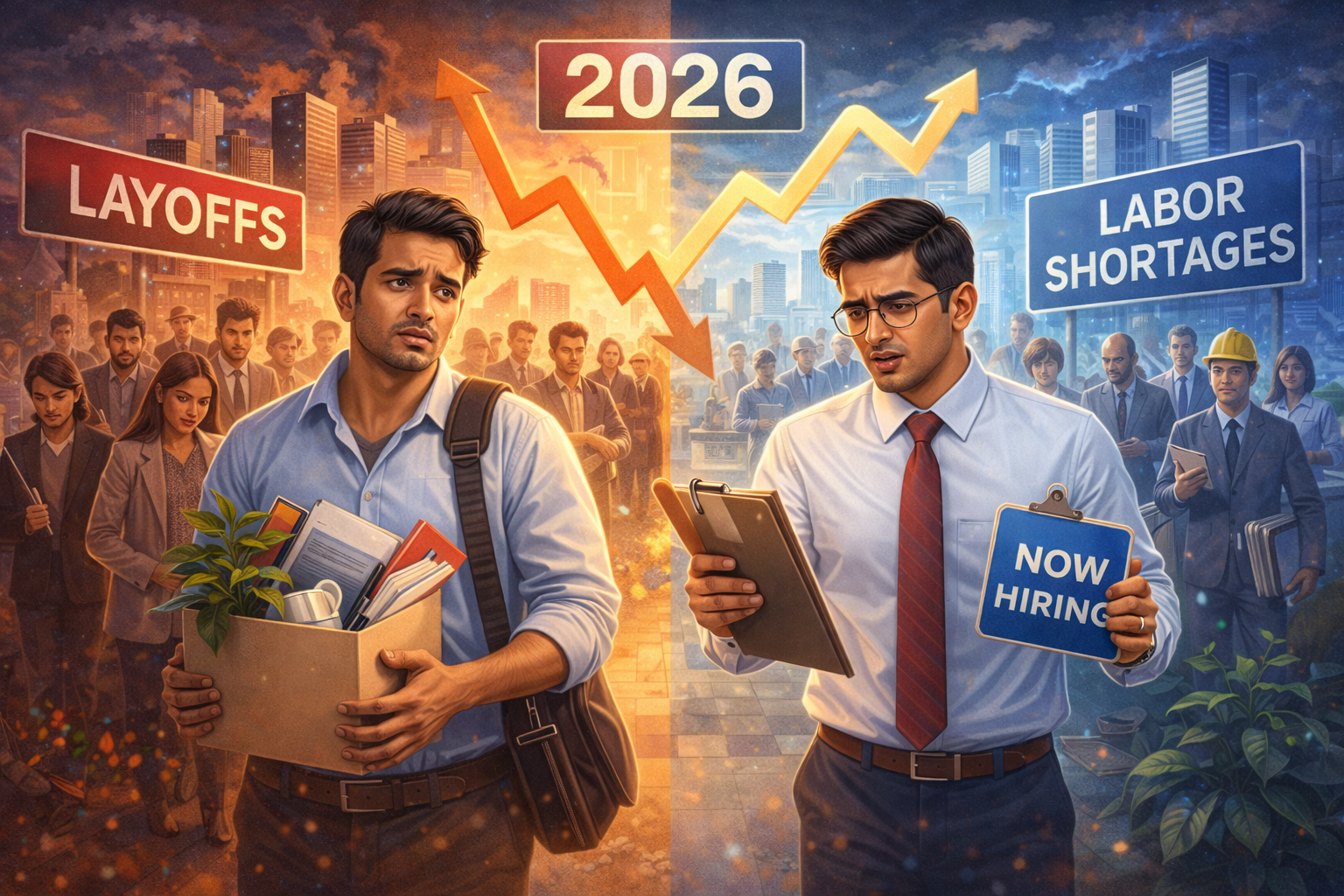
Here is the paradox that defines our current economic moment: In 2025, U.S. tech companies laid off more than 123,000 workers, bringing total tech sector job cuts to over 560,000 since 2022. Yet simultaneously, American manufacturers struggle to fill 415,000 open positions, healthcare systems face a projected shortage of 267,000 nurses, and the construction industry needs nearly half a million additional workers.
This is not a temporary market fluctuation. It is a structural transformation of the global labor economy—one that pits technological disruption against demographic reality, and efficiency-driven consolidation against the fundamental human capital required to keep societies functioning.
Welcome to the Great Labor Paradox of 2026.
The Numbers That Don’t Add Up
Let us begin with the data, because the scale of this disconnect is staggering when viewed in aggregate.
1. The Layoff Wave: Tech’s Great Correction
The technology sector, long considered the engine of American job growth, has undergone a brutal three-year contraction:
- 2022: 93,000 layoffs
- 2023: 191,000 layoffs (peak)
- 2024: 152,000 layoffs
- 2025: 123,000+ layoffs
Total tech layoffs (2022-2025): 559,000+ workers
According to data from Layoffs.fyi and Crunchbase News, the 2025 cuts were driven by three primary factors: artificial intelligence adoption (replacing roles entirely), post-pandemic over-hiring corrections, and pressure for profitability over growth. Intel alone announced 34,000 position eliminations. Amazon cut more than 20,000 roles. Microsoft reduced headcount by over 19,000.
Yet here is what makes this not a simple recession story: unemployment remains historically low at 4.4%, and job openings across the economy continue to outpace available workers by significant margins.
2. The Shortage Crisis: Where Did All the Workers Go?
While tech workers were receiving pink slips, other sectors were posting “Help Wanted” signs that remain unanswered. Consider these figures:
| Industry | Unfilled Positions (2025-2026) | Primary Cause |
|---|---|---|
| Manufacturing | 415,000 current / 1.9M by 2033 | Aging workforce + skills gap |
| Healthcare | 267,000 (nurses alone) | Burnout + retirement wave |
| Construction | 499,000 by 2026 | Lack of new entrants |
| Technology | 710,000 by 2034 | Skills mismatch |
| Skilled Trades | 3.8M needed by 2033 | Generational shift |
Sources: Bureau of Labor Statistics, National Association of Manufacturers, HRSA Health Workforce Analysis, McKinsey & Company
Understanding the Five Structural Forces Creating This Paradox
This is not a simple supply-and-demand imbalance. Five distinct structural forces have converged to create the most complex labor market in modern economic history:
Force 1: The AI Displacement vs. Creation Lag
Artificial intelligence is simultaneously eliminating and creating jobs—but not in equal measure, and not on the same timeline.
The Elimination (Immediate): In 2025, AI-driven automation was cited as a primary cause for layoffs at companies including Paycom (500+ cuts due to back-office automation), Google (hundreds of design roles eliminated), and multiple customer service operations. According to research from the International Monetary Fund, AI-related skills appeared in fewer than 1% of job postings before 2015 but nearly 5% by 2025—a 400% increase in demand for AI competencies.
The Creation (Delayed): While AI eliminates routine cognitive tasks, it creates demand for AI developers, data ethicists, prompt engineers, and human-AI interaction designers. However, these roles require advanced technical skills that the displaced workforce does not possess. The result is a skills chasm: 40% of global employment is exposed to AI, but only a fraction of workers have the training to transition into AI-augmented roles.
The Critical Insight: AI is currently better at replacing mid-level knowledge workers than at creating accessible entry points for displaced workers. This asymmetry explains why we see simultaneous white-collar layoffs and blue-collar shortages.
Force 2: The Great Retirement Wave Meets the Participation Plateau
Demographics are destiny, and the math is unforgiving.
The U.S. labor force participation rate stands at 62.4% as of December 2025—down from 67.3% in 2000. While the pandemic accelerated retirements, the underlying trend is structural: 10,000 baby boomers reach retirement age every day, and they are not being replaced at sufficient rates.
Consider these demographic realities:
- Manufacturing: 26% of the workforce is age 55 or older (3.9 million workers approaching retirement)
- Skilled Trades: Over 68% of facility operators and technicians are above age 45
- Healthcare: More than one-third of practicing physicians are over 55
Meanwhile, youth labor force participation (ages 16-24) has declined to 53.1%, down from 54.5% the previous year. Despite high wages in skilled trades—electricians now earn median salaries of $68,000, exceeding many college graduate starting wages—young workers are not entering these fields at replacement rates.
Force 3: The Skills Mismatch Acceleration
The half-life of professional skills has collapsed. According to IMF research, the skill universe contains more than 30,000 distinct competencies, with new skills emerging constantly in data visualization (Power BI, Tableau), AI applications (ChatGPT, GitHub Copilot), and sustainable technologies.
The Paradox in Practice: While 122,549 tech workers were laid off in 2025, the technology sector simultaneously projected a need for 710,000 additional workers by 2034. The laid-off workers were largely in legacy roles (hardware engineering, traditional software development, operations); the needed workers require skills in AI infrastructure, cybersecurity, and quantum computing.
This is not unemployment. This is obsolescence—and obsolescence is harder to solve than unemployment because it requires not just job matching, but fundamental skill reconstruction.
Force 4: The Geographic Arbitrage Reversal
For three decades, companies pursued labor cost optimization through offshoring and geographic arbitrage. That model is breaking down.
Reshoring initiatives—driven by supply chain security concerns, trade tensions, and the CHIPS Act—have brought manufacturing back to American soil. Intel’s $20 billion Arizona fabrication plant, TSMC’s Arizona facility, and numerous infrastructure projects have created demand for American workers at American wages.
The Cost Reality: A factory worker in China earns $4-5 per hour. That same worker in Ohio or Texas commands $25-30 per hour plus benefits. This is not inflationary in the traditional monetary sense; it is a structural repricing of labor that reflects the true cost of economic sovereignty.
The result: Manufacturing needs 3.8 million workers by 2033, but faces a 50% fulfillment gap (1.9 million unfilled positions) due to insufficient skilled labor availability.
Force 5: The Expectation Recalibration
Perhaps the most underappreciated force: workers have fundamentally recalibrated their relationship with employment.
The pandemic demonstrated that work could be different—more flexible, more autonomous, more integrated with life. Workers who experienced remote work, flexible hours, and geographic freedom are reluctant to return to rigid schedules, long commutes, and arbitrary presence requirements.
This recalibration manifests differently across generations:
- Gen Z: Prioritizes purpose, flexibility, and mental health; accepts lower wages for better work-life balance
- Millennials: Seeking stability after years of economic volatility; value remote work as compensation
- Gen X/Boomers: Accelerating retirement or seeking “encore careers” with meaning over maximum earnings
The result is a participation rate that remains stubbornly below pre-pandemic trends despite wage increases, signing bonuses, and enhanced benefits. Money alone is not sufficient to solve a labor shortage rooted in changed expectations.
The Sector-Specific Crises: A Closer Look
Healthcare: The Burnout Exodus
The healthcare worker shortage is perhaps the most consequential for societal functioning. According to the Health Resources and Services Administration (HRSA), the United States faces a projected shortage of 267,330 full-time equivalent nurses by 2026.
This shortage is not due to lack of training capacity alone. It is driven by exit velocity: more than 40% of nurses reported considering leaving the profession in 2024-2025 due to burnout, inadequate staffing ratios, and emotional trauma from pandemic-era care. The pipeline is leaking faster than it can be filled.
The implications extend beyond hospital staffing. Home health care, mental health services, and long-term care facilities face even more acute shortages as an aging population demands more care while the care workforce ages out of availability.
Manufacturing: The Skills Premium Explosion
Manufacturing wages have risen significantly—production workers now earn $29.51 per hour on average, with total compensation reaching $45.85 per hour when benefits are included. Yet 65% of manufacturers cite attracting and retaining talent as their primary business challenge.
The issue is skill specificity. Modern manufacturing requires competencies in automation, data analytics, and quality systems that traditional vocational training does not provide. The “skills gap” is not a euphemism for unwillingness to work; it is a genuine mismatch between training infrastructure and technological reality.
McKinsey estimates 20 skilled trade job openings for every one new worker through 2032. The “extraordinary rate of churn” in skilled trades costs companies more than $5.3 billion annually in hiring and training.
Technology: The Bifurcation Effect
The tech sector is experiencing a bifurcation: elite AI researchers and infrastructure engineers command salaries exceeding $500,000, while traditional software engineers face layoffs and wage stagnation.
This creates a “barbell” labor market in technology—high demand at the top (AI PhDs, specialized hardware engineers), high demand at the bottom (customer success, sales), but collapsing demand in the middle (generalist programmers, QA engineers, technical writers).
Companies like Meta, Amazon, and Microsoft are simultaneously laying off thousands while recruiting aggressively for AI-specific roles. The net effect is workforce reduction with skill set intensification.
The Economic Implications: Why This Paradox Matters
The layoffs-shortages paradox is not merely an HR challenge. It carries profound macroeconomic implications:
1. The Productivity Puzzle
Productivity growth has been elusive despite massive technology investment. One explanation: labor market frictions prevent efficient allocation of workers to roles. Displaced tech workers cannot easily transition to manufacturing or healthcare due to skill barriers, credential requirements, and geographic constraints. The result is simultaneous idle capacity (unemployed workers) and unmet demand (unfilled jobs)—a classic market failure.
2. The Inflation-Deflation Tension
Tech layoffs create deflationary pressure in white-collar wages and services. Labor shortages create inflationary pressure in goods, healthcare, and construction. The Federal Reserve faces an impossible task: monetary policy cannot simultaneously stimulate employment in tech and cool wage pressure in manufacturing.
3. The Growth Ceiling
Long-term economic growth requires both capital investment and labor availability. The reshoring of manufacturing, the energy transition, and infrastructure modernization all require workers who do not exist in sufficient numbers. Labor becomes the binding constraint on growth—a reversal of the post-2008 dynamic where capital was scarce and labor abundant.
Strategic Responses: How Organizations Are Adapting
Leading organizations are not waiting for policy solutions. They are implementing four strategic shifts:
1. The Reskilling Imperative
Approximately 70% of companies increased training and upskilling initiatives in 2025. The most effective programs share common characteristics:
- Internal mobility pipelines: Moving displaced workers into growth roles rather than external hiring
- Competency-based credentials: Replacing degree requirements with skills verification
- Apprenticeship expansion: Earning while learning in manufacturing, healthcare, and technology
- AI-human collaboration training: Teaching workers to augment rather than compete with automation
2. The Flexibility Premium
Organizations facing acute shortages are winning talent through radical flexibility:
- Healthcare: Self-scheduling, part-time pathways, and remote telehealth roles for nurses
- Manufacturing: Compressed workweeks, job sharing, and childcare subsidies
- Technology: Distributed teams, asynchronous work, and outcome-based management
The insight: Flexibility is compensation. In a tight labor market, schedule control can outweigh salary offers.
3. The Automation Acceleration
Faced with unavailable labor, companies are accelerating automation not to replace workers, but to amplify the workers they have:
- AI-powered maintenance systems allowing fewer technicians to manage more equipment
- Robotic process automation handling administrative tasks in healthcare
- Autonomous systems reducing physical demands in manufacturing and logistics
By 2026, more than two-thirds of maintenance teams expect to adopt AI-powered solutions—not to eliminate jobs, but to close the productivity gap created by unfilled positions.
4. The Talent Ecosystem Expansion
Progressive employers are expanding their talent pipelines beyond traditional sources:
- Second-chance hiring: Recruiting from justice-involved populations
- Military transition programs: Accelerated pathways for veterans
- Global talent mobility: Remote roles tapping international labor markets
- Returnship programs: Structured re-entry for caregivers returning after extended absence
The Path Forward: Scenarios for 2026 and Beyond
Three scenarios emerge for how this paradox resolves:
Scenario 1: The Great Rebalancing (Probability: 40%)
Wage differentials and reskilling investments gradually redirect talent from oversupplied sectors (generalist tech) to undersupplied sectors (healthcare, skilled trades, manufacturing). Tech workers retrain as electricians, nurses, and advanced manufacturing technicians. The transition is painful and takes 3-5 years, but market forces eventually clear the imbalance.
Scenario 2: The Automation Acceleration (Probability: 35%)
AI and robotics advance rapidly enough to eliminate shortage-area jobs before human workers can fill them. Manufacturing becomes lights-out automated. Healthcare shifts to AI diagnostics and remote monitoring. The labor shortage is “solved” through technological substitution rather than human capital investment.
Scenario 3: The Stagnation Trap (Probability: 25%)
Labor market rigidities—credential requirements, geographic immobility, skills mismatches—prevent rebalancing. Shortages persist in physical-world sectors while knowledge work remains volatile. Economic growth stalls due to labor constraints, and social tensions rise as displaced workers cannot access available opportunities.
Conclusion: Navigating the Paradox
The defining characteristic of the 2026 labor market is simultaneity: layoffs and shortages, displacement and demand, technological unemployment and human capital scarcity. This is not a contradiction to be resolved, but a tension to be managed.
For organizations, the imperative is clear: invest in reskilling infrastructure, embrace flexibility as a competitive weapon, and expand talent pipelines beyond traditional sources. For policymakers, the challenge is removing barriers to labor mobility—occupational licensing reform, housing supply constraints, and training program modernization.
For workers, the message is adaptation. The era of static career paths is over. Continuous learning, geographic flexibility, and willingness to transition across sectors are the new currencies of employability.
The labor paradox of 2026 is not a temporary aberration. It is the new normal—a structural feature of an economy undergoing simultaneous technological disruption and demographic transformation. Success belongs to those who recognize this reality and build strategies not for the labor market of the past, but for the paradoxical market of the present.
References and Data Sources
- Bureau of Labor Statistics (2026). The Employment Situation – December 2025. U.S. Department of Labor. https://www.bls.gov/news.release/pdf/empsit.pdf
- Crunchbase News (2026). Tech Layoffs: US Companies With Job Cuts In 2024 And 2025. https://news.crunchbase.com/startups/tech-layoffs/
- International Monetary Fund (2026). Bridging Skill Gaps for the Future: New Jobs Creation in the AI Age. Staff Discussion Notes. https://www.imf.org/-/media/files/publications/sdn/2026/english/sdnea2026001.pdf
- National Association of Manufacturers (2025). U.S. Manufacturing Workforce Data & Benchmarks 2025-2026. https://www.amtec.us.com/blog/manufacturing-workforce-report
- HRSA Health Workforce Analysis (2025). Projections of Nursing Supply and Demand. U.S. Department of Health and Human Services. https://beyer.house.gov/news/documentsingle.aspx?DocumentID=8921
Data current as of January 2026. Labor market figures subject to revision as new surveys are completed. Tech layoff figures represent best estimates based on public reporting and may not capture all workforce reductions.
About the Author
InsightPulseHub Editorial Team creates research-driven content across finance, technology, digital policy, and emerging trends. Our articles focus on practical insights and simplified explanations to help readers make informed decisions.