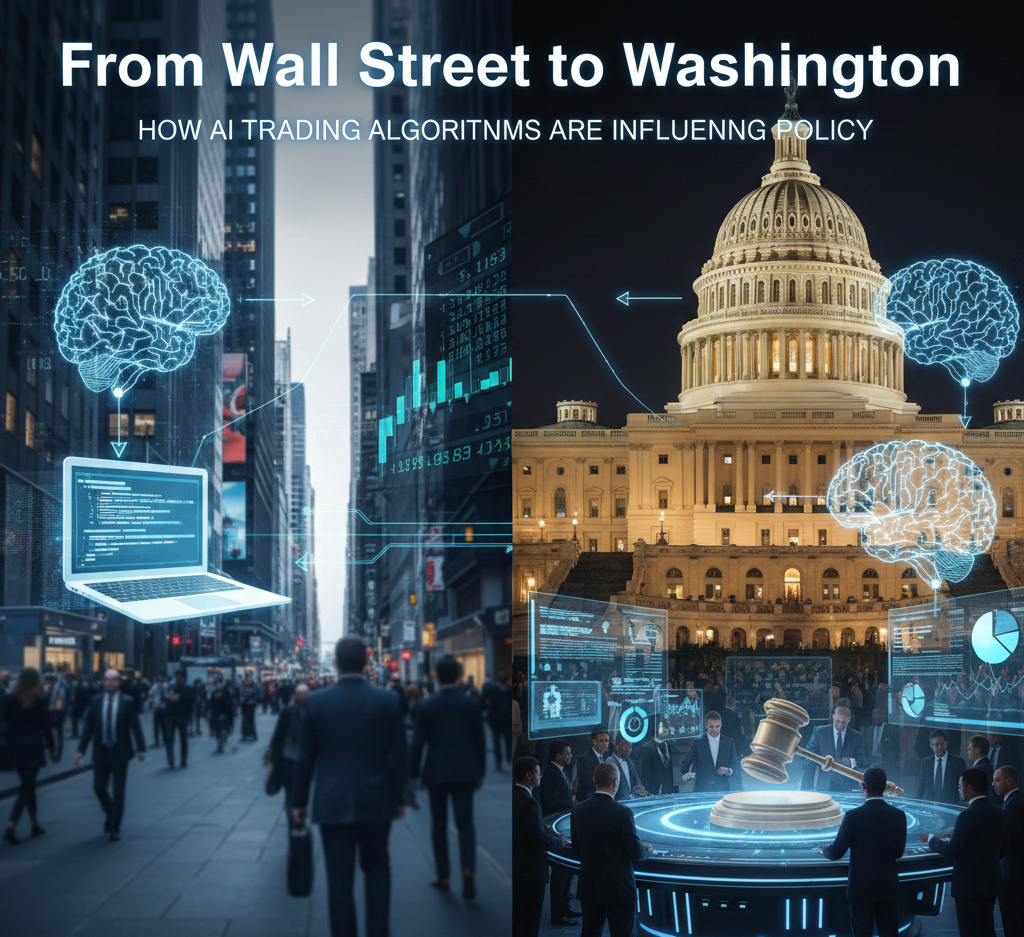
The intersection of artificial intelligence and financial markets has created a regulatory awakening in Washington. With over 60% of U.S. equity trading volume now driven by algorithmic systems, policymakers are scrambling to address the systemic risks, market manipulation potential, and investor protection challenges posed by AI-driven trading. This comprehensive analysis examines how AI trading algorithms are reshaping financial policy, the regulatory responses from the SEC and CFTC, and what the future holds for algorithmic oversight.
1. The Rise of AI Trading: By The Numbers
The transformation of financial markets through algorithmic trading has been nothing short of revolutionary. Understanding the scale of this shift is essential to grasp why Washington has turned its attention toward AI regulation.
Algorithmic Trading Market Statistics (2024-2025)
| Metric | Figure | Year |
|---|---|---|
| U.S. Equity Volume (Algorithmic) | 60-73% | 2024 |
| High-Frequency Trading (HFT) Volume | 49-61% | 2023-2024 |
| Global Algorithmic Trading Market Size | $18.8 billion | 2024 |
| Projected Market Size | $31.2 billion | 2028 |
| Average Trade Execution Speed | < 1 millisecond | 2024 |
Sources: Financial Industry Regulatory Authority (FINRA), SEC Market Structure Data, Grand View Research
The AI Evolution in Trading
Algorithmic trading has evolved through three distinct generations:
- Generation 1 (2000-2010): Rule-based algorithms executing pre-programmed strategies based on technical indicators
- Generation 2 (2010-2020): Machine learning models capable of pattern recognition and adaptive strategies
- Generation 3 (2020-Present): Deep reinforcement learning (DRL) and generative AI systems that can anticipate market scenarios and self-optimize
The current generation of AI trading systems represents a paradigm shift. Unlike traditional algorithms that execute predetermined strategies, modern AI systems utilize predictive data analytics (PDA) to forecast market movements, optimize execution timing, and even influence investor behavior—capabilities that have triggered intense regulatory scrutiny.
2. The Flash Crash Legacy: How One Day Changed Everything
May 6, 2010: The Trillion-Dollar Minute
No discussion of algorithmic trading policy can begin without examining the Flash Crash of 2010—the seminal event that transformed regulatory attitudes toward automated trading systems.
The Timeline of Chaos
| Time (ET) | Event | Market Impact |
|---|---|---|
| 2:32 PM | Waddell & Reed initiates algorithmic sell order | 75,000 E-Mini S&P contracts ($4.1B value) |
| 2:41 PM | Liquidity withdrawal by HFTs begins | Bid-ask spreads widen dramatically |
| 2:45 PM | Peak panic: “Hot potato” trading cascade | 27,000 contracts traded in 14 seconds |
| 2:47 PM | Market bottom | Dow down 998.5 points (9%) |
| 3:00 PM | Circuit breakers halt E-Mini trading | Temporary stabilization |
| 3:45 PM | Markets recover | Most losses erased |
The Regulatory Aftermath
The Flash Crash resulted in the implementation of Market-wide Circuit Breakers (Limit Up-Limit Down mechanisms) and the SEC’s Regulation SCI (Systems Compliance and Integrity), which mandated rigorous testing and risk controls for trading systems.
However, the most significant long-term impact was the establishment of the SEC’s Quantitative Analytics Unit and the beginning of algorithmic trading oversight as a permanent regulatory priority.
Case Study: Knight Capital (2012)
Just two years after the Flash Crash, Knight Capital Group suffered a catastrophic loss that further cemented regulatory concerns:
- Loss Amount: $440 million
- Duration: 45 minutes
- Cause: Deployment of outdated “Power Peg” code on a single server
- Result: 4 million unintended trades, 148 stocks affected
- Outcome: Near-bankruptcy, eventual acquisition by Getco
These events created the regulatory foundation that would later expand to encompass AI-specific trading risks.
3. The Regulatory Response: SEC and CFTC Actions
The SEC’s AI Task Force (2024-2025)
In August 2024, the SEC launched a dedicated AI Task Force to address the “transformative potential” of artificial intelligence in capital markets. This marked a significant escalation in regulatory focus, moving AI from a peripheral concern to a central policy priority.
SEC AI Roundtable Key Findings (May 2025)
The SEC convened industry stakeholders to discuss three critical areas:
| Focus Area | Key Concerns | Regulatory Implications |
|---|---|---|
| AI Benefits & Uses | Market efficiency, liquidity provision, fraud detection | Balancing innovation with oversight |
| Fraud & Cybersecurity | Model poisoning, adversarial inputs, data integrity | Enhanced disclosure requirements |
| Governance & Risk Management | “Black box” opacity, lack of explainability | Mandatory human oversight protocols |
CFTC Advisory on AI Trading Risks (December 2024)
The Commodity Futures Trading Commission issued a comprehensive advisory on December 5, 2024, warning regulated entities about AI deployment risks. The CFTC identified seven critical compliance failure modes:
- Opacity and Lack of Explainability: “Black-box” systems undermining transparency requirements
- Insufficient Supervision: Delegation of critical decisions without human oversight
- Inadvertent Market Manipulation: Unintentional spoofing or layering by AI systems
- Biased or Poor-Quality Data: Training data flaws leading to discriminatory outcomes
- Unvetted Third-Party Tools: Outsourcing risks without regulatory responsibility transfer
- Automated Error Cascades: Rapid propagation of errors across interconnected markets
- Cybersecurity Vulnerabilities: New attack surfaces including model poisoning
Current SEC Regulatory Framework for AI Trading
The SEC has developed a multi-layered approach to algorithmic oversight:
Key Regulations Affecting AI Trading (2025 Status)
| Regulation | Primary Focus | AI-Specific Application |
|---|---|---|
| Regulation NMS (2005) | Best execution, order protection | Prevents AI arbitrage across venues |
| Market Access Rule (15c3-5) | Risk management controls | Mandatory pre-trade risk filters for AI |
| Regulation SCI (2014) | Systems integrity, incident reporting | AI system testing and monitoring |
| Regulation SHO | Short sale restrictions | AI short-selling strategy compliance |
| FINRA Rule 3110 (Supervision) | Algorithm development oversight | Registration of AI developers |
4. From Algorithms to Legislation: The Policy Pipeline
How Trading Incidents Shape Policy
The path from Wall Street technology to Washington legislation follows a predictable but accelerating pattern:
The Policy Feedback Loop:
- Technology Deployment: AI trading systems deployed at scale
- Market Event: Flash crash, error cascade, or manipulation incident
- Regulatory Investigation: SEC/CFTC analysis and enforcement action
- Industry Consultation: Roundtables, comment periods, best practice development
- Rulemaking: New regulations or guidance issuance
- Congressional Oversight: Hearings and potential statutory changes
Congressional Action: The 119th Congress
The current Congress has introduced significant legislation addressing AI in financial markets:
H.R. 4801: Unleashing AI Innovation in Financial Services Act
This bipartisan proposal would establish “AI Innovation Labs” at the SEC, CFTC, and other financial regulators. Key provisions include:
- Regulatory sandboxes for AI test projects
- Relief from certain regulations during testing periods
- No enforcement action expectations for approved projects
- Public interest and investor protection requirements
- Systemic risk assessment protocols
H.R. 10262 (118th Congress): AI Act of 2024
Though not enacted, this legislation would have required:
- Comprehensive SEC study on AI benefits, risks, and challenges
- Public input through Request for Information (RFI) process
- Regulatory proposals and legislative recommendations
The SEC’s Use of AI in Regulation
In a fascinating twist, the SEC itself has become an AI adopter. The agency reported 30 AI use cases in its 2024 AI Use Case Inventory:
| SEC AI Application | Purpose | Impact |
|---|---|---|
| Corporate Issuer Risk Assessment (CIRA) | Detect anomalous patterns in financial reporting | Prioritized examination targeting |
| Trading Surveillance | Identify potentially manipulative activities | Enhanced market abuse detection |
| Comment Analysis | Review public comments on rulemaking | Improved regulatory feedback processing |
| Sentiment Analysis | Market sentiment monitoring | Early warning system development |
According to SEC Deputy Director Scott W. Bauguess, these tools help the agency “prioritize examinations so that they can direct resources to areas of the market that are the most susceptible to potential violative conduct.” [Source]

5. Conflicts of Interest: The Predictive Analytics Debate
The July 2023 SEC Proposal
One of the most significant regulatory actions affecting AI trading was the SEC’s proposal regarding conflicts of interest associated with predictive data analytics (PDA). This rulemaking, though withdrawn in June 2025, established the framework for future regulation.
What the Proposal Required
The SEC’s 3-2 vote sought to:
- Eliminate or neutralize conflicts of interest from covered technologies in investor interactions
- Mandate written policies for firms using PDA technologies
- Require recordkeeping regarding conflicts and compliance
The Conflict of Interest Problem
SEC Chair Gary Gensler articulated the core concern: “Today’s predictive data analytics models provide an increasing ability to make predictions about each of us as individuals. This raises possibilities that conflicts may arise to the extent that advisers or brokers are optimizing to place their interests ahead of investors’ interests.”
Real-World Example: Gamification and Trading Apps
The 2021 meme stock frenzy brought these conflicts into sharp focus. Trading platforms like Robinhood employed:
- Push notifications encouraging frequent trading
- Game-like interfaces with colorful graphics
- Predictive algorithms suggesting trades to users
- Payment for order flow arrangements
The result? Retail investors engaged in excessive trading that generated profits for intermediaries but often resulted in losses for the investors themselves.
Industry Opposition and Regulatory Uncertainty
Commissioners Hester Peirce and Mark Uyeda dissented from the 2023 proposal, arguing it was:
- Overly broad, encompassing even basic technological functions
- Potentially undermining investor decision-making capabilities
- Creating compliance burdens without clear benefits
Despite the withdrawal of this specific proposal in June 2025, the underlying conflicts remain unresolved, and the SEC has indicated that AI regulation will continue to be addressed in future rulemaking.
6. Global Context: EU AI Act and International Coordination
The EU AI Act: A Risk-Based Approach
While the U.S. has pursued a fragmented, agency-specific approach, the European Union has taken a comprehensive legislative path. The EU AI Act, effective August 1, 2024, establishes the world’s first comprehensive AI regulation.
Risk Classification for Financial AI
| Risk Level | AI Trading Applications | Regulatory Requirements |
|---|---|---|
| Unacceptable Risk | Social scoring by financial institutions | Prohibited |
| High Risk | Credit scoring, insurance pricing, algorithmic trading affecting market stability | Conformity assessments, risk management, human oversight |
| Limited Risk | Chatbots for customer service | Transparency obligations |
| Minimal Risk | Basic recommendation systems | Voluntary codes of conduct |
International Regulatory Coordination
The Financial Stability Board (FSB) and International Organization of Securities Commissions (IOSCO) have developed principles for AI oversight that influence national policies:
- Proportionality: Regulation should match the risk level of AI applications
- Technology Neutrality: Rules should apply regardless of the technology used
- Explainability: Decision-making processes should be interpretable
- Fairness: AI systems should not perpetuate bias or discrimination
- Robustness: Systems must be resilient to errors and attacks
China’s Approach: Algorithm Anti-Monopoly
China has taken a distinct approach, focusing on anti-monopoly and competition law applications to AI. The Platform Economy Anti-Monopoly Guidelines explicitly prohibit:
- Algorithm-enabled price-fixing and tacit collusion
- Using data and algorithms to monopolize markets
- Discriminatory pricing based on user data (algorithmic “price discrimination”)
The Anti-Monopoly Law amendments (December 2024) further strengthen these provisions, creating a regulatory environment where algorithmic trading strategies must be vetted for competitive effects.
7. The Future: Regulatory Sandboxes and AI Innovation Labs
Emerging Regulatory Frameworks (2025-2026)
The next phase of AI trading regulation will likely feature:
1. Embedded Compliance Mechanisms
Recent academic and regulatory proposals suggest requiring ex-ante blocking mechanisms within AI algorithms themselves. These systems would:
- Predict potential market manipulation scenarios
- Automatically prevent execution of problematic trades
- Create auditable trails of prevention decisions
- Require certification by external experts or regulatory bodies
2. Algorithm Registration and Certification
Building on FINRA’s 2016 rule requiring registration of algorithm developers, future regulations may mandate:
| Proposed Requirement | Description | Status |
|---|---|---|
| Algorithm ID | Unique identifier for each trading algorithm | Under SEC consideration |
| Source Code Repository | Regulatory access to trading logic | Proposed in EU |
| Stress Testing | Mandatory simulation of extreme scenarios | CFTC advisory 2024 |
| Kill Switch Certification | Verified ability to halt trading immediately | Industry standard |
3. AI-Powered Regulatory Oversight
The SEC’s adoption of AI tools for surveillance creates the foundation for “RegTech”—regulatory technology that can monitor AI trading in real-time. This “AI vs. AI” dynamic represents a new frontier in financial oversight.
Predictions for 2026 and Beyond
Based on current regulatory trajectories, we can anticipate:
- Q2 2026: Reintroduction of modified PDA conflict rules by SEC
- Q3 2026: Implementation of AI Innovation Labs under H.R. 4801 (if passed)
- 2027: Potential transaction tax proposals targeting HFT algorithms
- 2027-2028: International coordination on cross-border algorithmic trading standards
8. Key Takeaways for Investors and Traders
What This Means for Market Participants
For Individual Investors:
- Be aware of algorithmic influences on the platforms you use
- Understand gamification tactics that may encourage excessive trading
- Demand transparency from brokers about AI-driven recommendations
- Recognize that “free” trading often means your data and order flow are the product
For Professional Traders:
- Ensure compliance with existing algorithmic trading regulations (Reg NMS, Market Access Rule)
- Implement robust risk controls including pre-trade filters and kill switches
- Document AI decision-making processes for audit trails
- Monitor regulatory developments regarding embedded compliance requirements
- Prepare for potential registration of AI developers and algorithms
For Financial Institutions:
- Conduct holistic reviews of AI trading activities across all business lines
- Establish cross-disciplinary committees for algorithm risk assessment
- Implement end-to-end testing protocols from development to deployment
- Vet third-party AI vendors with the same rigor as internal systems
- Prepare for “black box” explainability requirements in future rulemaking
The Bottom Line
The influence of AI trading algorithms on Washington policy is no longer theoretical—it is the defining regulatory challenge of modern financial markets. With the SEC’s AI Task Force active, the CFTC issuing specific guidance, and Congress considering innovation frameworks, the regulatory landscape is evolving rapidly.
Market participants who proactively address AI governance, risk management, and compliance will be best positioned to thrive in this new environment. Those who wait for regulatory mandates may find themselves scrambling to catch up.
The message from Washington is clear: AI trading is here to stay, but it will operate within boundaries designed to protect market integrity and investor interests. The only question remaining is whether those boundaries will be drawn through collaborative innovation or reactive crisis response.
References and Further Reading
- U.S. Securities and Exchange Commission (SEC). (2025). Artificial Intelligence in Capital Markets: Policy Issues. Congressional Research Service Report IF13103. https://www.congress.gov/crs_external_products/IF/PDF/IF13103/IF13103.1.pdfThis CRS report provides comprehensive background on SEC AI initiatives, including the August 2024 AI Task Force launch and the May 2025 AI roundtable findings.
- Commodity Futures Trading Commission (CFTC). (2024, December 5). Advisory on Artificial Intelligence in Trading, Risk Management, and Compliance. CFTC Advisory. https://kennyhertzperry.com/news/are-your-trading-algorithms-ready-for-scrutiny-understanding-the-cftcs-guidance-on-aiThe CFTC’s December 2024 advisory outlines seven critical compliance risks associated with AI deployment in trading functions and provides guidance for regulated entities.
- European Securities and Markets Authority (ESMA). (2025). Artificial Intelligence and Market Abuse Regulation. Joint Research Paper with Japanese FSA. https://www.mfsa.mt/wp-content/uploads/2025/08/JFSA-Volume-1-Artificial-Intelligence-and-Market-Abuse-Regulation-2025.pdfThis paper examines the relationship between AI and market manipulation, proposing embedded compliance mechanisms and ex-ante blocking systems for trading algorithms.
- FINRA. (2016, April). Regulatory Notice 15-09: Effective Supervision and Control of Algorithmic Trading Strategies. https://www.skadden.com/-/media/files/publications/2015/05/finraprovidesguidanceoneffectivesupervisionandcont.pdfFINRA’s guidance establishes best practices for algorithmic trading supervision, including the five categories of suggested effective practices for firms engaging in algorithmic strategies.
- Investopedia. (2023, July 26). SEC’s New Rules Target Algorithms and Gamification Tools That Encourage Trading. https://www.investopedia.com/the-sec-s-new-rules-target-trading-apps-that-use-predictive-algorithms-7565878Analysis of the SEC’s July 2023 proposal regarding conflicts of interest in predictive data analytics and the regulatory response to trading app gamification.
Disclaimer: This article is for informational purposes only and does not constitute legal, financial, or investment advice. Regulatory frameworks are subject to rapid change, and readers should consult with qualified professionals regarding specific compliance obligations.
Tags: Algorithmic Trading, AI Regulation, SEC Policy, CFTC Guidance, Financial Technology, Market Structure, Predictive Analytics, FinTech Policy
About the Author
InsightPulseHub Editorial Team creates research-driven content across finance, technology, digital policy, and emerging trends. Our articles focus on practical insights and simplified explanations to help readers make informed decisions.