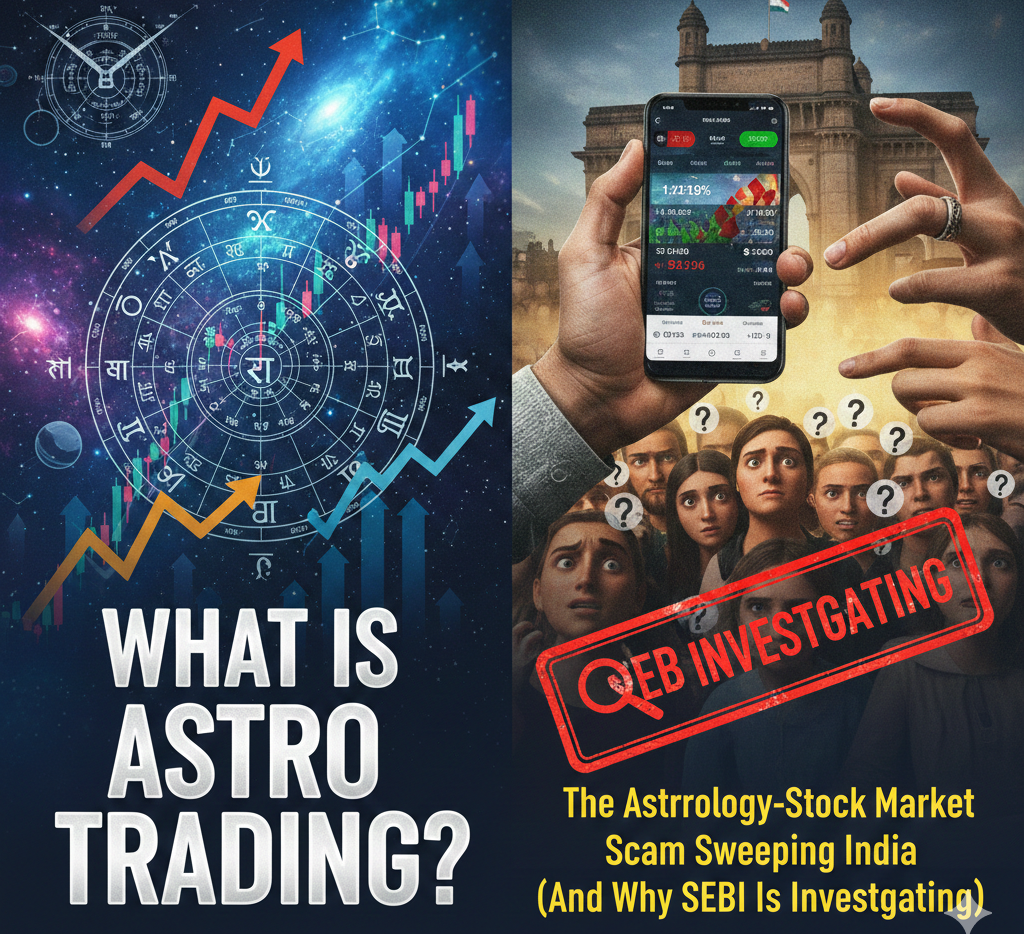
When Mars enters Leo, your portfolio will skyrocket. At least, that’s what thousands of Indian investors are being told by a new breed of “financial astrologers” who claim that planetary alignments hold the key to stock market riches. Welcome to the bizarre world of “Astro Trading”—where ancient Vedic astrology meets modern-day market manipulation, and where the Securities and Exchange Board of India (SEBI) is now cracking down on what it sees as a dangerous, unregulated scam.
In June 2025, prominent market expert Sanjiv Bhasin—former director at IIFL Securities and a familiar face on business channels like Zee Business and ET Now—was banned by SEBI for alleged front-running and stock manipulation. But here’s where it gets strange: just months before the ban, Bhasin had rebranded himself as an astrologer on social media, offering “Mundane Astrology” readings and planetary predictions to his 322,000+ followers. The cosmic pivot wasn’t coincidental—it was a calculated attempt to evade regulatory scrutiny while continuing to influence market behavior.
This isn’t an isolated case. Across India, a thriving ecosystem of self-proclaimed “Astro Traders” is exploiting cultural beliefs in astrology to peddle unregistered investment advice, charge exorbitant fees for courses, and leave retail investors holding massive losses. SEBI’s investigation into this phenomenon reveals a troubling pattern of fraud, misrepresentation, and regulatory arbitrage that threatens the integrity of India’s financial markets.
What Exactly Is Astro Trading?
Astro Trading—also known as Financial Astrology or Astro-Investing—is the practice of using astrological principles, planetary positions, and celestial events to predict stock market movements and make investment decisions. Proponents claim that the gravitational pulls, alignments, and retrograde motions of planets like Jupiter, Saturn, and Mars correlate with market volatility, sector rotations, and individual stock performance.
The methodology varies among practitioners, but common techniques include:
- Natal Chart Analysis: Examining an investor’s birth chart to determine “auspicious” times for buying or selling stocks
- Planetary Transit Tracking: Monitoring when planets enter specific zodiac signs to predict market trends
- Muhurat Trading: Timing trades based on Hindu astrological “auspicious hours” (Chaughadiya)
- Sector-Planet Correlation: Matching sectors to ruling planets (e.g., Saturn for steel and oil, Venus for cosmetics and luxury goods)
- Lunar Cycle Trading: Using full moons, new moons, and “void of moon” periods to time entries and exits
On the surface, it might seem harmless—another form of technical analysis, albeit an unconventional one. But the problem arises when self-styled “Astro Traders” cross the line from offering astrological consultations to providing specific stock recommendations, price targets, and trading calls—all without SEBI registration, disclosure requirements, or accountability.
The Sanjiv Bhasin Case: From Market Guru to Astrologer
The Sanjiv Bhasin saga represents perhaps the most high-profile example of the Astro Trading phenomenon—and its dangers. For years, Bhasin was a respected voice in Indian financial media, appearing regularly on CNBC Awaaz, ET Now, and Zee Business to share market insights. From 2017 to 2022, he served as a director at IIFL Securities, one of India’s leading brokerage firms.
But SEBI’s 149-page interim order, issued in June 2025, painted a damning picture. The regulator alleged that between January 2020 and June 2024, Bhasin engaged in systematic front-running:
- He would buy shares through futures contracts or cash segments
- Then recommend those same stocks on television and IIFL’s Telegram channel
- The resulting retail buying would drive up prices
- He would immediately sell, booking profits while retail investors were left holding the bag
The numbers were staggering. SEBI ordered the disgorgement of ₹11.37 crore in alleged illegal gains. In one instance, on January 11, 2022, Bhasin advised viewers to buy L&T Technology Services on Zee Business—after having already purchased 3,800 shares at ₹5,641.8 that morning. He sold immediately after the broadcast at ₹5,677.79, pocketing ₹1.36 lakh in minutes.
But the most bizarre twist came after SEBI initiated its investigation. Following search and seizure operations at multiple NCR locations in June 2024, Bhasin quietly exited IIFL and rebranded. His Instagram account became “Sanjiv Bhasin Astro.” His X (Twitter) bio now read: “Market Guru, Mundane Astrology, Fate & Freewill, Sense & Sensibility.” He began posting predictions about Mars entering Leo, geopolitical forecasts based on Pakistan’s “national horoscope,” and astrological consultations for relationships and careers.
SEBI didn’t buy the cosmic deflection. “SEBI cannot remain a mute spectator when fraudulent and manipulative activities take place in the securities market by personalities who are actually revered… and have a huge following on social media platforms,” the regulator stated in its order.
The Broader Ecosystem: How Astro Trading Scams Operate
The Bhasin case is just the tip of the iceberg. Across India, a sprawling network of “financial astrologers” and “Astro Traders” has emerged, operating through websites, YouTube channels, Telegram groups, and WhatsApp communities. These operators typically follow a predictable playbook:
1. The Bait: Free Predictions and “Educational” Content
Most Astro Trading scams begin with free content—daily horoscope readings for Nifty and Bank Nifty, YouTube videos predicting market crashes based on planetary alignments, or social media posts claiming “87% accuracy” in index forecasting. This builds credibility and attracts followers who are already culturally predisposed to believe in astrology.
2. The Hook: Expensive Courses and “Premium” Services
Once trust is established, the monetization begins. Operators sell courses ranging from ₹21,000 to ₹6.75 lakh, promising to teach the “secrets” of astro-trading. These courses often include:
- “Astro-technical” analysis combining planetary charts with price charts
- Personalized investment horoscopes based on birth details
- Access to exclusive WhatsApp groups for “live trading calls”
- Software tools that claim to calculate “auspicious” entry and exit points
3. The Trap: Unregistered Advisory Disguised as Education
The critical regulatory violation occurs when these “educators” cross into investment advisory territory. SEBI’s December 2025 order against Avadhut Sathe—another prominent finfluencer—illustrates this pattern perfectly. Sathe’s Avadhut Sathe Trading Academy collected ₹601.37 crore from over 3.37 lakh investors, offering courses that included specific buy/sell recommendations, entry and exit levels, and live trading sessions where Sathe displayed his own positions to influence participants.
Despite receiving an administrative warning in March 2024, Sathe continued operations, moving activities to private WhatsApp groups to avoid scrutiny. SEBI’s analysis of 186 participants’ trading accounts revealed that 65% incurred losses in the six months after completing courses—directly contradicting promotional materials showing “supernatural profits.”
4. The Astrology Shield
When confronted with regulatory action, many operators pivot to astrology as a defense mechanism. Since SEBI regulates investment advice but not astrological consultations, claiming that recommendations are “based on planetary positions” rather than financial analysis creates a gray area. Some even argue that financial astrology is a “spiritual service” exempt from securities regulations.
This arbitrage hasn’t worked. In November 2023, SEBI ordered P. Krishnakumar and Jagadeesan S. of YM Forecast to refund ₹30.92 lakh collected for “astro-based prediction” services. The regulator ruled that packaging investment advice as “financial astrology” doesn’t exempt operators from registration requirements under the SEBI (Investment Advisers) Regulations, 2013.
SEBI’s Crackdown: Regulatory Response to the Astro Trading Menace
SEBI’s concern about astrology-based investment advice isn’t new. As far back as 2010, the regulator issued explicit warnings: “Do not be guided by astrological predictions on share prices and market movements.” But the explosion of social media finfluencers and the cultural resonance of astrology in India have made enforcement increasingly urgent.
The regulatory framework is clear:
| Activity | SEBI Registration Required? | Penalty for Non-Compliance |
|---|---|---|
| General financial education | No | None |
| Specific stock recommendations with entry/exit points | Yes (Investment Adviser) | Market ban, disgorgement of gains, penalties |
| Research reports on securities | Yes (Research Analyst) | Market ban, disgorgement of gains, penalties |
| Astrological consultations (no specific securities advice) | No | None |
| “Astro-trading” courses with live trading calls | Yes (Investment Adviser) | Market ban, disgorgement of gains, penalties |
Recent enforcement actions demonstrate SEBI’s determination to close the astrology loophole:
- December 2025: Avadhut Sathe barred from securities market; ₹546 crore impounded
- June 2025: Sanjiv Bhasin and 11 associates banned; ₹11.37 crore disgorgement ordered
- November 2023: YM Forecast operators ordered to refund ₹30.92 lakh for unregistered astro-advisory
- March 2024: Administrative warnings issued to multiple finfluencers using educational guise for advisory
“The noticees were deriving wrongful gains by offering advisory services under the guise of education,” SEBI noted in the Sathe order. “Such conduct is characteristic of an investment adviser, not an educator.”
Why Astro Trading Resonates: The Psychology Behind the Scam
Despite regulatory warnings and enforcement actions, Astro Trading continues to attract victims. Understanding why requires examining both cultural and psychological factors:
Cultural Predisposition
India has one of the world’s highest rates of astrology belief, with the practice deeply embedded in daily life—from matchmaking and childbirth timing (including “Muhurat C-sections”) to business launches and political decisions. When financial uncertainty meets cultural familiarity, Astro Trading becomes a comfortable, seemingly logical bridge between tradition and modern investing.
Complexity Bias
Financial markets are inherently complex and unpredictable. Astro Trading offers a narrative framework that appears to explain market movements through planetary cycles—a seductively simple story in a chaotic world. The complexity of astrological calculations (Nakshatras, Dashas, Transits) creates an illusion of sophisticated analysis.
Confirmation Bias
Astro Traders exploit confirmation bias by highlighting successful predictions while ignoring failures. When a planetary alignment coincidentally precedes a market rally, it’s touted as proof of the method’s accuracy. When predictions fail, blame shifts to “individual horoscope variations” or “negative planetary aspects” in the investor’s birth chart—never the method itself.
Authority Transfer
Many Astro Traders are former market professionals (like Bhasin) or claim extensive trading experience. This transfers credibility from legitimate financial expertise to astrological claims. Investors reason: “He was a director at a major brokerage, so he must know what he’s doing with these planetary charts.”
FOMO and Social Proof
Promotional materials showcase testimonials from “successful” students, screenshots of profitable trades, and claims of “2X capital growth in 6 months.” SEBI’s investigation revealed these were often fabricated or selectively presented—one featured student had actually incurred losses of ₹3,05,704 during the period she was supposedly earning double her investment.
The Real Cost: Investor Losses and Market Integrity
The consequences of Astro Trading extend beyond individual financial losses—though those are substantial enough. Consider these documented cases:
- Nashik Astrologer Scam (February 2026): An astrologer allegedly cheated a grocer of ₹73 lakh after promising huge stock market returns. The accused organized meetings and online sessions, gave nominal initial returns to build trust, then disappeared—possibly to Dubai.
- Jodhpur Astrologer Fraud (October 2024): An astrologer lost ₹25 lakh to a Facebook scammer promising American stock market investments, demonstrating that even “experts” fall prey to astro-trading related frauds.
- CFA Institute Survey (March 2025): Found that 17% of Indian investors admitted to losing money by following influencer advice, with 59% of finfluencers having undisclosed brand sponsorships.
Beyond monetary losses, Astro Trading undermines market integrity by:
- Creating artificial volatility: When thousands of followers simultaneously buy stocks based on astrological “Muhurat” timings, it creates price distortions unrelated to fundamentals
- Eroding trust in legitimate advice: The proliferation of unregistered advisors makes investors cynical about all financial guidance, including proper SEBI-registered advisory
- Enabling pump-and-dump schemes: Astro Traders with large followings can artificially inflate stock prices through “planetary recommendations,” then exit while followers hold depreciating shares
Red Flags: How to Spot an Astro Trading Scam
Investors can protect themselves by recognizing warning signs:
| Red Flag | What It Means |
|---|---|
| Claims of “87% accuracy” or “guaranteed returns” | Legitimate advisors cannot guarantee returns; such claims violate SEBI regulations |
| Specific buy/sell recommendations in “educational” courses | Crosses the line into unregistered investment advisory |
| Fees above ₹50,000 for trading courses | Excessive fees often indicate the real product is advisory access, not education |
| No SEBI registration number displayed | Verify registration on SEBI’s intermediary directory; only 2% of Indian finfluencers are registered |
| “Astro-technical” analysis combining horoscopes with charts | Attempt to lend credibility to astrology through association with legitimate technical analysis |
| Pressure to take loans to pay course fees | Documented tactic in SEBI cases; legitimate educators never encourage debt for courses |
| Selective display of profitable trades only | SEBI found this misleading practice in multiple cases; demand verified track records |
The Verdict: Science, Superstition, and Securities Law
Does Astro Trading work? The scientific consensus is unambiguous: there is no empirical evidence that planetary positions predict stock prices. Academic studies have repeatedly found no correlation between celestial events and market returns. Astrology lacks the three pillars required for legitimate investment methodology: transparency, repeatability, and accountability.
But the legal question is more nuanced. SEBI doesn’t ban astrology itself—it bans unregistered investment advice, regardless of whether that advice is based on fundamental analysis, technical indicators, or planetary alignments. The regulator’s position is clear: if you’re telling people which stocks to buy and when, you need to be registered, disclose conflicts of interest, and meet fiduciary standards.
As SEBI Whole Time Member Kamlesh Chandra Varshney stated: “The regulator wants to send a signal that SEBI is intensifying enforcement against market influencers who misguide retail traders under the garb of education.”
For investors, the message is equally clear: Your financial future depends on fundamentals, not constellations. When someone claims that Saturn’s retrograde motion predicts a bull run in steel stocks, remember that Saturn is approximately 1.4 billion kilometers away—and has no opinion on the Indian stock market.
Conclusion: Keeping Markets Grounded in Reality
The Astro Trading phenomenon represents a collision between India’s deep cultural attachment to astrology and the explosive growth of retail investing. While belief in planetary influence is a personal matter, using that belief to extract money from investors through unregistered advisory services is securities fraud—plain and simple.
SEBI’s crackdown on Sanjiv Bhasin, Avadhut Sathe, and numerous others signals that the regulator will no longer tolerate the “education” loophole. Whether you’re analyzing balance sheets or birth charts, if you’re giving specific investment advice, you need to be registered, regulated, and accountable.
For retail investors, the best protection is skepticism. When someone promises that Mars entering Leo will make you rich, remember: Mars has been entering Leo every two years for billions of years, yet 90% of retail traders still lose money. The stars may be indifferent to your portfolio, but SEBI isn’t—and neither should you be when evaluating who’s managing your money.
Before following any financial advice, check SEBI’s intermediary directory. Verify credentials. Demand transparency. And remember: in the stock market, as in astrology, it’s easy to predict the past. The future, however, requires more than planetary positions—it requires due diligence, diversification, and a healthy dose of skepticism about anyone promising cosmic certainty in an uncertain world.
References
- Economic Times – “From stock tips to astro tips! Sanjiv Bhasin turned astrologer before Sebi ban”
https://m.economictimes.com/markets/stocks/news/from-stock-tips-to-astro-tips-sanjiv-bhasin-turned-astrologer-before-sebi-ban/articleshow/121929280.cms
Details on Sanjiv Bhasin’s transition to astrology and SEBI’s front-running investigation. - SEBI Order – Avadhut Sathe Trading Academy Private Limited (December 2025)
https://www.sebi.gov.in/sebi_data/attachdocs/dec-2025/ORDER_1764842991.pdf
SEBI’s interim order detailing unregistered advisory activities, ₹546 crore impoundment, and the “education vs. advisory” distinction. - India Today – “Sebi bans finfluencer Avadhut Sathe, freezes Rs 546 crore in major crackdown”
https://www.indiatoday.in/business/market/story/sebi-ban-finfluencer-avadhut-sathe-stock-market-biggest-crackdown-impounds-rs-546-crore-2831051-2025-12-05
Comprehensive coverage of SEBI’s largest action against a financial influencer. - Moneycontrol – “Inside SEBI’s crackdown on Avadhut Sathe and his popular training academy”
https://www.moneycontrol.com/news/business/markets/inside-sebi-s-tough-action-against-avadhut-sathe-and-his-popular-training-academy-13713323.html
Analysis of SEBI’s enforcement strategy against unregistered advisors operating under educational guise. - Moneycontrol – “Stars misalign for ‘financial astrologer’, asked to refund Rs 30.9 lakh”
https://www.moneycontrol.com/news/business/markets/stars-misalign-for-financial-astrologer-asked-to-refund-rs-30-9-lakh-collected-for-unregistered-investment-advice-11792761.html
SEBI’s action against YM Forecast for providing unregistered investment advice packaged as financial astrology. - Times of India – “Astrologer cheats grocer of Rs 73 lakh assuring stock market profit in Nashik”
https://timesofindia.indiatimes.com/city/nashik/astrologer-cheats-grocer-of-rs-73-lakh-assuring-stock-market-profit-in-nashik/articleshow/128221277.cms
Recent criminal case involving astro-trading related investment fraud. - Equentis – “Astrology and Stock Market Prediction: Does It Work?”
https://www.equentis.com/blog/can-astrology-predict-stock-market/
Analysis of SEBI’s position on astrology-based investing and comparison with research-based methodologies.
Disclaimer: This article is for informational and educational purposes only and does not constitute investment advice, legal advice, or recommendations to buy or sell any securities. The cases and individuals mentioned are based on publicly available regulatory orders and news reports. SEBI registration details and regulatory positions are accurate as of the publication date but may be subject to change. Investors should always verify the registration status of any investment advisor through SEBI’s official intermediary directory before engaging their services. Past regulatory actions do not guarantee future enforcement outcomes. The author and publisher disclaim any liability for losses incurred based on the information contained herein. Investments in securities markets are subject to market risks; please read all related documents carefully before investing.
About the Author
InsightPulseHub Editorial Team creates research-driven content across finance, technology, digital policy, and emerging trends. Our articles focus on practical insights and simplified explanations to help readers make informed decisions.