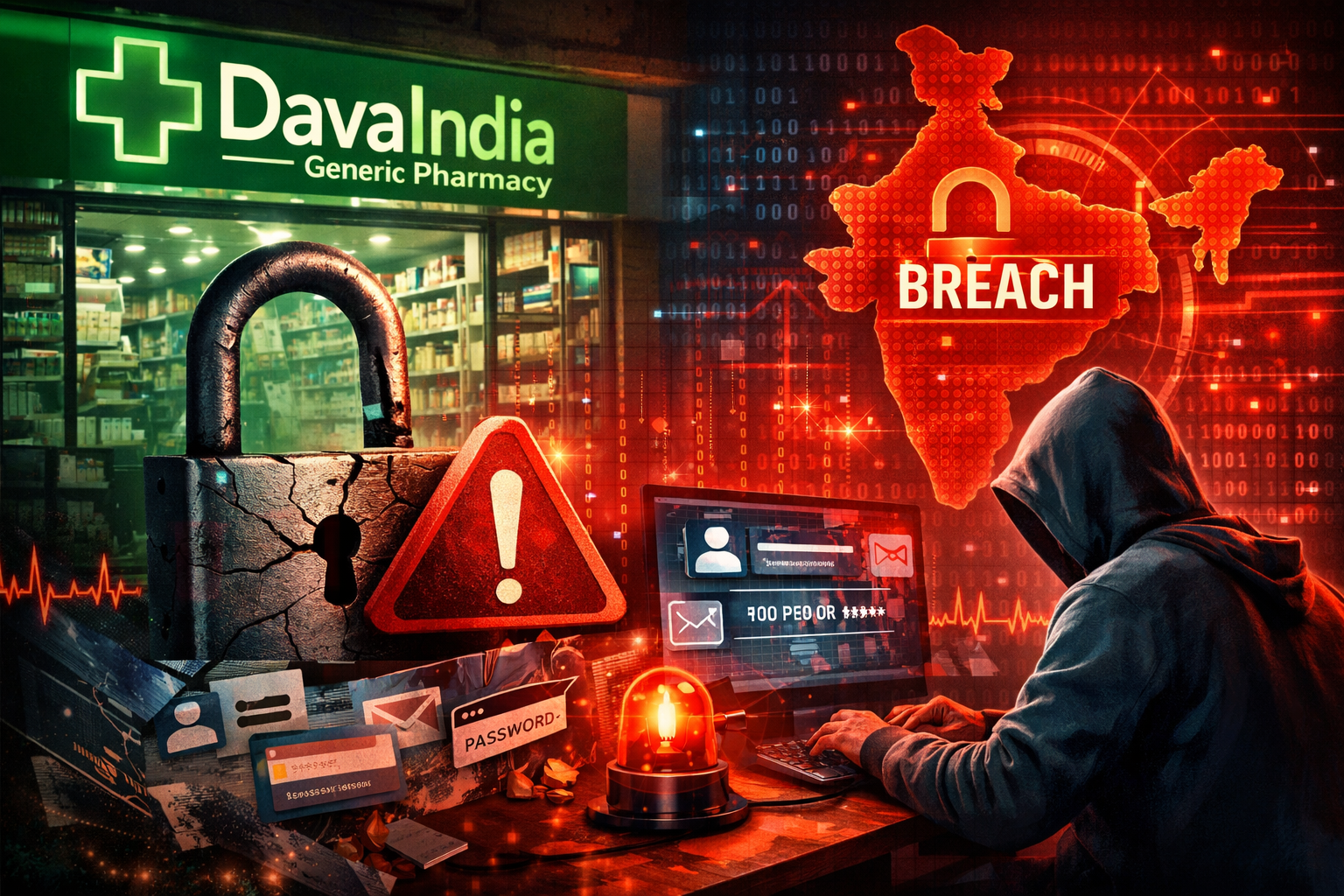
It was a vulnerability so basic, so glaring, that it barely required hacking skills to exploit. For months, one of India’s largest pharmacy chains left its administrative backdoor wide open—allowing anyone with internet access to create “super admin” accounts, view thousands of customer orders containing sensitive health information, and even alter prescription requirements for controlled medications. When security researcher Eaton Zveare stumbled upon the flaw in mid-2025, he wasn’t looking for trouble. He found a cybersecurity catastrophe waiting to happen.
The DavaIndia Pharmacy data breach, disclosed in February 2026, represents far more than a single company’s security lapse. It exposes the dangerous intersection of rapid retail expansion and neglected cybersecurity infrastructure in India’s booming digital economy. With over 2,300 stores nationwide and plans to add another 1,500 outlets, Zota Healthcare’s pharmacy arm is a major player in India’s healthcare retail sector. Yet for nearly a year, their digital platforms operated with effectively no administrative security—exposing nearly 17,000 online orders and administrative controls across 883 stores to potential exploitation.
As India implements its stringent Digital Personal Data Protection (DPDP) Act and cybersecurity incidents skyrocket from 10.29 lakh in 2022 to 22.68 lakh in 2024, the DavaIndia breach serves as a stark warning: in the race to digitize and expand, Indian retailers are leaving their customers’ most sensitive data perilously exposed.
The Breach: How a “Super Admin” API Became a Super Problem
The vulnerability discovered by Eaton Zveare wasn’t sophisticated. It didn’t involve zero-day exploits, advanced persistent threats, or nation-state hackers. It was far simpler—and therefore more embarrassing for a company handling sensitive health data.
Zveare found that DavaIndia’s website contained insecure “super admin” application programming interfaces (APIs) that allowed unauthenticated users to create high-privilege administrative accounts. In cybersecurity terms, this is equivalent to leaving the master keys to a bank vault hanging on a hook outside the front door.
With these elevated privileges, a malicious actor could:
- Access nearly 17,000 online orders containing detailed customer information
- Modify product listings and pricing across the entire platform
- Create promotional codes and discounts arbitrarily
- Alter prescription requirements for medications—including controlled substances
- Edit website content for defacement or disruption
- View administrative controls spanning 883 physical stores
System timestamps indicated these vulnerable interfaces had been accessible since late 2024—meaning the exposure persisted for approximately 8-10 months before discovery. Zveare reported the issue to CERT-In, India’s national cyber emergency response agency, in August 2025. The company patched the vulnerability within weeks, but confirmation of remediation wasn’t provided to authorities until late November 2025.
Zota Healthcare CEO Sujit Paul did not respond to media inquiries regarding the breach, and the company has not issued a public disclosure to affected customers—a concerning lack of transparency given the sensitivity of the exposed data.
Why Pharmacy Data Breaches Are Different
Not all data breaches are created equal. While exposure of names and email addresses is concerning, pharmacy order data carries uniquely sensitive implications that elevate this incident beyond typical retail breaches.
As Zveare noted in his disclosure: “Customer information was linked to their orders. This includes name, phone numbers, email IDs, mailing addresses, total amount paid, and the products purchased. Since this is a pharmacy, the products being purchased could be considered private and even embarrassing for some people.”
Consider what a pharmacy order history reveals:
| Data Element | Privacy Risk | Potential Misuse |
|---|---|---|
| Medication names and dosages | Reveals medical conditions (HIV, mental health, sexual health) | Discrimination, blackmail, insurance denial |
| Purchase patterns and frequency | Indicates chronic conditions or treatment adherence | Targeted scams, predatory marketing |
| Home addresses linked to medications | Physical vulnerability mapping | Theft targeting, stalking, harassment |
| Payment amounts and methods | Financial profiling | Financial fraud, identity theft |
| Prescription requirement toggles | System control over drug dispensing | Illegal drug distribution, public health risk |
The ability to alter prescription requirements is particularly alarming from a public health perspective. India’s Drugs and Cosmetics Act strictly regulates Schedule H and Schedule X medications—ranging from antibiotics to psychotropic substances. A malicious actor with administrative access could theoretically disable prescription checks, enabling unauthorized purchase of controlled medicines with potentially fatal consequences.
Zota Healthcare’s Aggressive Expansion vs. Security Investment
The timing of this breach is particularly telling. While DavaIndia’s digital infrastructure remained dangerously exposed, the company was executing one of the most aggressive retail expansion strategies in India’s pharmacy sector.
Zota Healthcare’s Growth Trajectory:
- Current footprint: Over 2,300 DavaIndia stores nationwide
- January 2026 expansion: 276 new outlets launched in a single month
- Future plans: 1,200 to 1,500 additional stores in the next two years
- Network coverage: Administrative controls exposed across 883 stores
This pattern—rapid physical expansion coupled with neglected digital security—is unfortunately common in India’s retail sector. Companies prioritize market share and store count over cybersecurity infrastructure, treating data protection as a cost center rather than a business imperative.
The DavaIndia case mirrors broader trends in Indian retail cybersecurity:
| Trend | Impact on Security | DavaIndia Example |
|---|---|---|
| Rapid digital transformation | Systems deployed without security review | Admin APIs live since late 2024 without authentication |
| Third-party platform dependencies | Shadow APIs and undocumented endpoints | “Super admin” interfaces likely legacy or debug features |
| Growth-at-all-costs mentality | Security teams understaffed and underfunded | 8+ month exposure window before detection |
| Lack of incident response readiness | Delayed disclosure and remediation | 3+ months between patch and confirmation to CERT-In |
The Regulatory Landscape: DPDP Act and CERT-In Requirements
India’s regulatory framework for data protection has evolved dramatically, and the DavaIndia breach tests the enforcement mechanisms of these new laws.
Digital Personal Data Protection (DPDP) Act, 2023
Enacted in August 2023 and being operationalized through 2024-2025, the DPDP Act introduces stringent requirements for organizations handling personal data. For healthcare entities like DavaIndia, the stakes are particularly high:
- Maximum penalties: Up to ₹250 crore (approximately $30 million) for failure to implement reasonable security safeguards
- Breach notification: Mandatory reporting to the Data Protection Board and affected individuals
- Data fiduciary obligations: Organizations must maintain data accuracy, implement security measures, and ensure data is processed only for lawful purposes
- Significant data fiduciaries: Companies handling large volumes of sensitive data face additional compliance requirements
The DPDP Act specifically categorizes health data as sensitive personal data requiring heightened protection. Pharmacy order histories—containing medication names, dosages, and purchase patterns—clearly fall under this classification.
CERT-In Directions and the 6-Hour Rule
Under the Information Technology Act, 2000, CERT-In mandates some of the world’s most stringent incident reporting requirements:
- Six-hour reporting window: All entities must report cybersecurity incidents within six hours of detection
- 20 reportable incident categories: Including data breaches, unauthorized access, and attacks on applications
- Log retention: 180 days of ICT system logs must be maintained within India
- Penalties for non-compliance: Fines up to ₹17.6 crore per violation and imprisonment up to one year
In the DavaIndia case, the timeline raises compliance questions:
- August 2025: Vulnerability reported to CERT-In by researcher
- Late August/Early September 2025: Vulnerability patched (within weeks)
- Late November 2025: Confirmation provided to cyber authorities
While the initial patching was relatively swift, the delay in formal confirmation and the lack of public disclosure to affected customers may attract regulatory scrutiny.
India’s Cybersecurity Crisis: By the Numbers
The DavaIndia breach is not an isolated incident but part of a alarming surge in cyberattacks targeting Indian businesses and consumers.
| Metric | Figure | Implication |
|---|---|---|
| Cybersecurity incidents (2022) | 10.29 lakh | Baseline before exponential growth |
| Cybersecurity incidents (2024) | 22.68 lakh | 120% increase in two years |
| Projected cybercrime losses (2025) | ₹20,000 crores | Across all sectors |
| Banking & financial services losses | ₹8,200 crores | Highest sectoral impact |
| Retail & e-commerce losses | ₹5,800 crores | Second highest sectoral impact |
| Internet penetration (households) | 86% | Massive attack surface expansion |
The retail and e-commerce sector’s ₹5,800 crore projected loss figure is particularly relevant to the DavaIndia case. As more pharmacy transactions move online—accelerated by COVID-19 and changing consumer habits—the healthcare retail sector is becoming an increasingly attractive target for cybercriminals.
Comparative Context: The Star Health Breach
To understand the potential consequences DavaIndia faces, one need only look at the ongoing Star Health and Allied Insurance case—India’s most severe healthcare data breach to date.
In August 2024, Star Health suffered a breach affecting over 30 million individuals. A hacker operating under the alias “xenZen” claimed access to sensitive customer records including health records, Aadhaar numbers, policy details, and medical images. The data was distributed via Telegram bots, making it searchable in real-time.
The fallout has been catastrophic:
- Leadership exodus: At least four senior executives across risk management, finance, compliance, and cybersecurity are expected to resign
- Regulatory scrutiny: Potential penalties up to ₹250 crore under the DPDP Act
- Criminal threats: Executives reportedly received bullets and death threats
- Data sale: Hacker claimed to possess 7.24 TB of data, offering it for $150,000
While DavaIndia’s breach (17,000 orders) is smaller in scale than Star Health’s (30 million records), the regulatory precedent is clear: Indian healthcare entities face severe consequences for data protection failures.
What Went Wrong: Technical Analysis
While Zota Healthcare has not released technical details of the vulnerability, security experts can infer the likely causes based on Zveare’s description of “insecure super admin APIs.”
Common API Security Failures
The DavaIndia breach likely involved one or more of these critical security lapses:
- Broken Object Level Authorization (BOLA): APIs failed to verify that the requesting user had permission to access specific administrative resources
- Missing Authentication: Administrative endpoints accepted requests without valid authentication tokens or session validation
- Debug/Development Endpoints in Production: “Super admin” interfaces likely intended for internal use were exposed to the public internet
- Insecure Direct Object References (IDOR): Sequential or predictable identifiers allowed enumeration of administrative functions
- Lack of Rate Limiting: Attackers could potentially automate account creation and data extraction without detection
The Shadow API Problem
Modern applications often contain “shadow APIs”—endpoints that are not documented, monitored, or secured because they were created for temporary use, debugging, or third-party integration. These APIs frequently bypass standard security controls and represent a growing attack vector.
The DavaIndia “super admin” APIs fit this profile perfectly: powerful interfaces with administrative capabilities that were likely never intended for public exposure but remained accessible due to configuration errors or oversight during deployment.
Lessons for Indian Retailers
The DavaIndia breach offers critical lessons for India’s rapidly digitizing retail sector:
1. Security Must Scale with Expansion
Opening 276 new stores in a month while leaving administrative APIs unauthenticated is a recipe for disaster. Retailers must ensure that cybersecurity investments keep pace with physical expansion.
2. API Security is Not Optional
As retailers build omnichannel experiences, APIs become the connective tissue between online platforms, mobile apps, and in-store systems. Each API endpoint represents a potential attack vector requiring authentication, authorization, and monitoring.
3. Compliance is More Than Checkbox Exercise
With the DPDP Act’s penalties reaching ₹250 crore and CERT-In’s 6-hour reporting mandate, compliance is now a board-level concern. Organizations need dedicated data protection officers, incident response plans, and regular security audits.
4. Transparency Builds Trust
Zota Healthcare’s silence on the breach—no public disclosure, no customer notification, no CEO statement—damages trust more than the breach itself. Under the DPDP Act, breach notification to affected individuals is mandatory, not optional.
5. Bug Bounty Programs and Responsible Disclosure
Organizations should establish clear channels for security researchers to report vulnerabilities. DavaIndia was fortunate that Zveare followed responsible disclosure practices; a malicious actor discovering the same flaw could have caused catastrophic harm.
What Customers Should Do Now
If you’ve purchased from DavaIndia Pharmacy online, take these immediate steps:
- Monitor financial statements: Check for unauthorized transactions on cards used for pharmacy purchases
- Change passwords: If you have a DavaIndia account, change your password immediately—and ensure it’s unique
- Watch for phishing: Be suspicious of emails or calls claiming to be from DavaIndia requesting personal information
- Review medication privacy: Consider whether your pharmacy order history reveals sensitive health conditions
- Enable account alerts: Set up notifications for any changes to your pharmacy account
- Demand transparency: Contact DavaIndia customer service to inquire whether your data was affected and what remediation is being offered
The Road Ahead: Regulatory Enforcement and Industry Change
The DavaIndia breach comes at a pivotal moment for Indian data protection. With the DPDP Act entering its enforcement-heavy phase in 2025, regulators are actively seeking cases to establish precedent. The healthcare sector, handling the most sensitive categories of personal data, is under particular scrutiny.
Key developments to watch:
- CERT-In’s response: Whether the agency issues formal directives or penalties for the delayed confirmation and lack of public disclosure
- Data Protection Board actions: The newly constituted board may take up this case to test its enforcement mechanisms
- Industry self-regulation: Whether pharmacy chains implement voluntary security standards before mandatory requirements force compliance
- Investor pressure: As cybersecurity becomes a boardroom issue, investors may demand security audits as a condition for funding expansion
The FICCI-EY Risk Survey 2026 found that 51% of Indian corporations now rank cybersecurity breaches as the top risk to organizational performance—ahead of changing customer demand (49%) and geopolitical events (48%). This shift in perception is long overdue.
Conclusion: A Wake-Up Call That Cannot Be Ignored
The DavaIndia Pharmacy data breach is more than a technical failure—it’s a symptom of a deeper malaise in Indian retail’s approach to digital security. In the rush to capture market share and expand footprints, companies are treating cybersecurity as an afterthought, exposing millions of customers to preventable harm.
For Zota Healthcare, the immediate priority must be transparency: notifying affected customers, explaining what data was exposed, and detailing remediation measures. For the broader industry, the message is clear—the era of growth-at-all-costs is ending. The DPDP Act’s ₹250 crore penalties and CERT-In’s 6-hour reporting mandate represent a new regulatory reality.
But beyond compliance, Indian retailers must recognize a fundamental truth: in an economy where 86% of households have internet access and cybercrime losses are projected to reach ₹20,000 crores, cybersecurity is not a cost center—it’s a business imperative. The companies that thrive in India’s digital future will be those that build security into their DNA, not those that bolt it on after a breach makes headlines.
The DavaIndia breach is a wake-up call. The question is whether India’s retail sector will hit snooze or finally get out of bed.
References
- TechCrunch – “Indian pharmacy chain giant exposed customer data and internal systems”
https://techcrunch.com/2026/02/13/indias-major-pharmacy-chain-exposed-customer-data-and-internal-systems/
Exclusive report on the DavaIndia security lapse discovered by researcher Eaton Zveare, detailing the exposed data and administrative controls. - Bitget News – “Indian pharmaceutical retail giant leaks customer information and internal infrastructure”
https://www.bitget.com/news/detail/12560605199887
Analysis of the DavaIndia breach and its implications for India’s rapidly expanding pharmacy retail sector. - Business20Channel – “DavaIndia & Zota Healthcare Security Lapse Exposes Customer Data”
https://business20channel.tv/davaindia-zota-healthcare-security-lapse-exposes-customer-da-14-february-2026
Detailed coverage of the breach’s impact on customer privacy and public health safety. - Mondaq – “Data Breach Reporting In India: Legal Obligations And Best Practices”
https://www.mondaq.com/india/data-protection/1725014/data-breach-reporting-in-india-legal-obligations-and-best-practices
Comprehensive guide to India’s data breach reporting framework under the IT Act and DPDP Act, including CERT-In’s 6-hour reporting mandate. - DPDP Consultants – “Star Health Faces ₹250 Cr Penalty After Data Breach, Raising DPDP Concerns”
https://www.dpdpconsultants.com/newsletter.php?id=22&title=star-health-faces-250-cr-penalty-after-data-breach-raising-dpdp-concerns
Analysis of regulatory penalties under the DPDP Act using the Star Health breach as a case study. - EY India – “51% of India Inc rank cybersecurity breaches as the top risk to organizational performance: FICCI-EY Risk Survey”
https://www.ey.com/en_in/newsroom/2026/02/51-percent-of-india-inc-rank-cybersecurity-breaches-as-the-top-risk-to-organizational-performance-ficci-ey-risk-survey
Survey data showing cybersecurity has become the top-ranked risk for Indian corporations. - Prime Infoserv – “Cybersecurity Threats Statistics 2025 and Government of India Initiatives”
https://primeinfoserv.com/cyber-security-statistics-2025-global-facts-major-breaches-and-indias-rising-cyber-risk/
Statistics on India’s cybersecurity incident growth from 10.29 lakh (2022) to 22.68 lakh (2024) and projected ₹20,000 crore losses.
Disclaimer: This article is for informational and educational purposes only and does not constitute legal, cybersecurity, or professional advice. The details of the DavaIndia data breach are based on publicly available reports from security researchers and media outlets. While every effort has been made to ensure accuracy, the author and publisher make no representations or warranties regarding the completeness or reliability of the information presented. Readers should consult with qualified legal and cybersecurity professionals regarding specific compliance obligations under the DPDP Act, CERT-In directions, and other applicable regulations. The mention of specific penalties and regulatory actions represents potential outcomes based on statutory provisions and precedent cases, not definitive predictions. Individual circumstances may vary, and regulatory interpretations are subject to change.
About the Author
InsightPulseHub Editorial Team creates research-driven content across finance, technology, digital policy, and emerging trends. Our articles focus on practical insights and simplified explanations to help readers make informed decisions.