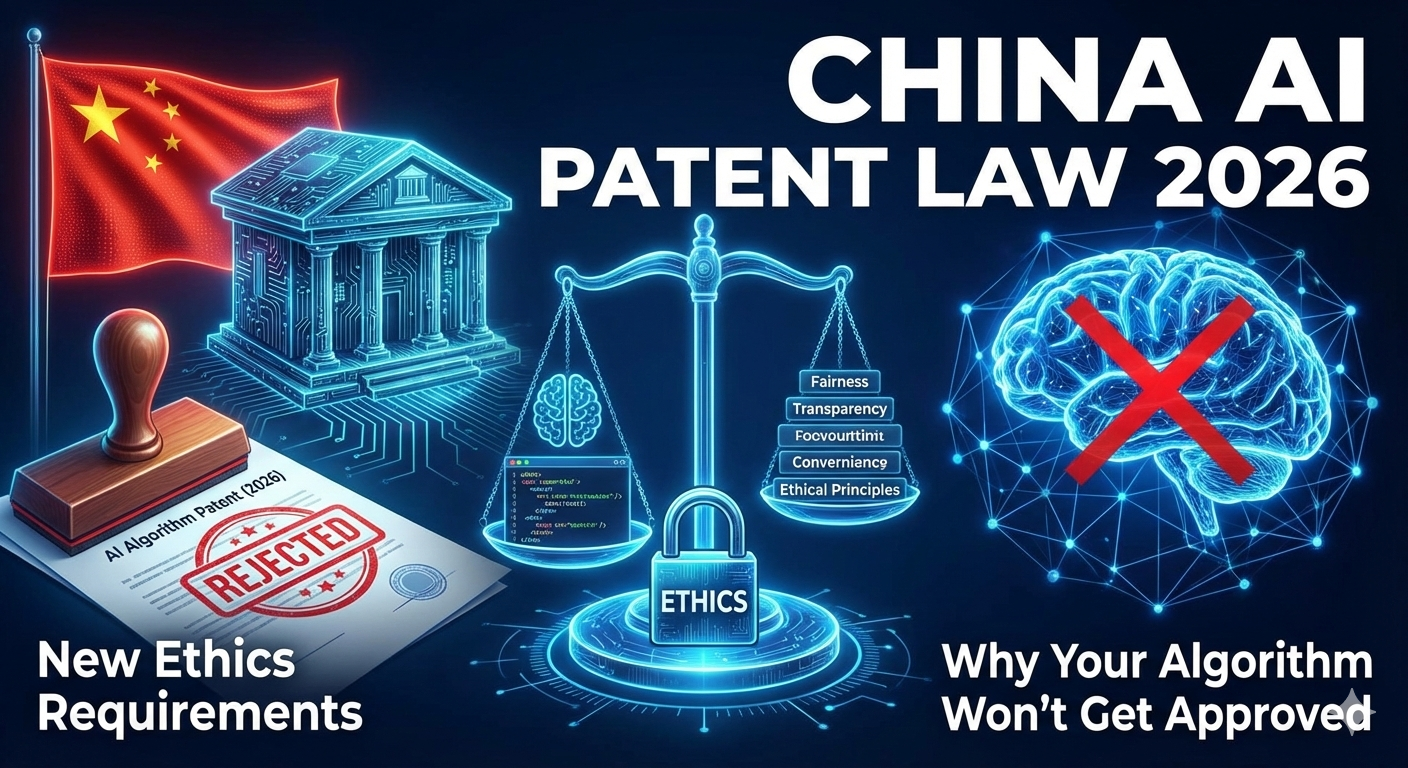
Critical Update: As of January 1, 2026, China has fundamentally transformed its AI patent examination standards. The China National Intellectual Property Administration (CNIPA) now rejects AI patent applications that violate ethical standards, use unlawful data, or cause algorithmic discrimination—regardless of technical innovation. This represents the most significant shift in global AI patent policy to date.
The New Reality: Ethics as a Patentability Gatekeeper
China’s intellectual property landscape has undergone a seismic shift that every AI innovator, patent attorney, and technology company must understand immediately. The revised Patent Examination Guidelines, effective January 1, 2026, have introduced a paradigm where technical excellence alone is no longer sufficient for patent protection. For the first time in major patent jurisdictions worldwide, ethical compliance has become a formal, non-negotiable requirement for AI patentability.
The implications are staggering. China, which received 1.8 million patent applications in 2024—representing 49.1% of all global filings and more than three times the volume of the United States—has effectively declared that algorithms violating social morality or public interest are categorically unpatentable. This isn’t merely a procedural update; it’s a fundamental redefinition of what constitutes patentable subject matter in the age of artificial intelligence.
Consider this: China has consistently ranked first globally in patent filings for five consecutive years, with computer technology accounting for 13.2% of all published patent applications worldwide. When a jurisdiction handling nearly half of all global patent activity changes its rules, the ripple effects touch every innovation hub from Silicon Valley to Bangalore.
Three Critical Pillars of the 2026 AI Patent Framework
The CNIPA’s amendments establish three interconnected requirements that form the foundation of AI patent examination. Understanding these pillars is essential for any entity seeking patent protection in China:
Pillar 1: Absolute Prohibition on Unlawful Data Usage
The revised Guidelines explicitly state that AI inventions involving data mining, analysis, or decision-making mechanisms that violate laws, social morality, or harm public interests shall not be granted patent rights. This prohibition operates under Article 5(1) of the Chinese Patent Law, which historically addressed inventions contrary to public order but now specifically targets AI’s data dependencies.
The CNIPA has provided a clarifying example that sends shockwaves through the marketing technology sector: A “big data-based sales assistance system for shopping mall mattresses” that collects facial images through cameras without customer awareness, conducting identity recognition and preference analysis for precision marketing, is now explicitly unpatentable. The rationale? China’s Personal Information Protection Law mandates that facial recognition equipment in public places requires separate consent for commercial purposes—absent such consent, the invention violates legal standards and fails the patentability threshold.
This example demonstrates that data compliance has shifted from post-grant operational risk to pre-grant examination hurdle. Patent applicants must now demonstrate the legality of data acquisition within the patent specification itself, fundamentally changing drafting strategies for AI applications.
Pillar 2: Zero Tolerance for Algorithmic Discrimination
Perhaps the most ethically significant change involves the prohibition of algorithms that embed discriminatory decision-making. The CNIPA has established that AI systems making value judgments about human life based on protected characteristics are contrary to social morality and therefore unpatentable.
The Guidelines cite an autonomous vehicle emergency decision-making model that incorporated pedestrians’ gender and age as parameters for collision avoidance. When accidents were unavoidable, the system determined vehicle trajectory based on these demographic factors—essentially assigning different values to human lives. The CNIPA rejected this application, stating it violated the fundamental social morality that all lives are of equal value.
This ruling has profound implications for:
- Autonomous vehicle systems making ethical decisions in unavoidable collision scenarios
- Healthcare AI prioritizing treatment based on demographic factors
- Financial services algorithms determining creditworthiness using potentially discriminatory variables
- Employment screening tools that may perpetuate bias
- Criminal justice risk assessment systems
Pillar 3: Elevated Inventive Step Requirements
The “slapping AI on it” era has officially ended in China. The revised Guidelines establish that merely applying existing AI models to new scenarios without substantive technical modification fails the inventive step requirement. This targets the common practice of repackaging known deep learning architectures for novel application domains.
The CNIPA’s “fruit-to-ship” example illustrates this perfectly: An application claiming a method for identifying ship numbers using deep learning was rejected because prior art already disclosed the identical process for fruit recognition. By merely changing the recognition subject without adjusting model structure, training methods, or feature processing, the applicant made only an obvious substitution that any skilled practitioner could implement.
To satisfy inventive step requirements under the 2026 framework, applicants must demonstrate:
- Meaningful modifications to model architecture or structure
- Innovative training methodologies or parameter optimization
- Novel feature processing techniques
- Unexpected technical effects beyond mere application context changes
Comprehensive Disclosure Requirements: The End of the Black Box
AI’s “black box” nature has long complicated patent disclosure requirements. The 2026 Guidelines address this head-on with stringent sufficiency of disclosure standards that demand transparency in AI model functionality. This represents a significant escalation from previous examination practices.
For AI model construction and training patents, specifications must now disclose:
- Complete model architecture including modules, layers, and connection relationships
- Detailed training steps, data requirements, and key parameters
- Optimization methodologies and convergence criteria
- Hardware implementation requirements where relevant
For AI application and deployment patents, the description must clearly explain:
- How the AI model integrates with the specific technical field or scenario
- Input and output data specifications and their technical relationships
- The problem-solving mechanism and technical effects
- Sufficient detail to enable reproduction by skilled practitioners
The Guidelines explicitly state that examination now considers “the contents of the description” where necessary, enabling examiners to scrutinize technical disclosures beyond claim language. This shift from claim-centric to specification-inclusive examination means inadequate technical disclosure can now independently doom an application.
Global Context: Why China’s Rules Matter Everywhere
China’s regulatory evolution cannot be dismissed as a localized development. With 5.7 million patents in force as of 2024—more than any other jurisdiction—and a 15-month average examination period that rivals global standards, China has become the proving ground for patent strategies.
Consider the comparative landscape:
| Jurisdiction | 2024 Patent Applications | Global Share | AI Ethics Requirements |
|---|---|---|---|
| China | 1,800,000 | 49.1% | Mandatory (2026) |
| United States | 501,831 | 13.6% | Under Discussion |
| Japan | 419,132 | 11.3% | Limited |
| South Korea | 295,722 | 8.0% | Emerging |
| Germany | 133,485 | 3.6% | EU AI Act Aligned |
The data reveals China’s overwhelming dominance in patent volume—filing more applications than the next three jurisdictions combined. When China mandates AI ethics compliance, it effectively establishes a de facto global standard for companies seeking to protect innovations in the world’s largest patent market.
Furthermore, China’s AI patent leadership extends beyond volume. Between 2014 and 2023, China filed over 38,000 generative AI patents—six times more than the United States during the same period. Chinese companies like State Grid Corporation (26,309 AI patents), Tencent, and Baidu are aggressively patenting across learning techniques, training data generation, and vision-oriented networks. The 2026 Guidelines will directly impact this massive patent portfolio’s expansion.
Practical Compliance Strategies for Patent Applicants
Navigating the 2026 framework requires fundamental shifts in patent preparation and prosecution strategies. Organizations must adopt proactive compliance measures to avoid the now-commonplace ethical rejections.
Strategy 1: Pre-Filing Ethics and Data Compliance Audits
Before drafting any AI patent application for China, conduct comprehensive audits of:
- Training data provenance: Document legal acquisition, consent mechanisms, and compliance with China’s Personal Information Protection Law and Data Security Law
- Algorithmic decision-making logic: Review whether algorithms make value judgments based on protected characteristics (race, gender, age, ethnicity)
- Application domain risks: Assess whether the technical field inherently raises ethical concerns (surveillance, credit scoring, hiring, criminal justice)
- Public interest implications: Evaluate whether the invention could harm public safety, social stability, or collective welfare
Strategy 2: Specification Drafting Best Practices
The 2026 Guidelines necessitate “active construction” rather than “passive recording” in patent drafting. Effective specifications should:
- Explicitly address data legality: Include statements regarding lawful data acquisition, consent procedures, and compliance with applicable regulations
- Detail technical improvements: Clearly articulate modifications to model architecture, training processes, or feature engineering that demonstrate substantive technical contribution
- Enable reproduction: Provide sufficient technical detail to overcome black box objections, including parameter configurations and implementation specifics
- Embed fallback positions: Structure dependent claims to provide “response anchors” for potential inventive step objections
Strategy 3: Inventorship Verification Protocols
The revised Guidelines explicitly prohibit AI systems from being named as inventors, mandating that inventors must be natural persons who made creative contributions to the invention’s substantive features. Patent agencies must now verify applicant identity information authenticity.
Effective January 1, 2026, all inventors must provide identification information in patent applications. For Chinese inventors, this includes nationality, ID type, and ID number. Foreign inventors must provide nationality information, with ID details currently optional but recommended for completeness.
Industry-Specific Impact Analysis
The 2026 Guidelines affect different technology sectors disproportionately. High-risk industries requiring immediate strategic reassessment include:
Autonomous Vehicles and Transportation
Emergency decision-making algorithms face heightened scrutiny. Any system incorporating demographic factors into collision avoidance calculations will likely face rejection based on social morality violations. Companies must redesign ethical decision frameworks to ensure equal protection regardless of pedestrian characteristics.
Facial Recognition and Biometrics
Commercial applications of facial recognition technology are now patentability minefields. Systems deployed in public spaces for marketing, customer analytics, or non-security purposes must demonstrate explicit consent mechanisms and legal basis for data processing. Covert collection systems are categorically unpatentable.
Financial Services and Credit Scoring
Algorithms using demographic proxies or potentially discriminatory variables risk rejection under the algorithmic discrimination prohibitions. Credit scoring systems must demonstrate fairness and avoid perpetuating historical biases in training data.
Healthcare and Medical Diagnostics
AI systems prioritizing treatment or resource allocation based on non-medical factors face significant patentability challenges. Triage algorithms must ensure equal valuation of human life regardless of patient demographics.
The Broader Implications for Global AI Governance
China’s integration of ethical standards into patent law represents a regulatory innovation that other jurisdictions are likely to emulate. While the United States continues debating AI inventorship and the European Union implements the AI Act’s risk-based classifications, China has leapfrogged to embed ethics directly into the intellectual property incentive structure.
This approach creates a powerful compliance mechanism: by denying the competitive advantage of patent protection to unethical AI, China effectively disincentivizes harmful algorithmic development. Companies must now choose between ethical compliance and exclusion from the world’s largest patent market.
The message is unambiguous: technical innovation without ethical foundation is no longer innovation worth protecting in China’s patent system. As AI technologies increasingly shape social structures, economic opportunities, and human rights, China’s 2026 Guidelines establish that patent systems must evolve to safeguard public interest, not merely reward technical cleverness.
Conclusion: Adapt or Abandon the China Market
The 2026 Patent Examination Guidelines represent an irreversible shift in AI patent strategy. Algorithms using unlawful data, causing discrimination, or violating public interest will not receive patent protection—regardless of technical sophistication or commercial potential. The “move fast and break things” approach to AI development is incompatible with China’s new patent reality.
For global innovators, the choice is stark: redesign AI development practices to meet China’s ethical standards or abandon patent protection in a jurisdiction representing nearly half of global patent activity. Given China’s centrality to global supply chains and technology markets, the latter option is rarely viable.
Success in this new environment requires integrating ethics into the earliest stages of AI research and development. Legal teams must collaborate with engineers to ensure data compliance and algorithmic fairness from conception through patent prosecution. The 2026 Guidelines don’t merely change patent drafting—they demand fundamental transformation in how we conceptualize responsible AI innovation.
Key Takeaways for Patent Practitioners
- Ethics compliance is now a patentability requirement, not merely a regulatory consideration
- Data legality must be demonstrated in patent specifications
- Algorithmic discrimination based on protected characteristics renders inventions unpatentable
- Technical improvements must be substantive, not merely application context changes
- Disclosure requirements have intensified to address AI’s “black box” nature
- AI systems cannot be named as inventors—only natural persons qualify
References
- China National Intellectual Property Administration (CNIPA). “Decision on Revising the Patent Examination Guidelines (Order No. 84).” November 10, 2025. Effective January 1, 2026. https://www.cnipa.gov.cn
- Lexology. “Strategic Shift in China’s AI Patent Examination (2026).” January 22, 2026. https://www.lexology.com/library/detail.aspx?g=1079732f-1583-40ca-a77c-11e3ca9b6bbd
- Mathys & Squire. “China Raises the Bar for AI Patents: What Changes from 1 January 2026.” December 30, 2025. https://www.mathys-squire.com/insights-and-events/news/china-raises-the-bar-for-ai-patents-what-changes-from-1-january-2026/
- World Intellectual Property Organization (WIPO). “World Intellectual Property Indicators 2025.” November 2025. https://www.wipo.int/web-publications/world-intellectual-property-indicators-2025-highlights/en/patents-highlights.html
- GreyB Insights. “Artificial Intelligence (AI) Patent Landscape: USA vs China.” December 29, 2025. https://insights.greyb.com/artificial-intelligence-ai-patent-landscape-usa-china/
Disclaimer
This blog post is provided for informational and educational purposes only and does not constitute legal advice. The content reflects the regulatory situation as of February 2026 and may not capture subsequent amendments or interpretations. Patent laws and examination guidelines are subject to change, and specific applications require analysis by qualified intellectual property attorneys familiar with current CNIPA practices. Readers should consult with licensed patent practitioners before making decisions regarding patent filings in China or any other jurisdiction.
About the Author
InsightPulseHub Editorial Team creates research-driven content across finance, technology, digital policy, and emerging trends. Our articles focus on practical insights and simplified explanations to help readers make informed decisions.