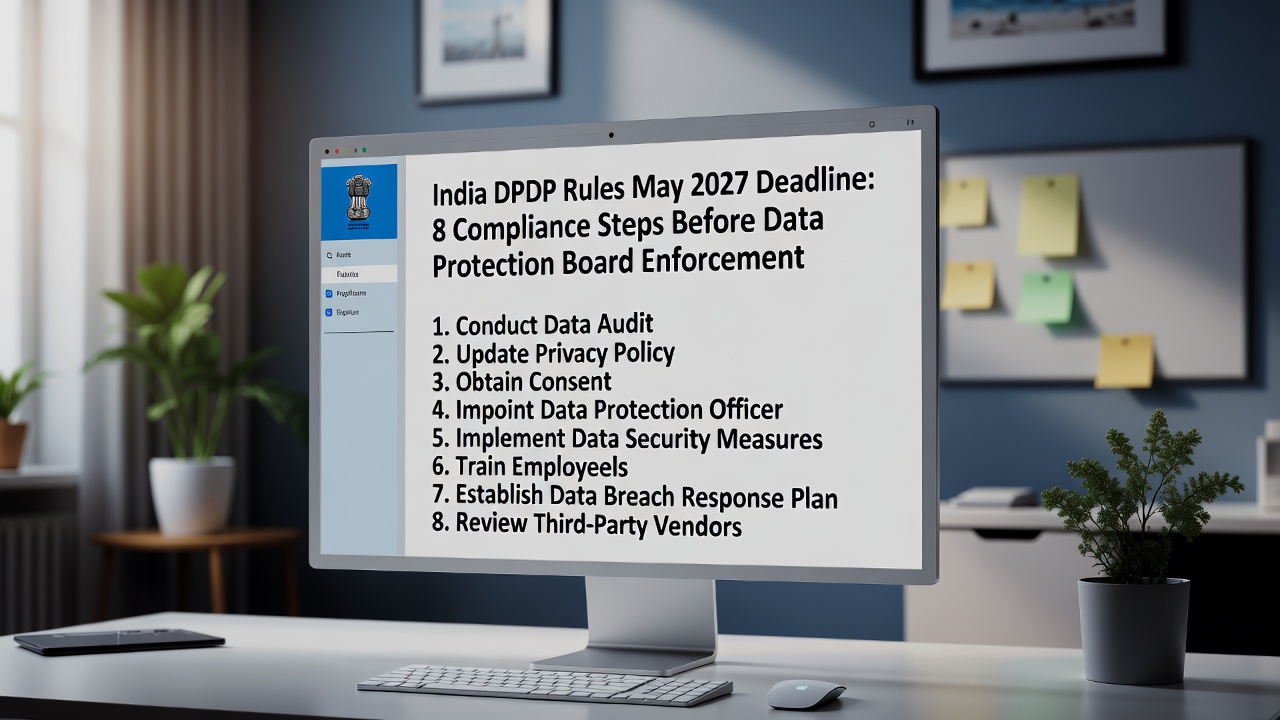
Compliance Countdown: India’s Digital Personal Data Protection (DPDP) Rules, 2025 have initiated an 18-month compliance marathon with a hard deadline of May 13, 2027. The Data Protection Board of India (DPBI) is now operational and will begin full enforcement on this date, with penalties reaching ₹250 crore (approximately $30 million USD) for violations. Organizations processing digital personal data in India—or offering goods/services to Indian residents—must complete eight critical compliance steps before enforcement begins. With only 15 months remaining, the window for preparation is closing rapidly. This is your definitive roadmap to compliance before the Board’s penalties become reality.
The DPDP Framework: From Act to Enforcement
India’s data protection landscape has transformed from fragmented sectoral regulations under the Information Technology Act, 2000 to a comprehensive, GDPR-style framework with the Digital Personal Data Protection Act, 2023 (DPDP Act) and the Digital Personal Data Protection Rules, 2025 (DPDP Rules). The Rules, notified on November 13, 2025, after incorporating 6,915 stakeholder inputs, establish the operational mechanics for India’s first unified data protection regime.
The implementation follows a carefully structured three-phase timeline designed to allow organizations to build compliance infrastructure while ensuring no regulatory vacuum:
| Phase | Effective Date | Key Activations |
|---|---|---|
| Phase 1: Foundation | November 13, 2025 | Data Protection Board established; definitions and rule-making powers activated; complaint portal launched |
| Phase 2: Consent Managers | November 13, 2026 | Consent Manager registration begins; technical standards and interoperability requirements operational |
| Phase 3: Full Compliance | May 13, 2027 | All substantive obligations enforceable; penalties activated; Board begins full enforcement |
The May 13, 2027 deadline is non-negotiable. Unlike GDPR’s implementation period or other jurisdictions’ grace periods, the DPDP framework explicitly states that penalties apply from Day 1 of Phase 3. The Data Protection Board, now operational with four members in the National Capital Region, will have full authority to investigate complaints, conduct inquiries, issue binding directions, and impose monetary penalties.
The ₹250 Crore Question: Penalty Structure
Understanding the financial stakes is essential for prioritizing compliance investments. The DPDP Act establishes a tiered penalty structure that makes non-compliance prohibitively expensive:
| Violation Category | Maximum Penalty | Applicable Section |
|---|---|---|
| Failure to maintain reasonable security safeguards | ₹250 crore (~$30M USD) | Section 30 |
| Failure to notify Data Protection Board of personal data breach | ₹250 crore (~$30M USD) | Section 30 |
| Non-compliance by Significant Data Fiduciary | ₹250 crore (~$30M USD) | Section 28 |
| Non-compliance with Board directions | ₹250 crore (~$30M USD) | Section 29 |
| Violations related to children’s data processing | ₹200 crore (~$25M USD) | Section 31 |
| Other violations by Data Fiduciaries | ₹50 crore (~$6M USD) | Section 28 |
| Failure to publish contact information (DPO/authorized person) | ₹10,000/day (max ₹10 lakh) | Section 32 |
The Board will assess penalties based on violation severity, duration, data volume affected, impact on individuals, organizational intent, cooperation level, remediation efforts, and any unfair advantage gained. Critically, there’s no “first-time offender” discount—maximum penalties apply immediately from May 13, 2027.
Who Must Comply: Territorial Reach and Applicability
The DPDP Act’s scope extends far beyond Indian borders, creating compliance obligations for global organizations:
Within India: All processing of digital personal data within Indian territory, including data initially collected in non-digital form and subsequently digitized.
Extraterritorial Application: Processing outside India is covered if it relates to offering goods or services to Data Principals (individuals) in India. This mirrors GDPR’s Article 3 approach but with broader “offering” language that captures marketing, e-commerce, SaaS, and digital services regardless of whether payment is involved.
Key Implications:
- A US-based streaming service with Indian subscribers must comply, even if processing occurs on US servers
- A UK e-commerce platform shipping to India falls under DPDP jurisdiction
- Multinational employers processing Indian employee data must comply regardless of where HR systems are hosted
- Global SaaS providers with Indian customers must implement DPDP-compliant data handling
The Act applies to “digital personal data”—information about an identifiable individual in digital form. This excludes non-personal data, anonymized data (if irreversible), and personal data processed purely for personal/domestic purposes.
The 8 Critical Compliance Steps Before May 2027
Organizations must complete these eight steps before the May 13, 2027 enforcement deadline. Each step builds upon the previous, creating a comprehensive compliance architecture.
Step 1: Comprehensive Data Mapping and Gap Analysis (Months 0-6)
Before implementing any controls, organizations must understand their data landscape. The DPDP Rules require itemized descriptions of personal data processed—meaning aggregate categories are insufficient.
Action Items:
- Inventory all personal data collection points across websites, mobile apps, CRM systems, HR platforms, marketing tools, and vendor systems
- Map data flows: what is collected, from whom, for what purpose, where stored, who has access, retention periods, and deletion procedures
- Identify Data Fiduciaries (entities determining purpose/means of processing) versus Data Processors (processing on behalf of fiduciaries)
- Assess whether your organization qualifies as a Significant Data Fiduciary (SDF) based on volume/sensitivity of data, risk to rights, and potential impact on sovereignty/integrity
- Document “legitimate uses” under Section 7 that may not require consent (employment-related processing, certain legal obligations, medical emergencies involving threats to life)
- Identify cross-border data transfers and assess whether destination countries have adequate protection levels or if additional safeguards are required
Critical Gap Areas to Address:
- Historical personal data in legacy systems that cannot support audit trails, deletion workflows, or access rights
- Shadow IT systems where departments process data outside approved platforms
- Vendor contracts lacking DPDP-mandated security and breach notification clauses
- Data retention periods not aligned with specific, declared purposes
Step 2: Implement Standalone Privacy Notices and Consent Mechanisms (Months 6-12)
The DPDP Rules mandate fundamental changes to how organizations communicate with data principals. Rule 3 requires notices that are independent, itemized, and actionable.
Notice Requirements:
- Standalone Presentation: Privacy notices must be separate from terms of service, end-user license agreements, or other legal documents
- Itemized Description: Specific enumeration of personal data categories processed (e.g., “name, email address, phone number, IP address, device identifiers” rather than “contact information”)
- Purpose Specification: Clear articulation of specific processing purposes (“account creation and authentication” vs. “improving services”)
- Language Accessibility: Notices must be available in English and any of the 22 official Indian languages where the Data Principal requests
- Actionable Mechanisms: Direct links or clear methods for withdrawing consent, exercising rights (access, correction, erasure), and submitting grievances
- Consent Withdrawal: Must be as easy as giving consent—if one-click opt-in is possible, one-click opt-out must be equally accessible
Consent Design Principles:
- Consent must be free, specific, informed, unconditional, and unambiguous
- No pre-ticked boxes, bundled consents, or implied consent through inaction
- Granular consent for distinct processing purposes—separate consents for marketing, analytics, and service delivery
- Verifiable consent mechanisms for children’s data (under 18) requiring parental verification
Step 3: Establish Data Principal Rights Infrastructure (Months 6-12)
The DPDP Act grants Data Principals comprehensive rights that organizations must operationalize before May 2027. These aren’t theoretical entitlements—they require technical infrastructure and process workflows.
Rights to Enable:
- Right to Access (Section 12): Data Principals can request summaries of processed data, processing purposes, and data sharing details. Organizations must provide this in clear, understandable format.
- Right to Correction and Erasure (Section 12): Ability to correct inaccurate data and complete incomplete data. Erasure rights apply when consent is withdrawn, purpose is fulfilled, or processing was unlawful.
- Right to Grievance Redressal (Section 13): Organizations must resolve complaints within 90 days. This requires ticketing systems, escalation procedures, and documented resolution workflows.
- Right to Nominate (Section 14): Data Principals can nominate representatives to exercise rights in case of incapacity or death—organizations must verify and honor these nominations.
Technical Implementation:
- Self-service portals for access requests and consent management
- Automated data discovery tools to locate all instances of a principal’s data across systems
- Secure identity verification mechanisms to prevent unauthorized access
- Audit trails documenting all rights requests and responses for Board inspection
Step 4: Deploy Reasonable Security Safeguards (Months 6-12)
Section 30’s ₹250 crore penalty for security failures makes this the highest-stakes compliance area. The DPDP Rules specify minimum technical safeguards that must be implemented “wherever applicable.”
Mandatory Security Measures (Rule 7):
- Encryption: Personal data must be encrypted both in transit (TLS 1.2 minimum) and at rest (AES-256 or equivalent)
- Access Controls: Role-based access with principle of least privilege; multi-factor authentication for privileged access; regular access reviews
- Network Segmentation: Isolation of systems processing personal data from general corporate networks
- Logging and Monitoring: Maintain logs of processing activities, access events, and security incidents for minimum 1 year (longer if required by sectoral regulations)
- Vulnerability Management: Regular security assessments, penetration testing, and patch management
- Incident Response: Documented procedures for detecting, containing, and remediating security incidents
Significant Data Fiduciary Additional Requirements:
- Annual independent data audits by Board-certified auditors
- Data Protection Impact Assessments (DPIAs) for high-risk processing
- Appointment of India-based Data Protection Officer (DPO) with board-level reporting
- Comprehensive business continuity and disaster recovery plans
Step 5: Implement 72-Hour Breach Notification System (Months 12-18)
The 72-hour breach notification requirement (Section 8) is among the strictest globally, matching GDPR’s timeline but with specific procedural requirements under Rule 8.
Breach Response Workflow:
- Detection and Assessment (0-24 hours): Automated monitoring systems to detect unauthorized access, exfiltration, or loss. Initial assessment of breach scope, affected data categories, and potential harm.
- Board Notification (Within 72 hours): Detailed report to Data Protection Board including:
- Nature of breach and affected systems
- Categories and approximate number of Data Principals affected
- Potential consequences and harm assessment
- Measures taken or proposed to address breach
- Contact details for further information
- Data Principal Notification (When harm risk exists): If breach poses risk to rights and freedoms, affected individuals must be notified in clear, plain language with recommended protective measures.
- Documentation: Maintain comprehensive records of breach detection, response actions, and remediation for Board inspection.
Critical Preparation:
- Pre-draft breach notification templates for common scenarios
- 24/7 incident response team with authority to trigger notifications
- Integration with CERT-In (Indian Computer Emergency Response Team) reporting requirements where applicable
- Tabletop exercises simulating breach scenarios to test response timelines
Step 6: Establish Data Retention and Deletion Architecture (Months 12-18)
The DPDP Rules introduce specific retention and deletion requirements that many organizations’ current systems cannot support. Rule 9 mandates purpose-limited retention with automatic deletion triggers.
Retention Requirements:
- Purpose Limitation: Data cannot be retained indefinitely. Specific retention periods must be defined for each processing purpose and communicated in privacy notices.
- Consent Withdrawal Trigger: Upon consent withdrawal, data must be deleted unless retention is required by law or for legitimate uses.
- 3-Year Inactivity Rule: Personal data must be deleted if the Data Principal has not interacted with the service for 3 years, subject to 48-hour prior notice and opportunity to withdraw consent.
- 1-Year Log Retention: Processing logs, traffic data, and access logs must be maintained for minimum 1 year (unless sectoral regulations require longer).
Technical Implementation:
- Automated deletion workflows triggered by retention period expiration or consent withdrawal
- Cryptographic erasure for encrypted data where key destruction is more practical than data overwriting
- Cascading deletion across backup systems, disaster recovery environments, and vendor processors
- Audit trails proving deletion compliance for Board verification
Historical Data Challenge: Legacy systems often lack deletion capabilities. Organizations must either upgrade systems, migrate data to compliant platforms, or implement compensating controls with documented risk acceptance.
Step 7: Implement Children’s Data Protection (Verifiable Parental Consent) (Months 12-18)
Section 9 and Rule 11 establish stringent protections for children’s data (under 18 years), with violations attracting penalties up to ₹200 crore.
Requirements:
- Verifiable Parental Consent: Before processing any child’s personal data, organizations must obtain and verify consent from parents or lawful guardians.
- Prohibited Processing: Tracking, behavioral monitoring, or targeted advertising directed at children is prohibited.
- Disability Protections: Similar verifiable consent requirements apply to processing personal data of individuals with disabilities who have lawful guardians.
- Educational Exemptions: Certain processing for educational institutions and child protection services may proceed without consent under specific conditions.
Verification Methods:
- Credit card verification (small charge to parent’s card)
- Video conference with parent/guardian
- Signed consent forms with identity document verification
- Digital signature or e-KYC (Know Your Customer) verification
- Consent Manager platforms with integrated parental verification
Implementation Complexity: Age verification without collecting additional personal data (which itself requires consent) creates technical challenges. Solutions include:
- Self-declaration with random audit sampling
- Third-party age verification services
- Default “under 18” assumptions with parental verification to unlock features
Step 8: Significant Data Fiduciary Obligations (If Applicable) (Months 0-18)
Organizations designated as Significant Data Fiduciaries (SDFs) face additional obligations under Section 10 and Rule 12. The Central Government will designate SDFs based on:
- Volume and sensitivity of personal data processed
- Risk to rights of Data Principals
- Potential impact on sovereignty and integrity of India
- Risk to electoral democracy
- Security of the State
- Public order
SDF-Specific Requirements:
- India-Based Data Protection Officer: Must be resident in India with board-level authority and direct reporting line to senior management. Contact details must be published prominently.
- Independent Data Auditor: Annual audits by Board-certified auditors to assess compliance with DPDP Act and Rules. Audit reports must be submitted to the Board.
- Data Protection Impact Assessments (DPIAs): Mandatory for any processing that involves high risk to rights of Data Principals, including systematic profiling, use of new technologies, large-scale processing of sensitive data, and processing that may restrict access to essential services.
- Periodic Data Protection Audits: Beyond annual independent audits, SDFs must conduct internal audits and maintain comprehensive documentation of processing activities.
- Enhanced Security Measures: Higher security standards commensurate with risk profile and data volume.
- Governance and Reporting: Board-level oversight of data protection with regular reporting to the Data Protection Board.
The Consent Manager Ecosystem: November 2026 Readiness
While full compliance isn’t required until May 2027, November 13, 2026 marks a critical milestone: Consent Manager registration and operationalization. Consent Managers are intermediaries that enable Data Principals to manage consent across multiple Data Fiduciaries through a unified interface.
Consent Manager Requirements:
- Must be companies incorporated in India with net worth ≥ ₹2 crore
- Must obtain Board certification for interoperable technical platforms
- Act as fiduciaries toward Data Principals (not Data Fiduciaries)
- Maintain consent and notice records for 7 years
- Provide neutral, non-discriminatory services
Data Fiduciary Actions by November 2026:
- Assess whether Consent Manager integration suits your business model (particularly relevant for B2C platforms with multiple data collection points)
- Evaluate Consent Manager service providers (expected to include major tech companies and specialized privacy vendors)
- Plan technical integration with Consent Manager APIs
- Update consent workflows to support Consent Manager-mediated consent collection and withdrawal
Cross-Border Data Transfers: The Final Frontier
The DPDP Act’s approach to cross-border transfers differs significantly from GDPR’s adequacy decisions. Section 16 allows the Central Government to restrict transfers to specific countries or territories through notification. As of February 2026, these notifications have not been issued, creating uncertainty for multinational organizations.
Current Status:
- General permission for cross-border transfers exists unless specifically restricted
- Government may impose additional conditions for transfers to foreign governments
- Standard Contractual Clauses (SCCs) or similar mechanisms may be required once restrictions are notified
- Research exemptions allow certain transfers for specified purposes
Preparation Strategy:
- Inventory all cross-border data flows and identify critical transfers
- Assess whether data localization alternatives exist for sensitive processing
- Prepare contractual frameworks for intra-group transfers
- Monitor MeitY notifications for restricted country lists
- Consider data residency solutions for high-risk processing categories
Sector-Specific Compliance Considerations
The DPDP Act operates alongside sectoral regulations, creating layered compliance obligations:
| Sector | DPDP Compliance Priorities | Sectoral Overlaps |
|---|---|---|
| Banking & Financial Services | SDF designation likely; reconciling with RBI’s data localization and cyber security guidelines | RBI Cyber Security Framework, SEBI data guidelines, PMLA obligations |
| Healthcare | Children’s health data exemptions; research exemption documentation; 3-year retention vs. medical record requirements | Digital Information Security in Healthcare Act (DISHA) when enacted, MCI regulations |
| E-commerce & Retail | Marketing consent management; 3-year inactivity deletion; high-volume transaction logging | Consumer Protection Act, IT Act e-commerce rules |
| Technology Platforms | Algorithmic accountability; SDF designation for large platforms; Consent Manager integration | IT Rules 2021 (intermediary guidelines), proposed Digital India Act |
| Ed-Tech | Verifiable parental consent for all users under 18; educational activity exemptions; children’s data prohibitions | UGC/AICTE regulations, POCSO Act |
| BPO & IT Services | Data Processor contract obligations; 1-year log retention; client data handling protocols | STPI guidelines, SEZ regulations, client contractual requirements |
The Implementation Roadmap: 15 Months to Compliance
With the deadline approaching, organizations should follow this phased approach:
Phase 1: Foundation (Now – May 2026)
- Complete comprehensive data mapping and gap analysis
- Assess SDF designation likelihood and prepare accordingly
- Begin vendor contract renegotiations with DPDP clauses
- Initiate privacy notice redesign for standalone, itemized format
- Establish governance structures and identify DPO candidates
Phase 2: Build (May 2026 – November 2026)
- Design consent and notice mechanisms with language localization
- Develop technical infrastructure for rights management and breach response
- Draft comprehensive policies and procedures
- Establish DPO function and grievance redressal systems
- Prepare for Consent Manager integration (if applicable)
Phase 3: Deploy (November 2026 – May 2027)
- Deploy all systems to production environments
- Conduct user acceptance testing for Data Principal rights workflows
- Execute breach response tabletop exercises
- Complete internal audits and documentation
- Finalize vendor contract executions with compliant clauses
- Conduct organization-wide training and awareness programs
Conclusion: The Cost of Waiting
India’s DPDP framework represents a fundamental shift from voluntary privacy practices to mandatory, enforceable obligations with severe financial penalties. The May 13, 2027 deadline is immovable, and the Data Protection Board’s enforcement powers—including penalties up to ₹250 crore—will be fully operational from Day 1.
Organizations that treat the 18-month transition period as a grace period for gradual adjustment are making a catastrophic error. The complexity of implementing itemized notices, automated deletion workflows, verifiable parental consent, and 72-hour breach response cannot be achieved overnight. Legacy system upgrades, vendor renegotiations, and technical infrastructure development require months of lead time.
The eight steps outlined here provide a comprehensive roadmap, but execution must begin immediately. The organizations that thrive under DPDP enforcement will be those that treated November 2025 not as the start of a countdown, but as the deadline for beginning preparation. With only 15 months remaining, the question is no longer whether you can afford to implement these steps—it’s whether you can afford not to.
Compliance Checklist Summary
- Step 1: Data mapping and gap analysis (identify all personal data, assess SDF status)
- Step 2: Standalone privacy notices and granular consent mechanisms (22 languages)
- Step 3: Data Principal rights infrastructure (access, correction, erasure, 90-day grievance resolution)
- Step 4: Reasonable security safeguards (encryption, access controls, 1-year logging)
- Step 5: 72-hour breach notification system (automated detection, Board reporting workflows)
- Step 6: Data retention and deletion architecture (3-year inactivity rule, automated deletion)
- Step 7: Children’s data protection (verifiable parental consent, no tracking/advertising)
- Step 8: SDF obligations (India-based DPO, independent auditor, DPIAs, board-level governance)
Critical Deadline: May 13, 2027 — Full enforcement begins with penalties up to ₹250 crore
References
- Ministry of Electronics and Information Technology (MeitY), Government of India. “Digital Personal Data Protection Rules, 2025.” Gazette Notification, November 13, 2025. https://www.meity.gov.in
- Fisher Phillips. “India’s New Data Privacy Rules Are Here: 8 Steps for Businesses as Key Compliance Deadlines Approach.” February 26, 2026. https://www.fisherphillips.com/en/news-insights/indias-new-data-privacy-rules-are-here.html
- Enterprise IT World. “DPDP Act Timeline: 18-Month Roadmap to May 2027.” November 14, 2025. https://www.enterpriseitworld.com/the-dpdp-act-2023-and-dpdp-rules-2025-timeline-for-implimentation/
- Lexology. “Enforcement of the DPDP Act and notification of the DPDP rules.” November 21, 2025. https://www.lexology.com/library/detail.aspx?g=314d0a35-26eb-45ef-b4df-5ee32f7ba127
- Ikigai Law. “A closer look at the DPDP rules 2025.” November 14, 2025. https://www.ikigailaw.com/article/647/a-closer-look-at-the-dpdp-rules-2025
Disclaimer
This blog post is provided for informational and educational purposes only and does not constitute legal advice. The content reflects the regulatory framework as of February 2026 based on the DPDP Act, 2023 and DPDP Rules, 2025. Data protection laws and enforcement practices are subject to change through subsequent notifications, Board guidance, or judicial interpretation. Organizations should consult with qualified legal counsel specializing in Indian data protection law to develop specific compliance strategies tailored to their operations. The penalty amounts and compliance requirements mentioned are based on current statutory provisions and may be subject to change.
About the Author
InsightPulseHub Editorial Team creates research-driven content across finance, technology, digital policy, and emerging trends. Our articles focus on practical insights and simplified explanations to help readers make informed decisions.