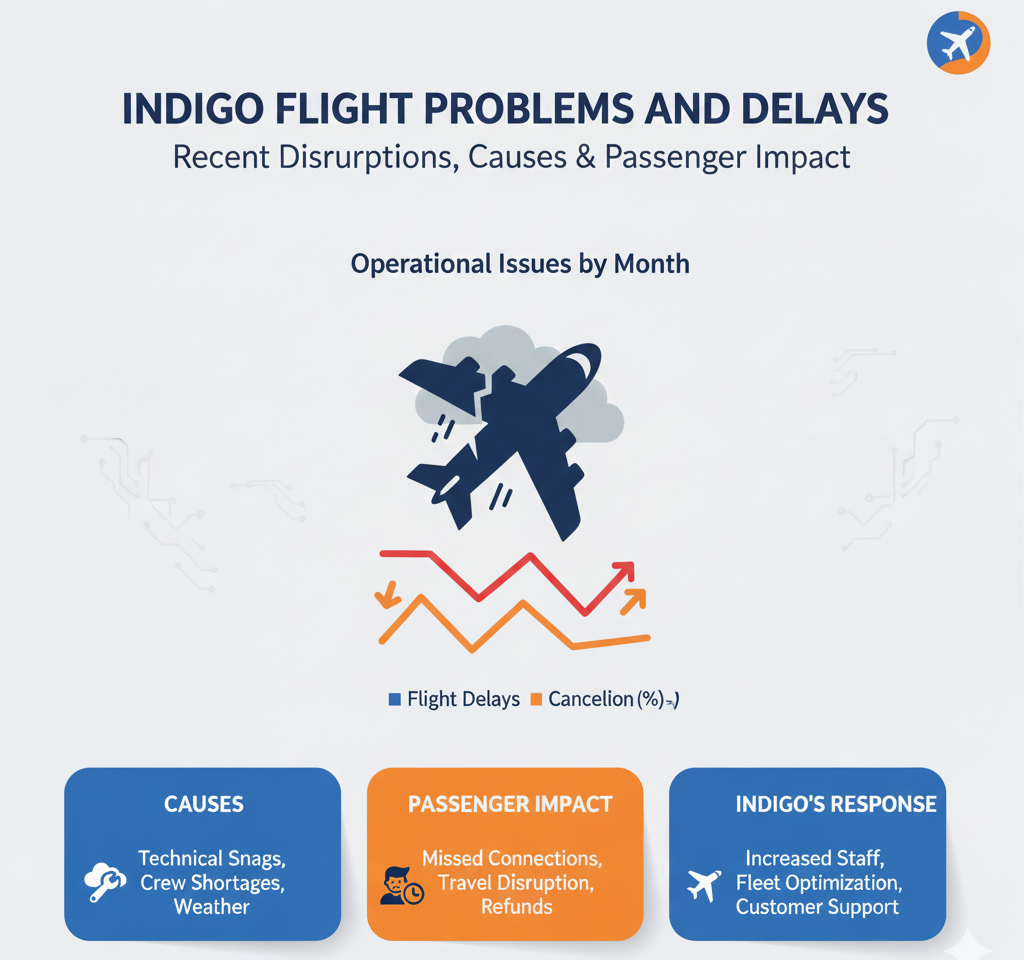
India’s aviation sector is facing unprecedented disruption as IndiGo, the country’s largest domestic airline, grapples with a perfect storm of operational challenges. In early December 2025, the carrier cancelled over 200 flights in a single day and saw its on-time performance plummet to just 35 percent—the worst among all major Indian airlines. For millions of passengers relying on IndiGo for domestic travel, the past week has been marked by frustration, long queues, and cancelled trips. Understanding what triggered this crisis is essential for both travelers and industry observers.
The Scale of the Disruption
The magnitude of IndiGo’s operational collapse has been staggering. On December 2 and 3, 2025, the airline cancelled at least 150 to over 200 flights nationwide, with particularly severe impacts at India’s four major aviation hubs: Delhi, Mumbai, Bengaluru, and Hyderabad. At Bengaluru’s Kempegowda International Airport alone, reports indicated 40 to 62 IndiGo cancellations in a single day, while Mumbai’s Chhatrapati Shivaji Maharaj International Airport recorded more than 30 cancellations with passengers facing waits of five to ten hours.
This disruption is especially significant given that IndiGo operates over 2,200 flights daily, commanding a dominant share of India’s domestic aviation capacity. When the country’s largest airline stumbles, the entire network feels the impact. The Directorate General of Civil Aviation (DGCA) reported that IndiGo’s on-time performance metrics collapsed from 84.1 percent in October to 67.7 percent in November, with the crisis intensifying further in early December.
Root Causes: A Convergence of Challenges
The current crisis stems from multiple interconnected factors rather than a single failure. The primary driver has been the implementation of new pilot fatigue rules that took effect progressively throughout 2025. These revised crew rostering regulations, introduced by India’s aviation regulator, increased mandatory weekly rest for pilots from 36 hours to 48 hours and limited night landings to just two per pilot instead of the previous six. While these changes were designed to improve flight safety and pilot well-being, they have created significant operational strain for airlines already managing tight crew schedules.
Compounding this challenge, a third-party IT outage struck on December 3, 2025, affecting airport check-in systems across multiple carriers. The outage forced airlines including IndiGo to revert to manual processing, creating bottlenecks and long queues at departure counters. At Bengaluru alone, this IT failure contributed to delays affecting around 58 flights in a single day. For an airline already stretched by crew constraints, even a short technology disruption cascaded through the entire day’s rotations, creating a domino effect of cancellations and delays.
IndiGo’s official statement acknowledged the multifaceted nature of the crisis, citing “technology glitches, schedule changes linked to the winter season, adverse weather conditions, increased congestion in the aviation system and the implementation of updated crew rostering rules.” The airline indicated it would implement “calibrated adjustments” to schedules over the following 48 hours to stabilize operations.
The Crew Shortage Dilemma
At the heart of IndiGo’s troubles lies a fundamental crew management challenge. The new fatigue rules, while well-intentioned from a safety perspective, have dramatically reduced the effective utilization of available pilots and cabin crew. By requiring longer rest periods and limiting night operations, the regulations have effectively reduced the number of flights each crew member can operate per week.
This issue has been building for months. In November alone, IndiGo cancelled 1,232 flights, with 755 of those cancellations directly attributed to crew and Flight Duty Time Limitation (FDTL) constraints. The airline appears to have been caught off-guard by the cumulative impact of these regulations, suggesting potential gaps in workforce planning and fleet management strategy.
The DGCA has been investigating the situation and has asked IndiGo to present detailed facts about the crisis along with mitigation plans. The regulator is working with the airline to reduce cancellations and delays, but the underlying issue—insufficient crew capacity under the new regulatory framework—requires structural solutions rather than quick fixes.
Passenger Impact and Growing Frustration
Behind the statistics are thousands of frustrated passengers whose travel plans have been upended. A passenger from Chennai, P Nataraj, was initially offered a rebooking on a flight departing nearly 24 hours later, forcing him to cancel his trip entirely. Another traveler, Ashish K Singh, took to social media to express his frustration after being stranded for 1-2 hours on a delayed flight from Mumbai to Ahmedabad, noting that “passengers deserve better” and highlighting the particular hardship faced by senior citizens and families.
The passenger backlash has been swift and vocal, with many social media users calling for boycotts and expressing skepticism about the airline’s ability to manage its operations. For a carrier that built its reputation on cost-efficiency and reliability, these operational failures represent a significant reputational risk.
Historical Context: A Pattern Emerging
The current crisis is not an isolated incident but rather the culmination of deteriorating performance. IndiGo’s on-time performance in November showed that crew-related issues accounted for 6 percent of delays, while air traffic control issues contributed 16 percent. The DGCA data reveals that operational and crew-related factors have become increasingly significant contributors to delays across the industry.
This pattern suggests that IndiGo’s challenges reflect broader structural issues in India’s aviation sector—particularly the balance between regulatory safety requirements and operational capacity. Other airlines may face similar pressures as they adapt to the new fatigue rules.
What Happens Next?
IndiGo has committed to stabilizing its schedule within 48 hours of the initial disruptions, though full normalization may take longer. The airline is offering alternate flights or refunds to affected passengers, though the rebooking options have proven limited given the scale of cancellations.
The DGCA’s investigation will likely examine whether IndiGo had adequate contingency planning for the new regulatory environment and whether the airline’s crew scheduling systems are sufficiently robust. Industry observers expect potential outcomes could include revised crew scheduling practices, possible recruitment of additional crew members, or adjustments to flight schedules to align with regulatory constraints.
For passengers, the immediate advice is to add significant buffer time when booking IndiGo flights over the coming weeks, maintain flexibility in travel plans, and consider alternative carriers where possible. The situation underscores the importance of travel insurance and the need to stay informed about airline operational status before heading to the airport.
Conclusion
IndiGo’s December 2025 crisis represents a critical moment for India’s aviation sector. While new pilot fatigue regulations serve important safety objectives, their implementation has exposed gaps in workforce planning and operational resilience. The convergence of regulatory changes, IT infrastructure vulnerabilities, and seasonal operational pressures created a perfect storm that overwhelmed the airline’s systems.
The resolution will require coordinated action: IndiGo must strengthen its crew management and contingency planning; the DGCA must work with airlines to find sustainable operational models under the new regulations; and airports must invest in more resilient IT infrastructure. For passengers, this episode serves as a reminder that even India’s largest and most established carriers can face significant disruptions, and flexibility and patience remain essential virtues in modern air travel.
References
- https://adept.travel/news/2025-12-03-indigo-delays-in-india-domestic-flights
- https://www.newindianexpress.com/nation/2025/Dec/03/indigo-cancels-over-200-flights-due-to-crew-shortage
- https://www.financialexpress.com/business/airlines-aviation/dont-fly-indigothey-loot-passengers-slam-carrier-after-over-130-flights-cancelled-airline-responds/4065048/
- https://www.dgca.gov.in
- https://www.newindianexpress.com/nation/2025/Nov/26/passengers-fume-as-indigo-flights-face-long-delays-airline-cites-operational-reasons
About the Author
InsightPulseHub Editorial Team creates research-driven content across finance, technology, digital policy, and emerging trends. Our articles focus on practical insights and simplified explanations to help readers make informed decisions.