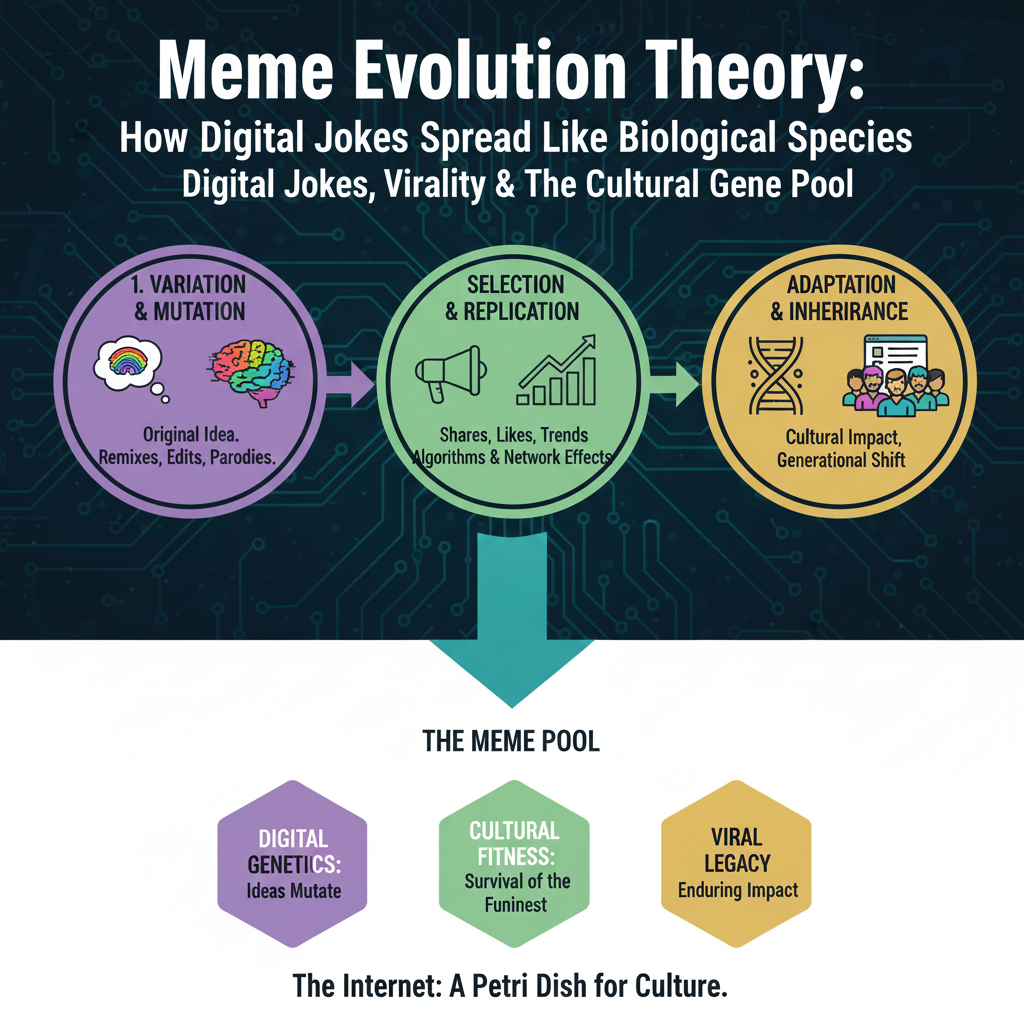
Internet jokes may feel disposable, but from the perspective of cultural evolution they look a lot like living things. They are born, mutate, compete, and either go extinct or colonize every corner of the web. Meme evolution theory tries to explain this strange life of ideas using the same tools biologists use to understand genes and species.
From Genes to Memes: The Evolutionary Analogy
The term meme was coined by evolutionary biologist Richard Dawkins in 1976 as a cultural analogue to the gene: a unit of information that spreads by imitation rather than inheritance of DNA. Songs, catchphrases, religious beliefs, and now reaction images and TikTok formats can all be treated as memes.[3]
Modern proponents of memetics argue that memes are subject to variation, selection, and inheritance, just like genes.[3] When you slightly rewrite a joke, remix an image, or add a new caption to an existing template, you are generating variation. Social media feeds, recommendation algorithms, and human attention act as selection environments that decide which variants survive and replicate.
Some cultural evolution researchers are cautious about how far the genetic analogy can be pushed, but a growing body of empirical work uses evolutionary tools—like fitness landscapes, phylogenies, and entropy—to study digital meme populations at scale.[1][4]
The Digital Petri Dish: Memes as Measurable Populations
What makes today’s internet uniquely valuable for meme evolution theory is that we can now track millions of memes, not just a handful of historical examples. A 2021 study in Scientific Reports analyzed about 2 million visual memes posted on Reddit between 2011 and 2020, grouping image macros into template “families” using deep learning and clustering methods.[1] Although the data cover an earlier decade, they remain one of the most comprehensive, high-resolution views of meme evolution we have.
The researchers found that:
- The overall “meme ecosystem” grew exponentially, with the number of new templates roughly doubling every six months during the period studied.[1]
- Memes with long lifespans typically showed rapid early adoption: a fast surge of reposts early on was a good predictor of persistence.[1]
- Over time, memes moved towards higher visual complexity: early templates tended to feature simple foreground images on plain backgrounds, whereas later ones often involved intricate, context-rich scenes such as edited movie stills.[1]
In evolutionary terms, this looks like an ever-expanding species radiation—new meme “species” constantly branching off, filling new niches, and becoming more specialized as competition intensifies.
Variation: How Memes Mutate and Recombine
In biology, random mutation and recombination generate the raw material for natural selection. In the meme ecosystem, variation comes from creative remixing, context shifts, and platform affordances.
Common types of meme mutation include:
- Caption mutations: same image template, new text (“Distracted Boyfriend” with politics one week, AI tools the next).
- Template crossover: combining two existing formats, like layering the “Drake Hotline Bling” preference structure onto another visual template.
- Contextual reassignment: moving a meme from gaming culture into finance Twitter or academic circles, where it takes on new in-jokes and meanings.
- Platform-driven changes: vertical video for TikTok, multi-image carousels on Instagram, or threaded memes on X, each nudging different structures of variation.
Because humans are intentional agents, meme variation is less random than genetic mutation. Creators often try to optimize a joke for funniness, relatability, or controversy. That has led some theorists of technological and cultural change to flirt with Lamarckian language—where “acquired” improvements are deliberately passed on—rather than purely Darwinian blind variation.[5] But once released into the wider network, a meme’s fate is largely out of any one individual’s control, and selection dynamics still dominate.
Selection: Attention as the New Natural Environment
Which digital jokes survive? Meme evolution theory highlights that success is not about truth or moral value, but about replication advantage—what some memeticists call being “good for the meme,” not necessarily good for us.[3]
Several selection pressures shape meme fitness today:
- Cognitive ease: Memes that are instantly recognizable and require little effort to decode spread faster. Familiar formats lower cognitive load: once you know how a template works, you can appreciate or produce new variants more quickly.
- Emotional impact: Content that triggers strong affect—laughter, outrage, awe—tends to get more engagement and therefore more algorithmic promotion. This parallels how certain biological traits spread because they reliably trigger responses in potential mates or rivals.
- Identity signaling: Many memes function as badges for group membership. Sharing a niche meme about a specific game, political subculture, or academic field signals in-group status. That makes highly specialized memes viable within subcommunities even if they are opaque to outsiders.[1][4]
- Platform algorithms: Feed-ranking systems on TikTok, Instagram, X, and Reddit create powerful artificial environments. They reward repeated engagement patterns (saves, shares, watch time), amplifying certain meme lineages while letting others die out quickly.
This multi-layered selection environment helps explain why objectively low-effort or scientifically misleading memes can thrive. For example, the ongoing popularity of “carcinization” memes—jokes claiming that “everything evolves into crabs”—plays on a grain of biological truth while misrepresenting evolutionary theory by implying a goal-directed process.[2] They spread not because they accurately teach evolution, but because they are funny, surprising, and easy to repurpose to new contexts.[2]
Inheritance and Lineages: Tracing Meme Family Trees
Biologists reconstruct phylogenetic trees to infer how species diverged from common ancestors. Internet researchers are beginning to do something similar with memes, using large-scale datasets and similarity metrics to identify meme “families.”[1]
In the Reddit study, template clusters behave like species, and each individual meme instance is like an organism.[1] By tracking:
- when a template first appears,
- how quickly instances accumulate, and
- how long the template continues to be used,
researchers can estimate something like a meme’s ecological niche and fitness over time.
They also examined memes in an entropy–complexity space, where:
- Entropy captures randomness or unpredictability in pixel patterns, and
- Statistical complexity captures structural richness.[1]
Over the 10-year window, subreddits tended to move toward higher complexity, suggesting that successful memes increasingly pack more information and contextual cues into a single frame.[1] This is analogous to biological lineages that evolve more intricate morphologies or behaviors as they adapt to specific environments.
Are Memes Like Viruses, Parasites, or Symbionts?
One influential strand of meme theory uses a virus-of-the-mind metaphor: ideas that hijack cognitive machinery to propagate themselves, sometimes at our expense.[4] When applied to modern platforms, this suggests that certain digital jokes, conspiracy narratives, or harmful stereotypes may spread because they are adapted to our cognitive biases, not because they benefit individuals or societies.
Philosopher Steve Stewart-Williams argues that most of the time what is good for memes is also good for us, or at least neutral: useful tools, accurate knowledge, effective norms all replicate well because they are genuinely advantageous.[3] But in a minority of cases—witch hunts in early modern Europe, or self-destructive online challenges today—the memetic perspective helps explain why harmful ideas can be locally stable and self-reinforcing, even if they damage their hosts.[3]
On the internet, we can see both patterns:
- Mutualistic memes such as educational explainers and pro-social campaigns (for example, public-health infographics) that spread because they are informative and shareable.
- Parasitic memes that exploit outrage, novelty, or tribalism to go viral without offering real value, and sometimes undermining trust or well-being.
Beyond Jokes: Memes, Tech, and Cultural Evolution
While popular usage equates memes with jokes, cultural evolutionists and technology scholars work with a broader notion. Some speak of “techno-memes”: design ideas, interface patterns, or engineering tricks that proliferate across tools and platforms.[5] For example, the “stories” format—ephemeral, vertical content—originated on one platform and rapidly replicated across many others, much like a successful adaptation spreading across related species.
This broader lens highlights that the same selectionist logic applies whether we are looking at cat images or user-interface conventions. In both cases:
- Variation comes from creative tinkering and recombination.
- Selection comes from user adoption, economic pressures, and platform policies.
- Inheritance occurs through copying, forking, and remixing across networks.
What Meme Evolution Theory Can (and Can’t) Explain
As meme talk has gone mainstream, some evolutionary biologists have pushed back against overextended analogies. The Harvard carcinization commentary, for instance, stresses that evolution is not a directed process striving toward crabs—or toward any endpoint at all.[2] Memes that imply everything “tends” toward one outcome turn a nuanced theory into a punchline.[2]
Responsible use of meme evolution theory means acknowledging both its power and its limits:
- It is powerful for describing patterns of spread, competition, and transformation in large-scale cultural data, especially where detailed logs of copying events exist (as on Reddit or TikTok).[1]
- It is limited when it ignores human agency, institutional structures, and material incentives that shape what gets created in the first place.[3][4]
For a fuller picture, researchers increasingly combine memetic-style models with psychology (attention, memory, emotion), sociology (network structure, norms), and platform studies (algorithm design, moderation).
Why Understanding Meme Evolution Matters
Digital jokes can feel trivial, but they are part of a broader internet metalanguage—a rapidly evolving symbolic system that people use to signal identity, negotiate politics, and react to real-world events.[1] Studying how these memes evolve helps us:
- Design healthier social platforms by recognizing which meme traits are amplified by algorithms and which might be suppressed.
- Anticipate the spread of harmful narratives and design counter-memes that are both accurate and competitively shareable.
- Appreciate the creativity and complexity of online cultures, rather than dismissing them as noise.
Like biological evolution, meme evolution has no long-term plan. But it is not random either. At any moment, millions of small creative acts are feeding into a vast selection system powered by attention and algorithms. Understanding that system turns internet humor from a blur of distraction into a living laboratory for cultural change.
References
- https://www.nature.com/articles/s41598-021-99468-6
- https://www.oeb.harvard.edu/news/2025/02/truth-about-carcinization-internet-memes-vs-evolution
- https://www.stevestewartwilliams.com/p/the-case-for-memetics
- https://www.taylorfrancis.com/chapters/edit/10.4324/b23047-25/meme-theory-justin-lane
- https://www.americanscientist.org/article/what-are-techno-memes-anyway
About the Author
InsightPulseHub Editorial Team creates research-driven content across finance, technology, digital policy, and emerging trends. Our articles focus on practical insights and simplified explanations to help readers make informed decisions.