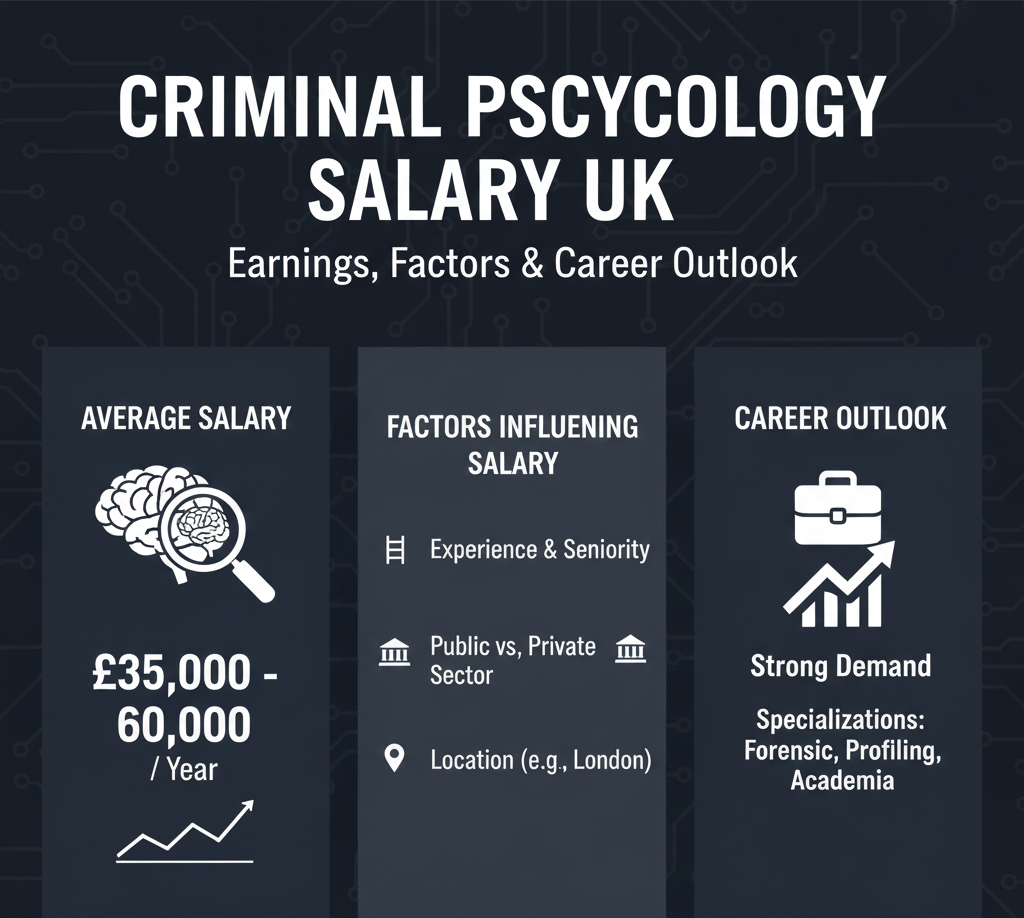
Criminal psychology – often used interchangeably with forensic psychology in the UK – sits at the intersection of mental health and the criminal justice system. It is intellectually demanding, emotionally challenging, and, for many, deeply rewarding. But how well does it pay in 2025, and what can you realistically expect at different stages of your career?
This article brings together the latest publicly available salary data and guidance to give a clear, evidence-based picture of criminal psychology salary in the UK, with a particular focus on forensic roles in the NHS, HM Prison and Probation Service (HMPPS), and related sectors.
Criminal vs Forensic Psychology: Why Salary Data Overlaps
In the UK, most roles that the public thinks of as “criminal psychologist” are formally advertised as forensic psychologist posts within the NHS, HMPPS, the Scottish Prison Service, or private providers.
For that reason, the most reliable and up-to-date salary data relates to forensic psychologists, which is the protected professional title regulated by the Health and Care Professions Council (HCPC). Criminal psychology as a specialism usually develops within this broader forensic framework.
Headline Salary Figures for 2025
Different sources use different samples (job adverts vs employee-reported pay), so it is useful to look at them together:
- Average forensic psychologist salary (UK-wide, all sectors): around £43,100 gross per year, based on recent job adverts and salary data aggregated by Jobted for 2025.[1]
- Average criminal psychologist salary (self-reported): PayScale data for 2025 indicates an average of about £33,800 per year for roles titled “Criminal Psychologist”.[2]
- Typical progression banding: guidance from recent career resources puts qualified criminal/forensic psychologists at roughly £40,000–£50,000, rising to £65,000–£90,000+ at consultant level, depending on sector and location.[3]
The variation largely reflects sector (NHS vs prison vs private), level of seniority, and region, with London and specialist consultancy roles paying at the upper end.
Salary by Career Stage
1. Assistant / Trainee Level
Early-career posts are typically advertised as Assistant Psychologist, Trainee Forensic Psychologist or research roles, often in prisons, secure units, or NHS forensic services.
- Recent UK career guidance suggests £22,000–£26,000 for trainee or assistant-level roles in criminal or forensic psychology.[3]
- Jobted’s analysis of trainee forensic psychologist roles shows starting salaries around £26,300 per year in 2025, based on current job adverts.[1]
At this stage, posts are often fixed-term and competitive, but they provide the supervised experience needed for full HCPC registration.
2. Newly Qualified / Early Career Forensic or Criminal Psychologist
Once you are HCPC-registered (usually following a BPS-accredited degree, further training, and supervised practice), you can apply for qualified forensic psychologist or equivalent roles.
- Career guidance for 2025 places qualified criminal or forensic psychologists in the band of roughly £40,000–£50,000 per year, depending on employer and region.[3]
- Jobted’s aggregate data shows an average forensic psychologist salary of about £43,100, with starting salaries for qualified practitioners around £34,900 and experienced roles reaching higher bands.[1]
This stage often involves working directly with offenders, conducting assessments, contributing to risk management plans, and supporting treatment and rehabilitation programmes.
3. Mid-Career and Senior Criminal/Forensic Psychologist
With several years’ experience, you can move into senior or lead practitioner roles, supervising teams and shaping interventions and policy.
- Recent career overviews suggest senior criminal psychologists commonly earn in the region of £50,000–£60,000.[3]
- Jobted’s breakdown indicates that experienced forensic psychologists (10–20 years) average around £56,700, with late-career professionals typically surpassing £60,000.[1]
These roles may involve service development, advanced risk assessments, complex case consultations, and multi-agency leadership.
4. Consultant and Highly Specialist Roles
At the top of the ladder are consultant, principal and lead psychologist roles, often managing services or regions, or working in specialised consultancy.
- Guidance for 2025 places consultant psychologist salaries in the range of £65,000–£90,000+ per year for those specialising in criminal or forensic work.[3]
- Some recent Scottish pay guidance, based on 2025 NHS Agenda for Change bands, shows consultant/lead psychologists on Band 8c earning in the region of the high £80,000s to low £90,000s.[5]
Consultant criminal psychologists may oversee multiple services, lead national programmes, act as expert witnesses, or run independent practices focused on assessment, training, and consultancy.
Public Sector Pay: NHS and Prison Service Bands
Most UK criminal/forensic psychologists are employed in the NHS or HM Prison and Probation Service (HMPPS), where pay follows structured national scales.
NHS Forensic Psychology Salaries
Recent NHS and career data show that forensic psychologists in England and Wales are broadly aligned with the Agenda for Change (AfC) pay system:[4]
- Trainee forensic psychologists (NHS): typically on Band 6, earning roughly £37,000–£45,000.[4]
- Qualified forensic psychologists: usually on Band 7, around £46,000–£53,000.[4]
- Senior / principal roles: progress through Bands 8a–8c, rising into the £60,000–£90,000 range depending on seniority and responsibilities.[4][5]
In Scotland, current NHS pay tables updated for 2025 show a similar but slightly higher range for some bands, with qualified psychologists at Band 7 earning in the £50,000–£59,000 region and senior bands exceeding £80,000.[5]
HM Prison and Probation Service (HMPPS)
Forensic psychologists employed directly by HMPPS also follow structured pay bands, which roughly mirror NHS levels.[4]
- Trainee forensic psychologists (HMPPS): start at around £33,000 per year on Band 5.[4]
- Registered psychologists (Band 7): start at about £47,900.[4]
- Senior, principal and lead psychologists (Bands 8–11): progress from the high £40,000s and £50,000s through to £70,000+, with national lead posts exceeding this.[4]
London weighting and specialist allowances can increase headline salary for roles in high-cost or high-security environments.
Private Sector and Consultancy Earnings
Beyond the public sector, some criminal and forensic psychologists work for:
- private healthcare providers and secure units
- independent consultancy (e.g., expert witness work, risk assessments, training)
- research, think-tanks, or specialist NGOs
Recent career resources and training providers suggest that the average salary for a criminal psychologist in the UK can be around £50,000 in these mixed sectors, with top-level consultants earning substantially more depending on case load and reputation.[8]
These figures are more variable than NHS or HMPPS bands because income can depend on contracts, billable hours, and business development, but they illustrate the upper earning potential for experienced specialists.
Factors That Influence Criminal Psychology Salaries
1. Experience and Seniority
Experience remains the single biggest driver of pay. Jobted’s 2025 analysis shows a clear climb from entry-level salaries in the mid-£30,000s to late-career averages above £60,000, with senior posts and consultancy exceeding this.[1]
2. Sector: NHS, Prison Service, Academia, or Private Practice
NHS and HMPPS pay is highly structured, which offers security and transparency but less flexibility for rapid pay increases. Private practice and consultancy, by contrast, can be more lucrative but less predictable, especially in the early years of self-employment.
3. Geography
Location has a consistent impact across all sources:
- Roles in London and the South East often include salary weighting to offset higher living costs, raising the effective salary.[4]
- Recent Scottish pay scales for psychologists are among the more competitive in the UK public sector, especially at senior levels.[5]
4. Specialisation and Additional Skills
Within criminal and forensic psychology, you can increase your value – and earning potential – by developing:
- expertise in complex risk assessment tools and structured professional judgement
- experience in highly secure or specialist services (e.g., personality disorder, sexual offending, terrorism-related work)
- skills in research, service evaluation, and programme development
- court-report and expert witness experience
PayScale and other salary aggregators note that moving employer, gaining further qualifications, or taking on managerial responsibility are common ways criminal psychologists boost their pay over time.[2]
How Criminal Psychology Pay Compares to Other Routes in Psychology
While this article focuses on criminal and forensic work, it can be useful to compare briefly with other applied psychology careers:
- Clinical psychology: typically follows similar NHS pay bands (6–8c) to forensic psychology, with broadly comparable earning potential for qualified and senior roles.
- Counselling and health psychology: again aligned with AfC bands where employed in the NHS, though there may be more variation in private practice income.
In other words, criminal and forensic psychology are competitive rather than unusually high-paying, with slightly above-average UK earnings at mid-career and strong potential at senior and consultant level.
Is a Career in Criminal Psychology Financially Worth It?
Financially, criminal psychology in the UK offers:
- Stable, structured pay in the public sector, with clear progression and benefits such as pensions and paid leave.
- Above-average earnings compared with the UK national salary once qualified and established.[1]
- High-end potential for those who reach consultant level or build strong private practices, with earnings that can exceed £80,000–£90,000 in some cases.[3][5][8]
However, it is also a long training pathway, typically requiring:
- a BPS-accredited psychology degree
- postgraduate training and supervised practice
- several years of assistant or trainee roles that are not highly paid
For many, the decision is less about maximising salary and more about combining solid, long-term financial security with work that has real impact on individuals, communities, and the criminal justice system.
Conclusion
The latest data from 2025 show that criminal psychology salaries in the UK are competitive, particularly after qualification and into mid-career. Most practitioners can expect to move from assistant roles in the low-to-mid £20,000s and £30,000s into qualified positions around £40,000–£50,000, with experienced and consultant-level psychologists reaching £65,000–£90,000+ depending on sector and location.[1][3][4][5][8]
If you are prepared for a demanding training journey and motivated by work at the interface of psychology and law, criminal psychology offers a solid financial foundation alongside the opportunity to contribute meaningfully to public safety and rehabilitation.
References
- https://uk.jobted.com/salary/forensic-psychology
- https://www.payscale.com/research/UK/Job=Criminal_Psychologist/Salary
- https://uniquemark.co.uk/comprehensive-guide-how-to-become-a-criminal-psychologist-uk/
- https://www.prospects.ac.uk/job-profiles/forensic-psychologist
- https://www.planitplus.net/JobProfiles/View/404/112
- https://icieducation.co.uk/blog/how-to-become-a-criminal-psychologist/
About the Author
InsightPulseHub Editorial Team creates research-driven content across finance, technology, digital policy, and emerging trends. Our articles focus on practical insights and simplified explanations to help readers make informed decisions.