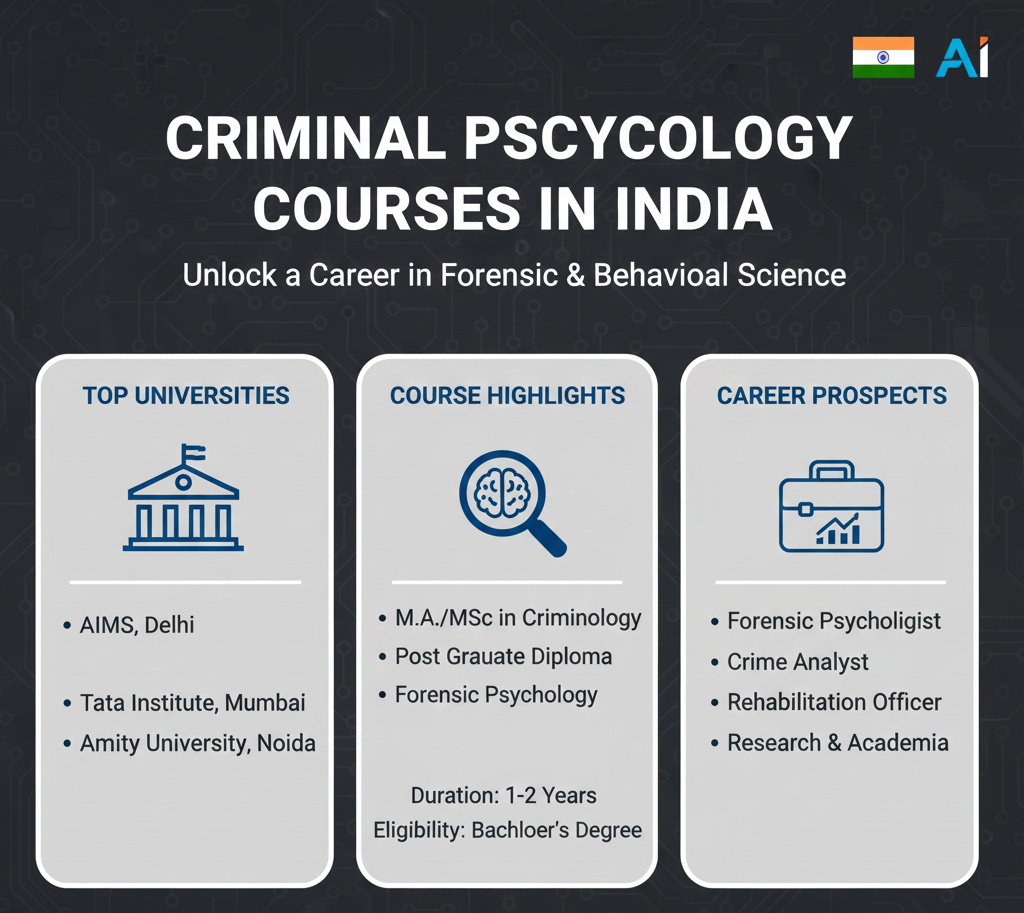
Interest in criminal psychology courses in India has grown sharply in recent years, driven by true-crime content, media coverage of complex cases, and an expanding criminal justice system that needs psychological expertise. In India, criminal psychology is typically offered under the broader umbrella of forensic psychology, investigative psychology, or criminology, through a mix of degree programs, diplomas, and short-term certifications.
What Is Criminal Psychology & How It Differs from Forensic Psychology
Criminal psychology focuses on understanding the thought processes, motives and behavioural patterns of offenders – why people commit crimes, how they choose victims, and how their background, personality, and environment interact. In India, most academic and professional offerings bundle this into forensic psychology, which more broadly covers the application of psychology to the legal and justice system – including assessments, courtroom testimony, victim psychology, and investigative work.[6]
Short-term and diploma-level courses often explicitly highlight topics such as:
- Nature vs nurture in criminal behaviour
- Serial offenders, psychopathy, and antisocial personality disorder
- Juvenile delinquency and young offenders
- False confessions and interrogation dynamics
- Eyewitness testimony and credibility assessments[3]
Types of Criminal / Forensic Psychology Courses in India
For Indian learners, the landscape broadly falls into four tiers:
1. Full-Fledged Postgraduate Degrees (M.Sc / M.A)
These are typically two-year programs that provide the most rigorous academic training in criminal and forensic psychology.
- M.Sc Forensic Psychology – National Forensic Sciences University (NFSU), Gandhinagar
NFSU, an Institution of National Importance under the Ministry of Home Affairs, offers a 2-year M.Sc in Forensic Psychology that trains students in investigative processes, psychological aspects of crime, and scientific methods in forensic psychology.[6] Graduates are prepared for roles in investigative agencies, correctional settings, courts and research. - M.Sc Psychology (Forensic) – SGT University, Gurugram
SGT University runs an M.Sc Psychology (Forensic) that bridges psychology and the legal system, with strong coverage of criminal behaviour, investigative psychology, forensic assessments and victimology.[2] The program builds skills in criminal profiling, risk assessment and expert testimony, positioning graduates for careers as forensic psychologists, profilers, consultants and rehabilitation counsellors.[2]
Some forensic science institutes and universities also integrate criminal psychology components within M.Sc Criminology or M.Sc Forensic Science programs, often with electives concentrated on offender behaviour and investigative psychology.[5]
2. Postgraduate Diplomas & Executive Programs
Postgraduate diplomas are popular among working professionals (lawyers, police officers, counsellors, social workers) who want specialised knowledge without committing to a full degree.
- PG Diploma in Investigative & Forensic Psychology – NMIMS (School of Liberal Arts)
NMIMS offers a Post Graduate Diploma aimed at providing academic and research-based knowledge of forensic practice, including investigative and forensic psychology. The program is tailored to those interested in applied work at the intersection of law, investigation and psychological assessment. - PG / Executive Diploma in Forensic Psychology – IGMPI
The Institute of Good Manufacturing Practices India (IGMPI) runs PG and Executive Diplomas in Forensic Psychology that cover criminal behaviour analysis, victimology, investigative psychology, and the role of psychologists across law enforcement, corrections and victim advocacy. The program is available in regular and online-live modes and includes structured study material, assignments and an online exam for certification.
3. Short-Term Online Certificates (Beginner to Advanced)
There is a fast-growing ecosystem of online criminal/forensic psychology courses in India aimed at students from Class 11–12 upwards, graduates from any stream, or working professionals exploring a career move.
- Online Forensic Psychology Course – SIFS India
SIFS India offers an online forensic psychology course (with current 2025 batches) that introduces the intersection of psychology and the legal system, criminal behaviour and profiling, witness credibility and assistance to law enforcement.[1] Participants learn to assess mental status in legal cases and conduct basic criminal profiling, with emphasis on legal and ethical aspects.[1] - Forensic Psychology Course – Cognizavest
Cognizavest runs a one-month online course with live classes, case studies, roleplays and assignments, open to learners from age 16 upward.[3] The curriculum includes foundations of forensic psychology, criminal behaviour, serial offenders, juvenile delinquency, psychopathy, false confessions, insanity defence, eyewitness reliability and psychological autopsy topics.[3] - Forensic Psychology & Criminal Profiling – IFS Education Departments
IFS offers multiple tiers of online certification in forensic psychology and criminal profiling – from short-term certificates (up to 2 months) to PG and expert-level certifications (up to 12 months), with fees that scale by depth and duration.[4] These programs focus on profiling, behavioural analysis and applied investigative work.
4. Forensic Science & Criminology Programs with Criminal Psychology Modules
Some institutions primarily branded as forensic-science colleges embed criminal psychology into broader curricula.
For instance, Lloyd Institute of Forensic Science highlights forensic psychology as a key area within forensic science programs, while listing national-level colleges such as Lok Nayak Jayaprakash Narayan National Institute of Criminology and Forensic Science (Delhi) and NFSU for related M.Sc Criminology and forensic science degrees that usually include modules on criminal behaviour and psychology.[5]
Eligibility, Duration & Typical Fees
Eligibility
- Master’s degrees (M.Sc / M.A): Usually require a bachelor’s degree in psychology or a closely related field (sometimes any graduation with psychology credits), with minimum aggregate marks as defined by each university.[2][6]
- PG Diplomas: Often open to graduates from psychology, social sciences, law, medicine, or related disciplines; some executive formats accept broader professional backgrounds.
- Short-term certificates: Many entry-level online certificates are open to any stream; some specify a minimum age (e.g., 16+) without requiring a psychology degree.[3]
Duration & Fees Snapshot
- Master’s programs: Typically 2 years, four semesters.[2][6] For example, SGT University’s M.Sc Psychology (Forensic) is structured as a 2-year program, with per-semester fees reported in the range of INR 75,000 (check latest prospectus for updates).[2]
- PG Diplomas: Commonly 1 year, sometimes offered in weekend or blended formats, with fees varying significantly by institution.
- Online certificates: Ranging from 1–6 months. IFS Education’s forensic psychology and criminal profiling certifications start with short-term options around a couple of months and scale up to 12-month advanced formats, with fee slabs from around INR 5,000 upwards depending on level.[4]
Because fees and structures can change frequently, aspirants should always consult the latest information on official university or provider websites such as NFSU, SGT University, NMIMS, SIFS India, Cognizavest, or IFS before applying.
Core Skills You Gain from Criminal Psychology Courses
Across institutions and formats, high-quality criminal and forensic psychology courses in India aim to build both conceptual and applied skills, including:
- Understanding of criminal behaviour: Theories of crime, personality, mental disorders associated with offending, and social-contextual factors.
- Investigative and profiling skills: Behavioural analysis, criminal profiling, linkage analysis, and risk assessment for reoffending.[2][4]
- Assessment and report writing: Using psychological tools and interviews to assess suspects, victims and witnesses, and preparing reports suitable for courts or investigative agencies.[1][6]
- Legal and ethical literacy: Knowledge of Indian legal frameworks, admissibility of psychological evidence, confidentiality, informed consent and professional ethics.[1]
- Research skills: Designing and interpreting research related to crime, victimisation and justice processes – a key focus in university-level programs.[6]
Career Paths After a Criminal Psychology Course in India
Because criminal psychology is still a specialised and emerging field in India, most professionals build multi-disciplinary careers that combine psychology, criminology, and forensic science. Graduates from M.Sc Forensic Psychology or specialised diplomas may explore roles such as:
- Forensic psychologist or criminal behaviour analyst in investigative or correctional settings[2][6]
- Consultant to law enforcement agencies for offender profiling, interrogation strategies, and risk assessment[2][4]
- Expert witness or court consultant on mental state, competency, or credibility issues[1][6]
- Victim support and rehabilitation professional, including in NGOs and government schemes[3]
- Academic or researcher in criminology, forensic psychology, or related behavioural sciences[6]
- Roles in policy think-tanks, criminal justice reform projects, and crime data analysis
Entry-level short courses alone usually do not qualify someone to work independently as a forensic psychologist, but they can be a strong stepping stone for students to decide whether to pursue a full degree or for professionals (e.g., lawyers, police, journalists) to integrate psychological insights into their existing work.
How to Choose the Right Criminal Psychology Course in India
Given the expanding range of options, a few practical criteria can help you choose wisely:
- Accreditation & recognition: Prefer universities recognised by UGC or institutions of national importance (e.g., NFSU) and established universities like SGT or NMIMS for degree-level studies.[2][6]
- Curriculum depth: Review whether the syllabus includes both offender and victim psychology, investigative work, assessment tools, research methods, and Indian legal context.
- Faculty & industry linkages: Check if instructors have field experience in forensic practice, court work, or criminal investigations, and whether the program facilitates internships, case discussions or lab exposure.
- Mode of delivery: Decide between on-campus, hybrid or fully online based on your location and schedule. Short-term online certificates (like SIFS India or Cognizavest) are good for exploration, while master’s programs are better for long-term careers.[1][3]
- Career support: Look for institutions that explicitly mention placement assistance, networking opportunities with forensic experts, or links with investigating agencies.[1][2][5]
Future Outlook: Why Now Is a Good Time to Enter the Field
India’s law enforcement and justice systems are increasingly integrating scientific and psychological inputs into investigations and trials. The expansion of forensic science universities, the establishment of NFSU as an institution of national importance, and the proliferation of specialised diplomas and online programs all signal sustained demand for trained professionals at the intersection of psychology, law, and criminology.[5][6]
For students fascinated by the “why” behind crime – and for professionals in law, policing, media or social services seeking deeper behavioural insight – a well-chosen criminal psychology or forensic psychology course in India can open up meaningful and impactful career directions.
Conclusion
Criminal psychology in India is no longer a fringe interest; it is evolving into a structured academic and professional pathway. From intensive M.Sc programs at institutions like NFSU and SGT University to focused PG diplomas at NMIMS and IGMPI, and flexible online certificates from SIFS India, Cognizavest and IFS, learners have multiple entry points depending on their background and goals. By prioritising accredited institutions, robust curricula and clear career outcomes, aspiring professionals can position themselves at the forefront of a niche that sits at the heart of modern criminal justice.
References
- https://www.sifs.in/course-details/online-course-forensics-psychology
- https://sgtuniversity.ac.in/bhs/programmes/msc-in-psychology-forensic
- https://cognizavest.com/forensic-psychology-course/
- https://www.ifsedu.in/forensic-psychology-and-criminal-profiling/
- https://lifs.co.in/blog/forensic-psychology-courses.html
- https://nfsu.ac.in/Programs/programinfo/55?deptid=58
About the Author
InsightPulseHub Editorial Team creates research-driven content across finance, technology, digital policy, and emerging trends. Our articles focus on practical insights and simplified explanations to help readers make informed decisions.