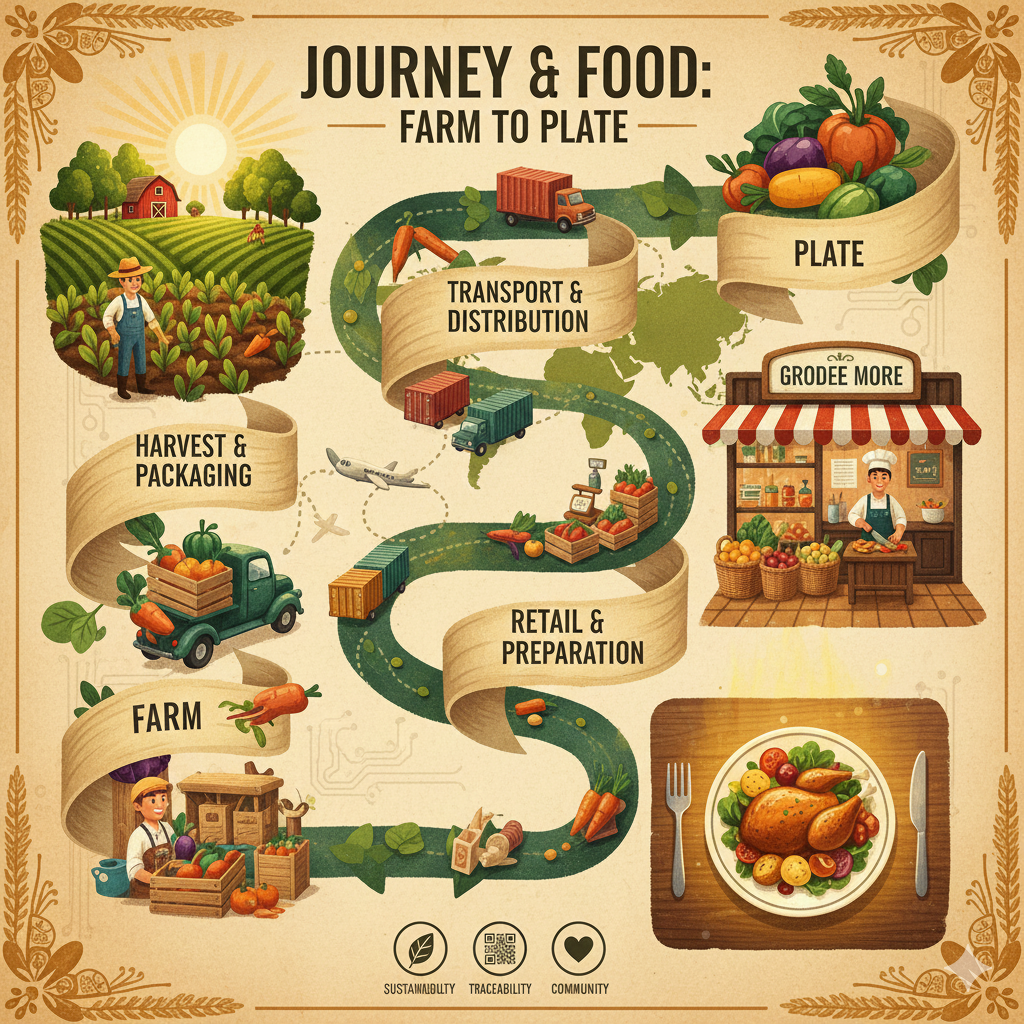
Every meal has a story. In 2025, that story spans farms, factories, cold-storage warehouses, ports, retailers, delivery apps and, increasingly, digital platforms that track food in real time. Understanding this journey from farm to plate helps explain why prices are rising, why some products disappear from shelves, and why sustainability and transparency have become central to how we eat.
1. The Starting Point: Farms in a Warming, Volatile World
The journey begins on farms, ranches, orchards and fisheries that are under growing pressure from climate change, shifting trade policies and rising input costs. Persistent inflation and tariffs on key materials and inputs now shape everything from fertilizer costs to the price of steel for food cans.[5]
On the demand side, the global food and beverage market is enormous. Recent industry analysis estimates the food and beverage sector at around $8.7 trillion in 2025, with strong growth projected toward the next decade.[1] This scale amplifies every disruption: drought in one region, conflict in another, or a spike in energy prices can ripple across the world and into your grocery basket.
At the same time, global hunger is worsening. Between 2020 and early 2025, the number of people facing acute food insecurity has risen sharply to around 343 million, driven by conflict, economic shocks and climate impacts.[2] This contrast—abundant global production alongside growing food insecurity—frames many of the debates around how our food system should work.
2. Processing and Packaging: Adding Value, Adding Complexity
Once harvested, most food does not go straight to the supermarket. It is sorted, cleaned, milled, slaughtered, pasteurized, canned, frozen or otherwise processed. Each step adds value but also introduces complexity and cost.
Packaging is a good example. Food manufacturers are facing higher costs partly because of tariffs on materials such as imported steel, which can push up the cost of canned food by as much as tens of cents per can when metal prices spike.[5] These seemingly small increases compound across billions of units and ultimately influence retail prices.
Processing is also where many sustainability decisions are made: whether to use recyclable packaging, how to design products for longer shelf life, and how to reduce energy use in factories. Companies are increasingly turning to analytics, automation and AI-driven planning tools to squeeze out inefficiencies and emissions from these middle stages of the food chain.[5][6]
3. Cold Chains, Warehouses and Transport: The Logistics Backbone
Between the factory and the store (or your front door) lies a dense logistics network of refrigerated trucks, storage depots, ports and distribution centers. This is where the concept of the cold chain becomes critical. Maintaining the right temperature prevents spoilage, protects food safety and reduces waste.
Recent assessments of the dedicated food supply chain market—covering storage, transport and related services—value it at roughly hundreds of billions of dollars in 2025, with strong growth driven by investments in cold chain infrastructure, traceability and AI-powered logistics.[1] This segment is expanding faster than the overall food market as companies race to modernize how they move perishable products.
Yet challenges remain. The food and beverage industry continues to face supply chain disruptions from shipping delays, ingredient shortages and climate-related shocks, while inflation and tariffs keep cost pressures high. Many distributors report that supply chain losses have risen over the past two years thanks to delayed shipments, quality issues and poor coordination across partners.[1]
4. Retail Shelves and Restaurant Kitchens: Where Consumers Feel the Impact
The most visible part of the journey is where we encounter food: in supermarkets, convenience stores, restaurants and through e‑commerce and delivery apps. This is also where many of the hidden costs of earlier stages show up as higher prices and shrinking promotions.
In the United States, the Department of Agriculture’s Economic Research Service forecasts that overall food prices in 2025 will rise by about 3.0%, slightly faster than the 20‑year historical average.[4] Prices for food eaten at home (groceries) are expected to rise by 2.4%, while food-away-from-home—restaurants, cafés and take‑aways—is projected to increase by about 3.9%.[4] These differences reflect higher labor, rent and service costs in the hospitality sector compared with retail grocery.
Specific categories can move much more sharply. Egg prices, for example, are forecast to increase by around 25% in 2025 on average, due in part to earlier spikes and disease-related disruptions in production.[4] By contrast, prices for fresh vegetables are expected to stay roughly flat this year.[4] These shifts help explain why some items feel suddenly expensive while others seem relatively stable.
5. Digital Transformation: Traceability, Data and Transparency
One of the biggest changes in the farm-to-plate journey is not physical but digital. Food companies are investing in technologies that provide end‑to‑end traceability—the ability to track ingredients and finished products through every step of the chain.
New regulations, such as FSMA 204 food traceability rules in the United States, are pushing distributors and retailers to capture and share more detailed data about where food came from and how it moved.[3] Large distributors are integrating their supplier networks with digital platforms so that shipment events, lot numbers and product attributes are captured automatically, helping them respond faster to recalls and improve inventory management.[3]
Digital transformation goes beyond compliance. Cloud-based ERP systems, predictive analytics and AI tools are being deployed to forecast demand, optimize routes, automate warehouse operations and even support autonomous delivery pilots.[5][6] Retailers and brands are also experimenting with technologies like RFID and IoT sensors to gain real-time visibility into stock levels and product freshness, which can cut waste and ensure shelves are stocked with the right products at the right time.
6. Food Waste: The Invisible Leg of the Journey
Not all food that starts the journey makes it to a plate. Globally, the Food and Agriculture Organization has long estimated that around one‑third of food produced for human consumption is lost or wasted each year, equivalent to about 1.3 billion tonnes.[1] While that figure is a longer‑term benchmark rather than a 2025‑specific update, more recent supply chain analyses reinforce that waste remains stubbornly high, with losses occurring at every stage from harvest to retail.
In 2025, companies are focusing on several waste-reduction strategies:
- Better demand forecasting using predictive analytics to reduce over‑ordering and over‑production.[1][5]
- Improved cold chain management to prevent temperature-related spoilage during transport and storage.[1][5]
- Enhanced inventory visibility through RFID and tracking systems, so retailers know exactly what is on shelves and when it expires.
- Reformulating packaging to extend shelf life without compromising sustainability goals.[5]
Reducing waste is essential not only to lower costs and emissions but also to help close the gap between abundant production and growing food insecurity.
7. The Last Mile: Home Kitchens, Choices and Behaviors
The journey ends—not at the supermarket, but in the home kitchen and restaurant dining room. Here, individual choices have significant aggregate effects.
Consumers are asking more questions about where food comes from, whether it is produced ethically, and what its carbon footprint might be. In response, brands highlight local sourcing, regenerative agriculture, and fair-labor certifications. Digital labels, QR codes and apps are emerging that let shoppers scan a product and see supply chain details, from farm origin to shipping route.[3]
At the same time, household-level waste remains a major piece of the puzzle. Meal planning, understanding date labels, and using leftovers creatively are small, practical steps that reduce demand-side waste and make better use of the vast infrastructure that moves food from fields to forks.
8. Looking Ahead: Building a More Resilient Farm-to-Plate Journey
In 2025, the journey of food from farm to plate is both more fragile and more technologically advanced than ever. Climate pressures, geopolitical tensions, tariffs and inflation continue to test the resilience of global food supply chains.[5][6] At the same time, rapid advances in data analytics, traceability systems and automation are giving producers, distributors and retailers new tools to manage risk and cut waste.[1][3]
For consumers, understanding this journey helps explain why prices behave the way they do and why issues like transparency, sustainability and digital traceability are no longer niche concerns. Every purchase is a vote for the kind of supply chain we want—one that can reliably deliver safe, affordable food while reducing its environmental footprint and ensuring that more of what is grown actually nourishes people, not landfills.
References
- https://www.anchorgroup.tech/blog/food-beverage-supply-chain-statistics
- https://procurementtactics.com/supply-chain-statistics/
- https://www.spscommerce.com/blog/4-key-trends-reshaping-the-food-supply-chain/
- http://www.ers.usda.gov/data-products/food-price-outlook/summary-findings
- https://lacerta.com/blog/food-supply-chain
- https://clarkstonconsulting.com/insights/2025-consumer-products-supply-chain-trends/
About the Author
InsightPulseHub Editorial Team creates research-driven content across finance, technology, digital policy, and emerging trends. Our articles focus on practical insights and simplified explanations to help readers make informed decisions.