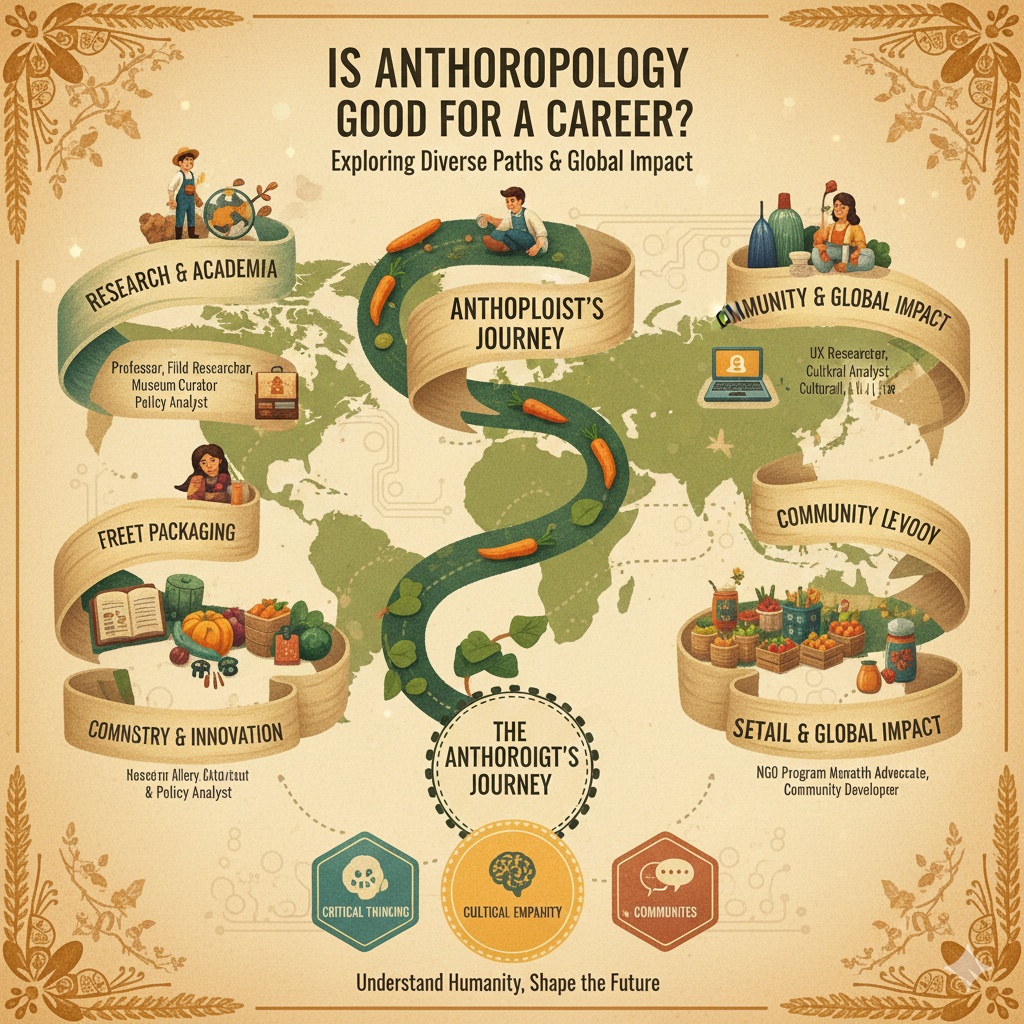
Is Anthropology a Good Career Choice in 2025?
Anthropology has a persistent reputation as fascinating but “impractical”—great if you love people and cultures, less great if you want a stable, well-paid job. Recent data from 2024–2025 complicates that picture: the job market is more diverse than many assume, salaries are competitive in several subfields, but some paths (especially academia) are highly competitive and slow-growing.[1][2][3]
If you are considering anthropology as a major or career, the key question is not simply, “Is anthropology good for a career?” but rather, “Under what conditions is anthropology a strong career choice—and for whom?”
What Does an Anthropology Career Really Look Like?
Anthropology is the study of humans across time and space—our cultures, biology, languages, and material remains. In practice, this translates into multiple career tracks:
- Cultural and social anthropology: work in UX research, market research, design, international development, NGOs, public policy, community organizations, HR, and consulting.[1][2][5]
- Archaeology: roles in cultural resource management (CRM), heritage management, museums, government agencies, and environmental or engineering firms.[1][2][4]
- Biological and forensic anthropology: positions in forensic labs, medical examiner offices, public health, research institutes, and some government agencies.[1][3]
- Applied and business anthropology: jobs in product design, organizational development, user experience, and strategic research for private companies.[2][5]
Critically, many anthropology graduates work in roles where their job title is not “anthropologist” at all—such as UX researcher, policy analyst, program manager, or product researcher.[1][2][4]
Job Outlook: Is There Demand for Anthropologists?
Recent U.S. data paints a cautiously positive picture, with important caveats:
- The U.S. Bureau of Labor Statistics (BLS) projects employment for anthropologists and archaeologists to grow by about 4–8% between 2023 and 2033, depending on the source and specific subfield—ranging from “as fast as average” to “faster than average” compared with all occupations.[1][2][3][4][5]
- A June 2025 analysis of BLS data found around 8,070 anthropologists and archaeologists employed in the U.S. in May 2024.[3]
- Growth in some specializations is stronger, particularly cultural resource management (CRM)11,000 new full-time CRM jobs in the next decade.[2]
On the other hand, the academic job market is tight. An article in Anthropology News notes that only about 21% of anthropology PhDs secure tenure-track positions, and that fewer than 8% of all anthropology graduates end up in academic jobs.[6] This makes academia one of the least reliable long-term targets if job security is your top priority.
Salaries: Can You Make a Good Living in Anthropology?
Recent salary data is more encouraging than many stereotypes suggest, though outcomes vary by sector and education level.
- Using May 2024 BLS data, a 2025 forensic-anthropology career report found that anthropologists and archaeologists earned an average annual wage of about $71,070, with a median (50th percentile) of about $64,910 in the U.S.[1][3][4]
- Percentile breakdowns indicate substantial upside at the high end: the top 10% of anthropologists earn above $100,000 annually.[3]
- Wayne State University, summarizing BLS data, reports a mean salary around $63,800 for professional anthropologists overall.[2]
- Some applied niches are particularly well-paid: the same Wayne State summary cites an average salary around $94,000 in U.S. cultural resource management.[2]
Systematic breakdowns by sector are limited, but patterns from universities and professional associations consistently show that:
- Government, consulting, and CRM roles tend to pay above the overall median.[2][3][4]
- Entry-level NGO, community, or non-profit roles may start lower but can still lead to mid-career salaries in the $60,000–$80,000 range, especially when combined with management or policy skills.[1][2]
- Academic positions vary widely; tenure-track roles can be competitive salary-wise, but adjunct or temporary roles are often poorly paid relative to the education required.[6]
Key Skills That Make Anthropologists Employable
Why are employers outside academia increasingly interested in anthropology graduates? Several recent university career pages and employer surveys highlight that anthropology trains precisely the “human-centered” capabilities modern organizations struggle to find.[1][2][4][5]
Commonly cited transferable skills include:
- Qualitative and mixed-methods research: interviews, observation, fieldwork, and data synthesis applied to customers, communities, or employees.
- Critical thinking and problem framing: the ability to ask the right questions and challenge assumptions—a trait highly valued by employers.[5]
- Cultural competence: working effectively across cultures, communities, and stakeholder groups—central to global businesses and public agencies.[1][2][5]
- Communication skills: writing clear reports, presenting insights, and translating complexity for non-expert audiences.[1][4]
- Ethical and systemic thinking: understanding how policies, technologies, and markets affect real people on the ground.
Brigham Young University notes that the job market for anthropology majors is currently “strong,” and that BLS expects “faster than average” growth from 2023–33. They also cite employer surveys indicating that critical thinking, clear communication, and problem solving matter more than specific majors for many hiring managers.[5] That lines up with broader national employer surveys showing that humanities and social science graduates can perform well when they can demonstrate their skills concretely.
Where Anthropology Graduates Are Actually Working
Recent career-outlook pages and alumni surveys point to a wide spread of real-world roles for anthropology graduates:[1][2][4]
- Government and public sector: city planning, public health, historic preservation, environmental review, heritage and tourism, national parks, and tribal/Indigenous affairs.[1][2][4]
- Healthcare and public health: community health worker, program coordinator, qualitative researcher, medical anthropology roles in hospitals or NGOs.[2][4]
- Business and technology: UX researcher, product research and design, organizational development, market research, customer insights, and service design.[1][2][4][5]
- Museums and cultural institutions: curation support, education, outreach, and collections management.
- Forensics and legal contexts: forensic anthropology roles in medical examiner offices, coroners, and disaster victim identification teams (typically with graduate training).[1][3]
Career listings from universities such as Wayne State and California State University Stanislaus include alumni working in transportation management, economic development, industrial design, automotive product research, and state agencies—illustrating how anthropology can be a foundation for surprisingly varied paths.[2][4]
When Is Anthropology a Strong Career Bet?
Based on current data, anthropology can be a very good career choice under several conditions:
1. You are open to non-academic careers
The clearest success stories come from graduates who pivot into applied roles—UX research, CRM, public policy, evaluation, development, or corporate research.[1][2][3][5] If your plan is “professor or nothing,” you are choosing one of the most competitive corners of an already small job market.[6]
2. You actively build complementary skills
Anthropology alone is rarely a “plug-and-play” professional credential. Students who combine it with:
- Data skills (statistics, GIS, coding, survey design),
- Design or UX training,
- Policy, public health, or environmental courses, or
- Business and management skills,
tend to have noticeably stronger job prospects.[2][4][5] Many successful anthropologists work at the intersection of qualitative insight and another applied domain.
3. You are willing to pursue graduate study in targeted niches
Fields like forensic anthropology or specialized research roles usually require at least a master’s, often a PhD.[3][6] In contrast, applied corporate and NGO roles may be accessible with a bachelor’s if you can show strong project work, internships, or portfolios (especially in UX and design research).[1][2][5]
4. You are comfortable with ambiguity and exploration
Anthropology rarely offers a single predefined pathway (unlike nursing or accounting). Students who do best tend to treat the degree as a platform and intentionally experiment with internships, field schools, lab work, and volunteer projects to build a coherent story about what they can do.
Risks and Trade-offs to Consider
To stay realistic, you should weigh several risks:
- Small core labor market: The total number of formally titled anthropologist roles is modest compared with fields like engineering or business.[3][6]
- Academic bottlenecks: Tenure-track positions are limited, and adjunct work is often poorly compensated relative to required education.[6]
- Geographic constraints: Fieldwork-heavy roles (e.g., CRM, archaeology, some government jobs) may require relocation or extensive travel.[2][3][4]
- Need for proactive career planning: Anthropology majors who do not build complementary skills or networks may face a harder early-career job search.
None of these are deal-breakers, but they do mean anthropology is best for students ready to plan actively, not passively hope the major will “speak for itself.”
Practical Tips If You Are Considering Anthropology
- Clarify your long-term interests early: Are you more excited by public health, tech and UX, heritage, environmental issues, or forensic work? Use that to shape electives and internships.
- Use your methods courses to build a portfolio: Collect examples of real research you have done—interviews, observations, survey analysis—that you can show to employers.
- Seek out applied experiences: Field schools, museum work, local NGOs, public-health departments, or usability labs all translate well into the job market.[1][2][4]
- Learn to translate your skills: Practice turning phrases like “ethnographic methods” into employer language such as “in-depth customer research” or “field-based user insights.”
Conclusion: Is Anthropology Good for a Career?
Anthropology in 2025 is neither a guaranteed ticket to precarious underemployment nor a simple path to high-paying work. The evidence suggests it can be an excellent career foundation—if you are willing to pursue applied roles outside academia, strategically build complementary skills, and actively craft a professional narrative around your expertise.
If you are passionate about understanding people, cultures, and systems, and you are prepared to pair that passion with practical experiences in fields like UX, public health, policy, or cultural resource management, anthropology can be not just intellectually rewarding but professionally viable.
References
- https://www.southalabama.edu/colleges/artsandsci/syansw/anthropology/careers_in_anthro.html
- https://clas.wayne.edu/anthropology/programs/career-outlook
- https://www.forensicscolleges.com/careers/forensic-anthropologist
- https://www.csustan.edu/anthro/careers-anthropology
- https://anthropology.byu.edu/why-anthropology
- https://www.anthropology-news.org/articles/an-anthropology-winter-or-strategic-renewal/
About the Author
InsightPulseHub Editorial Team creates research-driven content across finance, technology, digital policy, and emerging trends. Our articles focus on practical insights and simplified explanations to help readers make informed decisions.