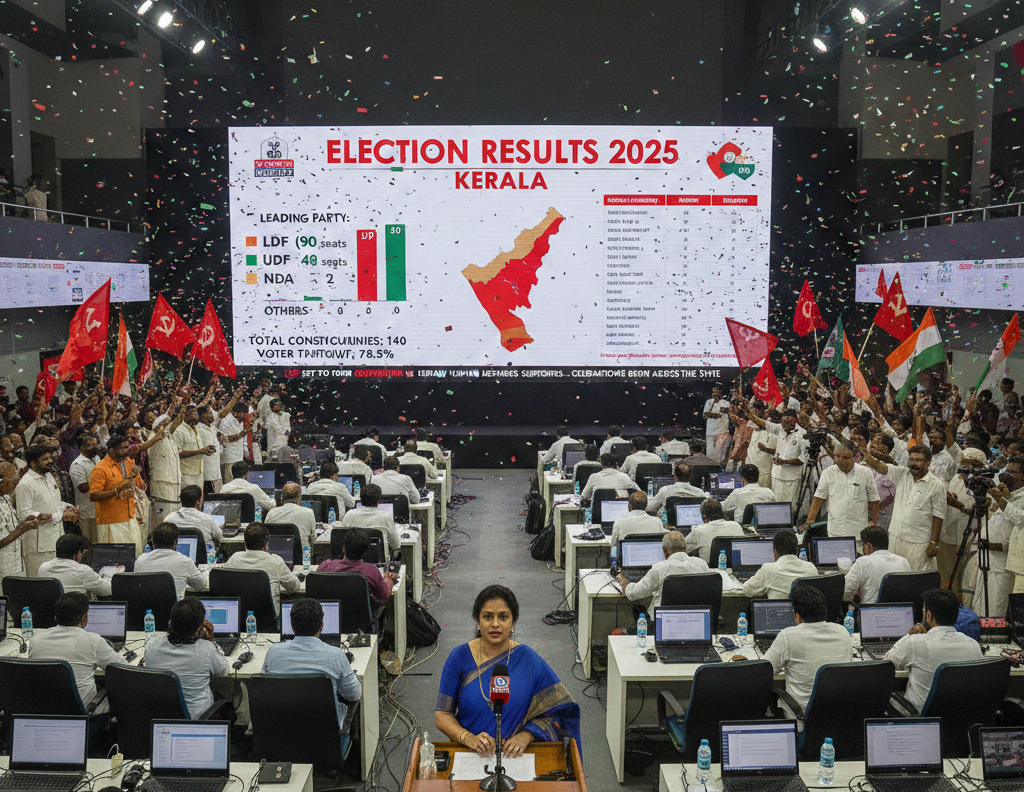
The 2025 Kerala local body election results have reshaped the state’s political conversation. The Congress-led United Democratic Front (UDF) has emerged as the primary winner across most tiers of local governance, the Left Democratic Front (LDF) has suffered major reverses, and the BJP-led National Democratic Alliance (NDA) has scripted a historic breakthrough in the state capital, Thiruvananthapuram.[1][3][5]
These polls, held midway through the current state government’s term, are widely viewed as a bellwether for the 2026 Kerala assembly elections. In this article, we break down the numbers, examine regional patterns, and explore what these results could mean for the state’s political future.
1. The Big Picture: UDF Surges, LDF Retreats, NDA Breaks Through
According to figures compiled from the State Election Commission trends and major news outlets, the UDF achieved a clear edge in the 2025 civic polls.[1][3][5] While final granular ward-wise data continues to be tabulated on the official portal of the State Election Commission, Kerala, media reports point to three headline developments:
- UDF dominance in local bodies: The UDF secured a majority of Gram Panchayats, Block Panchayats, District Panchayats, municipalities and corporations, displacing the LDF from several of its strongholds.[1][3][5]
- LDF’s significant losses: The ruling CPI(M)-led LDF lost control of numerous local bodies it had won in the previous cycle, reflecting voter dissatisfaction across multiple regions.[1][3][6]
- NDA’s historic capital win: The BJP-led NDA captured the Thiruvananthapuram Corporation, ending nearly five decades of uninterrupted Left control and marking a turning point in Kerala’s traditionally bipolar politics.[2][4][5][8]
In essence, voters appear to have sent a dual message: consolidation of anti-incumbency sentiment behind the UDF, and a new space for the BJP in select urban pockets.
2. Corporation and Municipality Results: Urban Kerala in Flux
2.1 Corporations: UDF Leads, NDA Takes the Capital
Kerala has six municipal corporations. News reports indicate that:
- The UDF won control of four corporations, including key cities such as Kochi, Thrissur and Kannur, reclaiming spaces it had lost in 2020.[1][3]
- The LDF was reduced to just one corporation stronghold, widely reported as Kozhikode, underlining the scale of its urban retreat.[1]
- The NDA scored its biggest-ever victory in the state by winning the Thiruvananthapuram Corporation, emerging as the single-largest force in the 101-member council with 50 wards, while the LDF fell to 29 and the UDF to 19 (two independents also won).[1][2][5]
This outcome is particularly significant because the capital had been under uninterrupted Left control for around 45 years, making the NDA’s win a symbolic and strategic milestone.[5] National leaders like Shashi Tharoor publicly acknowledged that the BJP’s performance signalled a “notable shift” in the city’s political mood.[8]
2.2 Municipalities: UDF’s Sweep and NDA’s Strategic Pockets
At the municipality level, the UDF extended its dominance:
- Reports indicate the UDF won a majority of municipalities, capturing control in urban and semi-urban regions such as Ernakulam, Alappuzha, Malappuram, Kottayam, Wayanad and parts of Palakkad.[1][3]
- The LDF retained influence in some municipalities in Thiruvananthapuram, Kollam, Kozhikode and Kannur, but with significantly eroded margins.[1][3]
- The NDA registered notable municipal gains, especially by retaining Palakkad municipality and winning the strategically important Tripunithura municipality in Ernakulam district by a narrow margin (21 seats to the LDF’s 20).[1][4]
The municipal verdict paints a picture of an electorate that is willing to experiment with alternatives in urban governance, especially where local issues like waste management, urban infrastructure, and service delivery have become pressing.
3. Panchayats and Rural Trends: UDF’s Broad-Based Advantage
Beyond the cities, the 2025 results show a broad-based shift in rural Kerala as well. By late counting hours, media tallies cited State Election Commission trends indicating that:[5]
- The UDF led or won a majority of the state’s 941 Gram Panchayats and had an edge in Block and District Panchayats, including a lead in seven of the fourteen districts.[3][5]
- The LDF was ahead in the remaining seven districts but with a substantially reduced presence in many local bodies compared with the earlier cycle.[3]
This rural performance matters because panchayat representatives are often the first point of contact between the state and citizens on welfare schemes, housing, healthcare outreach and agriculture-related interventions. A strong UDF presence at this level gives the opposition significant organisational leverage ahead of 2026.
4. Why the NDA’s Thiruvananthapuram Win Matters
The single most discussed outcome of the 2025 Kerala local body elections is the NDA’s victory in the Thiruvananthapuram Corporation.[2][4][5] Beyond the numbers, there are several reasons why this result is being treated as historic:
- Breaking a Left bastion: The LDF’s 45-year control over the capital was often cited as proof of its deep urban support. Losing it undermines that narrative.[5]
- Urban BJP footprint: The BJP has long struggled to convert vote share into seats in Kerala. Thiruvananthapuram, combined with gains like Tripunithura, signals a more consolidated urban presence.[1][4]
- High-profile candidates: The victory of candidates such as former IPS officer R Sreelekha from Thiruvananthapuram underlined the party’s strategy of projecting credibility and administrative experience at the local level.[1][3][6]
For the BJP, this is less about immediate control of the state and more about building a long-term organisational base. Analysts have highlighted on platforms like CNBC-TV18 that these local wins strengthen the NDA’s narrative of slow but steady expansion in a state where it has historically been marginal.[4]
5. What Went Wrong for the LDF?
The LDF’s underwhelming performance is one of the most striking aspects of the 2025 verdict.
- Anti-incumbency at multiple levels: After years in office, the state government has faced criticism over issues such as price rise, unemployment and project delays. Voters often use local elections to signal dissatisfaction without changing the state government itself.[1][3][5]
- Local governance fatigue: The loss of several panchayats and municipalities suggests that local-level grievances over development priorities, service delivery and ward-level leadership played a role.[1][6]
- Fragmented opposition earlier, consolidated now: In 2020, the opposition vote was often divided. In 2025, reports suggest a more consolidated anti-LDF sentiment behind UDF candidates, especially in panchayats and municipalities.[1][3]
Despite this, the LDF remains a formidable force: it still retains control of several local bodies and a clear organisational structure, particularly in northern districts such as Kozhikode and Kannur.[1][3] The question is whether it can course-correct before the 2026 assembly polls.
6. UDF’s Opportunity – and Challenge
For the UDF, the 2025 results are undoubtedly a morale booster. With major gains across rural and urban Kerala, the front has positioned itself as the principal alternative to the ruling LDF.[1][3][5]
However, the coalition now faces two key challenges:
- From protest vote to governance test: Voters who backed the UDF in local bodies will expect visible improvements in local governance – from panchayat-level welfare targeting to municipal infrastructure. Failure on this front could blunt its momentum in 2026.
- Managing coalition dynamics: As with any multi-party front, the UDF must balance internal equations and candidate aspirations, particularly in districts where smaller allies have gained strength.
Nationally, the UDF’s performance in Kerala offers the Congress a rare positive storyline. Coverage in outlets such as the Hindustan Times and Financial Express highlights how the alliance has outperformed expectations against a long-entrenched Left government.[3][5]
7. Reading the Tea Leaves for the 2026 Assembly Elections
How far can local body results be extrapolated to predict assembly outcomes? Political history in Kerala suggests caution: civic polls are influenced heavily by hyper-local issues, candidate profiles and caste-community equations. Yet, several trends from 2025 are too important to ignore:
- Momentum with the UDF: The breadth of the UDF’s gains, from district panchayats to corporations, gives it significant organisational and psychological advantage heading into 2026.[1][3]
- Openings for the NDA: The NDA has transitioned from being a largely symbolic presence to a real contender in select urban centres. If it can convert civic visibility into legislative seats, the traditional LDF–UDF bipolarity could be challenged in specific constituencies.[2][4][8]
- LDF at a crossroads: The ruling front must undertake serious introspection on governance delivery and political messaging. Its response to this setback over the next year will be crucial.
For observers, the best way to track how these dynamics evolve will be to watch both election data and policy moves over the coming months via credible sources such as the SEC Kerala TREND portal, and national outlets like The Times of India[1] and Hindustan Times[5].
Conclusion
The Kerala election results 2025 for local bodies mark a critical inflection point. The UDF has emerged as the primary beneficiary of anti-incumbency, the LDF has been handed a serious warning, and the NDA has made a historic breakthrough in the state capital. While civic polls do not mechanically translate into assembly seats, they shape narratives, organisational strength and voter perception.
As Kerala moves toward the 2026 assembly elections, these results will act as both a scorecard and a starting point — a scorecard of how voters view current governance, and a starting point for all three fronts to recalibrate strategies in a rapidly evolving political landscape.
References
- https://timesofindia.indiatimes.com/city/kochi/kerala-local-body-election-results-2025-nda-and-ldf-neck-and-neck-in-thiruvananthapuram-corporationlive-updates/articleshow/125943780.cms
- https://www.youtube.com/watch?v=JLeFobh9Xls
- https://www.financialexpress.com/india-news/kerala-local-body-election-result-2025-live-updates-check-kerala-election-commission-municipal-election-result-winning-candidates-ward-wise-at-sec-kerala-gov-in/4074087/
- https://www.youtube.com/watch?v=wnhaDrYx3ZY
- https://www.hindustantimes.com/india-news/kerala-local-body-election-result-2025-live-ldf-udf-nda-panchayat-results-101765596084056.html
- https://www.newsonair.gov.in/udf-and-nda-make-gains-in-kerala-local-body-elections/
- https://economictimes.com/news/politics-and-nation/kerala-local-election-results-2025-shashi-tharoor-acknowledges-bjps-historic-performance-in-thiruvananthapuram-calls-it-notable-shift-in-/articleshow/125947186.cms
- https://sec.kerala.gov.in/public/te/
About the Author
InsightPulseHub Editorial Team creates research-driven content across finance, technology, digital policy, and emerging trends. Our articles focus on practical insights and simplified explanations to help readers make informed decisions.