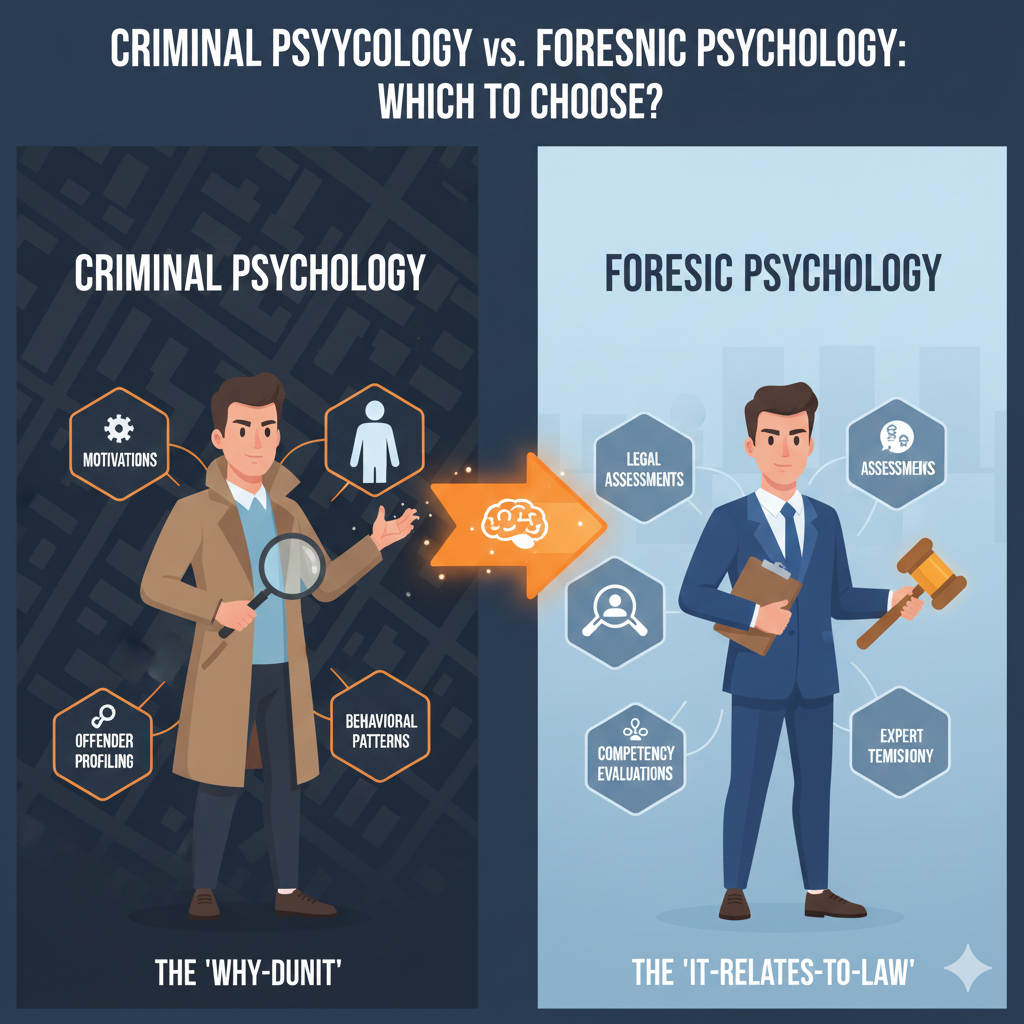
Choosing between criminal psychology and forensic psychology depends on whether you want to dive deep into the minds of offenders or apply psychological expertise across the broader legal system. Both fields offer rewarding careers in criminal justice but differ in focus, daily tasks, and work environments.
Defining Criminal Psychology
Criminal psychology centers on understanding the thoughts, motives, and behaviors of individuals who commit crimes. Professionals in this field analyze patterns in criminal behavior, develop offender profiles, and identify social or environmental factors behind offenses.[1][2]
Key responsibilities include reviewing case files, analyzing evidence to uncover motivations, compiling criminal profiles, and finding connections between criminals and victims. Criminal psychologists guide law enforcement in apprehending suspects and predict future crimes based on behavioral data.[1][3]
Defining Forensic Psychology
Forensic psychology applies psychological principles to legal and judicial settings, spanning both criminal and civil matters. Unlike the narrower focus of criminal psychology, forensic psychologists bridge psychology and law by assessing mental states, providing court testimony, and evaluating witnesses.[2][4]
Typical tasks involve testifying as an expert witness, ensuring the validity of witness testimonies, diagnosing suspects and victims, and leading therapy sessions in rehabilitation settings. They also conduct competency evaluations to determine if defendants are fit to stand trial.[1][4]
Key Differences: A Side-by-Side Comparison
| Aspect | Criminal Psychology | Forensic Psychology |
|---|---|---|
| Primary Focus | Offender behavior, motivations, and profiling | Legal applications, including court evaluations and civil matters |
| Typical Tasks | Crime scene analysis, suspect interviews, risk assessments | Competency evaluations, expert testimony, jury consulting |
| Work Environment | Law enforcement agencies, research | Courts, prisons, correctional facilities |
| Scope | Narrow: Criminal investigations | Broad: Criminal and civil legal contexts |
This table highlights how criminal psychology is specialized in criminal profiling, while forensic psychology has a wider scope, including victim support and policy advising.[2][4]
Career Paths and Daily Realities
Criminal psychologists often collaborate with police on investigations, using behavioral cues to advise on interviews and predict offender actions. For example, they might profile a serial offender by studying crime scenes and past cases to narrow suspect lists.[4][5]
Forensic psychologists, meanwhile, frequently appear in courtrooms, assessing a defendant’s mental fitness or evaluating witness credibility. They may also work on child custody cases or advise on parole decisions, extending beyond pure criminal work.[3]
Both roles involve high-stress interactions with incarcerated individuals, requiring strong stress management skills. Criminal psychologists handle tension during active investigations, while forensic experts manage it in prolonged court proceedings.[1]
Education and Training Requirements
Entry into either field typically requires a bachelor’s degree in psychology, often with specializations in criminology for criminal psychologists or forensic/legal emphasis for forensic ones. Advanced roles demand a master’s or doctorate, plus licensure.[4]
Criminal psychologists benefit from training in data analysis from case files, while forensic psychologists focus on psychological testing and legal knowledge. Both may pursue certifications in areas like risk assessment or trial consulting.
How They Work Together in the Legal System
Despite differences, these fields often intersect. In complex cases, criminal psychologists provide offender profiles and motivation insights, while forensic psychologists evaluate mental competency and testify on findings. This collaboration enhances investigations, improves interrogations, and informs sentencing.[4]
For instance, a criminal psychologist might analyze patterns to predict an offender’s next move, and a forensic psychologist could then assess if the suspect understands trial proceedings, creating a comprehensive approach to justice.
Factors to Consider When Choosing
- Interest in Research vs. Application: Prefer studying criminal minds and patterns? Choose criminal psychology. Enjoy courtroom dynamics and legal impact? Opt for forensic.
- Work-Life Balance: Criminal psychology may involve fieldwork with law enforcement; forensic often means court schedules and institutional settings.
- Career Goals: Forensic psychology offers broader opportunities in civil law, policy, and consulting, while criminal psychology suits those passionate about profiling and prevention.
Both demand resilience due to emotional demands, but they contribute uniquely to public safety and justice.[2][3]
Conclusion
Criminal psychology and forensic psychology both play vital roles in understanding crime and supporting the justice system, but your choice hinges on whether you want to specialize in offender behavior or apply psychology more broadly in legal contexts. Assess your skills, interests, and long-term goals to decide which path aligns best with your career vision.
References
- https://www.indeed.com/career-advice/finding-a-job/criminal-psychology-vs-forensic-psychology
- https://www.nu.edu/blog/criminal-psychology-vs-forensic-psychology/
- https://www.alliant.edu/blog/criminal-psychology-vs-forensic-psychology
- https://northpennnow.com/news/2025/feb/13/criminal-psychology-vs-forensic-psychology-their-roles-and-how-they-work-together-in-the-legal-system/
- https://und.edu/blog/criminal-psychology-vs-forensic-psychology.html
About the Author
InsightPulseHub Editorial Team creates research-driven content across finance, technology, digital policy, and emerging trends. Our articles focus on practical insights and simplified explanations to help readers make informed decisions.