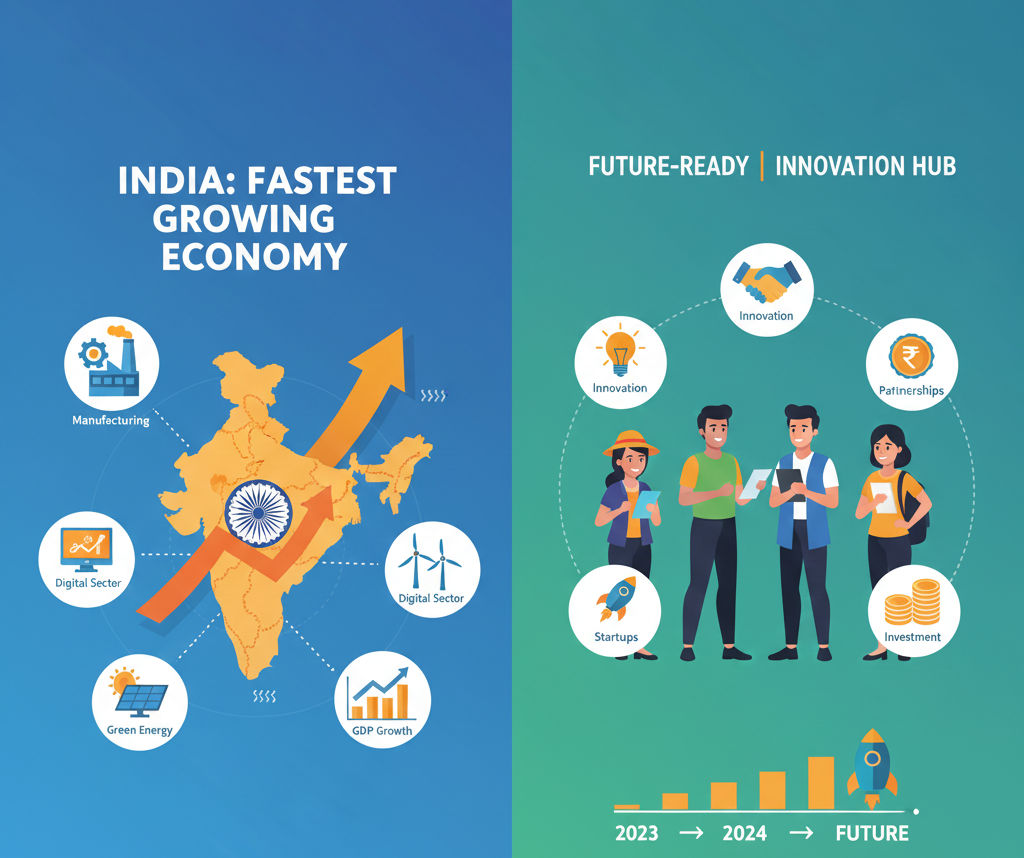
India has firmly established itself as the fastest-growing major economy, expanding at roughly 6.5–6.9% annually in recent years, even as many advanced and emerging economies slow down.[1][6] Yet a persistent question dominates public debate: if the economy is doing so well, why are there still not enough good jobs?
This apparent contradiction – strong GDP growth but weak employment outcomes – is often described as “jobless growth”. The reality is more nuanced: India is creating jobs, but not at the pace, quality, or in the sectors needed to absorb its massive and rapidly changing workforce.
India’s Growth Story in Numbers
Recent data underlines how impressive India’s growth performance has been:
- The World Bank notes that India “continued to be the fastest-growing major economy,” with growth around 6.5% in FY24–25, despite a challenging global environment.[6]
- Deloitte’s October 2025 outlook estimates India’s GDP growth at roughly 6.7–6.9% for FY 2025–26, after a strong 7.8% year-on-year expansion in the April–June quarter.[1]
- Trading Economics, using official statistics, reports India’s full-year GDP growth at about 6.5% in FY 2024–25, with the country now among the world’s top four economies by nominal GDP.[2][3]
- The IMF projects growth of around 6.6% in 2025, keeping India at the top of the global growth tables.[5]
On paper, this is an economic success story: rapid growth, macroeconomic stability, rising investment, and growing global influence.[4] Yet surveys, electoral debates, and everyday conversations reveal a mismatch between the macro numbers and people’s lived experience of work, wages, and security.
Why Growth Is Not Translating into Enough Jobs
1. A service-led growth model that is not labor-intensive enough
India’s growth is heavily driven by services rather than manufacturing. Services such as IT, finance, business services, and communications contribute well over half of GDP, while agriculture still employs a disproportionately large share of the workforce.[2][3]
High-productivity modern services – IT, digital platforms, finance – are high value-add but not high employment. They tend to employ relatively small, highly skilled workforces. This creates a dual economy: global-facing firms grow rapidly, while the bulk of workers remain in low-productivity informal or subsistence activities.
2. Manufacturing has not become a mass employer
Historically, countries like China, South Korea, and Vietnam used labor-intensive manufacturing (textiles, electronics assembly, basic machinery) as a bridge between agriculture and modern services. India’s manufacturing share of GDP has largely stagnated in the mid-teens, and its employment potential remains underutilized.[2][3]
Several factors constrain manufacturing-led job creation:
- Fragmented, small-scale firms that struggle to achieve productivity and scale.
- Logistics and infrastructure gaps, though these have improved with highways, ports, and digital infrastructure.
- Complex regulations and compliance burdens that discourage formal hiring.
- Intense competition from more established manufacturing hubs in East and Southeast Asia.
Government schemes like Production-Linked Incentives (PLI) and “Make in India” aim to change this, and there are early signs of growth in electronics and auto components. But so far, the scale of job creation is not large enough to absorb millions of low- and semi-skilled workers entering the labor force each year.
3. A demographic boom without matching job intensity
With a population of over 1.4 billion and a median age under 30, India has one of the world’s largest and youngest workforces.[5][3] This is often described as a “demographic dividend” – but only if enough productive jobs exist.
Two pressures show up simultaneously:
- Rising aspirations: Education access has expanded, and more young Indians expect salaried, urban, white-collar or formal-sector jobs.
- Limited high-quality openings: Many new jobs are informal, low paid, or precarious, particularly in construction, small retail, and personal services.
The result is visible in the intense competition for government posts and formal sector roles, where millions apply for a handful of vacancies. Underemployment – people working fewer hours or below their skill level – is as important a concern as open unemployment.
4. Skill mismatch between education and industry needs
India has expanded schooling and higher education dramatically, but skills do not always match industry needs. Employers frequently report difficulty in finding job-ready candidates, even for entry-level roles, while graduates struggle to find appropriate work.
Common issues include:
- Insufficient emphasis on vocational and technical training relative to general degrees.
- Uneven quality across engineering and management institutes.
- Low exposure to practical, digital, and soft skills required by modern workplaces.
Initiatives like the National Skill Development Corporation and sector skill councils are designed to narrow this gap, but the pace is uneven and often lags behind the speed at which industries and technologies change.
5. Informal work dominates, masking the quality of jobs
A large share of India’s workforce is in informal employment – either self-employed in tiny enterprises, working as casual labor, or employed in small firms without contracts or social security.[3] Economic growth does raise incomes in these segments over time, but it does not always translate into formal, stable, or well-protected jobs.
This has three key implications:
- Workers face income volatility and limited resilience to shocks.
- Productivity remains low, limiting wage growth.
- Women’s participation is especially constrained by unpaid care work, safety concerns, and lack of flexible formal roles.
In other words, India does create work – but a lot of it remains low-productivity and insecure, which feels like “no jobs” from a quality-of-life perspective.
6. Technology and productivity gains can be job-light
Rapid adoption of digital technologies, automation, and AI boosts productivity and growth – yet may not always create proportional employment gains, especially in routine or clerical tasks. McKinsey, for example, highlights 18 future arenas that could add up to USD 1.7–2 trillion in revenues by 2030, from digital infrastructure and advanced manufacturing to green energy and healthcare.
These sectors are promising, but many are skill- and capital-intensive. Without deliberate policy design, they can reinforce a pattern where GDP expands faster than employment.
Is India Really Experiencing “Jobless Growth”?
The phrase “jobless growth” is powerful but somewhat misleading. A more accurate description is:
- Growth that is less employment-intensive than India needs.
- Growth that creates more good jobs for the top slice of the skill distribution than for the median worker.
- Growth where new jobs are often informal or low-wage, so improvements feel modest or fragile.
Multiple data sources show that employment has grown, but not fast enough to keep up with population and aspirations, and not strongly enough in formal, urban, higher-productivity roles.[1][2][6]
What Would It Take to Turn Growth into Broad-Based Jobs?
Closing the gap between GDP performance and job outcomes requires a multi-pronged approach. Several policy themes recur across recent analyses by multilateral institutions and research organizations.[4][6]
1. Deepen labor-intensive manufacturing
India needs a more aggressive push on sectors that can absorb large numbers of workers with moderate skills, such as textiles and apparel, food processing, light engineering, toys, and electronics assembly.
Key steps include:
- Reducing logistics and compliance costs for small and medium manufacturers.
- Improving industrial clusters and plug-and-play infrastructure.
- Designing PLI and export schemes with explicit employment targets and incentives.
2. Invest massively in skills and employability
Growth in advanced services, technology, and modern manufacturing can translate into more jobs if the workforce can shift into these sectors. That requires:
- Scaling high-quality vocational training with strong industry linkages.
- Curriculum reforms to emphasize digital literacy, problem-solving, and soft skills.
- Flexible, modular learning pathways so workers can upskill or reskill mid-career.
3. Support MSMEs and formalization
Micro, small, and medium enterprises (MSMEs) are the backbone of employment but often struggle with access to credit, technology, and markets. Policies that simplify compliance, expand digital credit and payments, and provide shared services (accounting, HR, technology) can help MSMEs grow, formalize, and hire more.
4. Raise women’s labor force participation
Women’s participation in the labor market remains significantly below potential. Improving access to safe transport, childcare, flexible work arrangements, and targeted skilling can unlock a huge employment and growth dividend. This is not just a social priority but an economic necessity.
5. Harness new growth arenas for employment, not just output
As India builds capabilities in areas like renewable energy, digital public infrastructure, healthcare delivery, and urban services, policies can be calibrated to maximize job creation – for example, by promoting decentralized renewable installations, care economy jobs, and local service ecosystems alongside high-tech hubs.
Conclusion: From Headline Growth to Lived Prosperity
India’s macroeconomic story is genuinely impressive: among the world’s fastest-growing major economies, rapidly rising to the top tier of global GDP rankings, and contributing an increasing share of global growth.[1][4][6]
But growth alone does not automatically translate into broad-based, dignified employment. The current pattern heavily favors capital- and skill-intensive sectors, services over manufacturing, and formal islands in a sea of informality. For most young Indians, the real test of success is not whether GDP grows at 6.5% or 7%, but whether they can find stable, well-paying, and meaningful work.
Bridging the gap between growth and jobs will demand focused action on labor-intensive industries, skilling, MSME dynamism, women’s participation, and the design of new growth sectors. If India can get this right, the “fastest-growing economy” label will start to feel much closer to everyday reality – not just a headline.
For further reading and data, see recent analysis from the World Bank, IMF, Deloitte, and other research organizations on India’s growth prospects and labor market trends.[1][4][5][6]
References
- https://www.deloitte.com/us/en/insights/topics/economy/asia-pacific/india-economic-outlook.html
- https://tradingeconomics.com/india/full-year-gdp-growth
- https://en.wikipedia.org/wiki/Economy_of_India
- https://econofact.org/indias-path-to-becoming-one-of-the-worlds-largest-economies
- https://www.imf.org/en/countries/ind
- https://www.worldbank.org/ext/en/country/india
About the Author
InsightPulseHub Editorial Team creates research-driven content across finance, technology, digital policy, and emerging trends. Our articles focus on practical insights and simplified explanations to help readers make informed decisions.