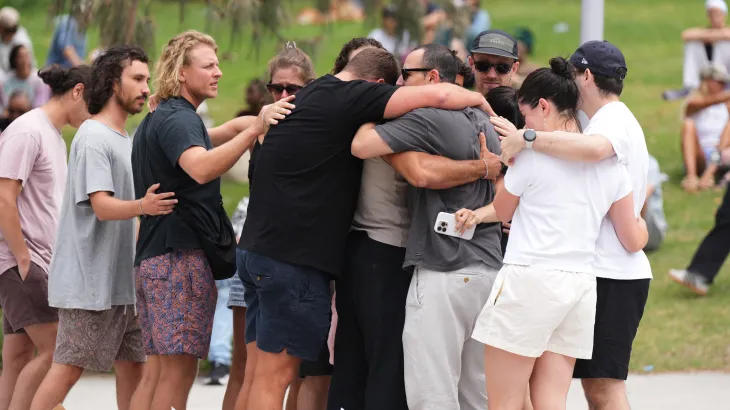
On December 14, 2025, a peaceful Hanukkah celebration at Sydney’s iconic Bondi Beach turned into tragedy when a father-and-son duo opened fire, killing at least 15 people and injuring dozens more. This attack, described by Australian Prime Minister Anthony Albanese as a “targeted attack against Jewish Australians” and a “terrorist incident,” has shocked the nation and reignited debates on antisemitism.[1]
The Attack Unfolds: Timeline and Immediate Aftermath
The incident occurred around 6:45 p.m. local time during the “Chanukah by the Sea” event, organized by the Orthodox Jewish movement Chabad. Hundreds had gathered on the beach to mark the start of Hanukkah when shots rang out from a nearby footbridge. Eyewitness videos captured chaos as attendees fled, with bullets whizzing past families and children. Among the dead was Rabbi Eli Schlanger, assistant rabbi at Chabad of Bondi and a key event organizer, alongside a 10-year-old child and a 40-year-old man who succumbed to injuries at the hospital.[1]
Emergency services responded swiftly, with at least 42 people hospitalized, including two police officers wounded by gunfire. New South Wales Police Commissioner Mal Lanyon confirmed on December 15 that the threat was contained: “We are satisfied that there were two offenders involved. We are not looking for a further offender.” The elder gunman, aged 50, was shot dead by police at the scene, while his 24-year-old son was critically wounded and hospitalized in custody.[1]
Investigators recovered six firearms and two “basic” improvised explosive devices (IEDs) that were active at the scene. Police raided a home in a Sydney suburb believed to belong to the suspects, seizing additional evidence. A bystander heroically tackled and disarmed one gunman, an act captured on video and praised nationwide.[2]
Profile of the Shooters: Father-and-Son Duo
Details on the perpetrators remain limited as the investigation unfolds, with authorities withholding names pending formal charges and family notifications. The 50-year-old father was a licensed gun owner, raising questions about Australia’s stringent firearm laws implemented post-1996 Port Arthur massacre. These laws drastically reduced mass shootings, making this the first deadly incident of its scale since 2022.[1]
The 24-year-old son, now in critical condition, was identified as his accomplice. No specific background on Pakistani origins or connections has been reported in official updates or credible news from the past week. Police have not disclosed ethnic, religious, or migratory histories, focusing instead on the attack’s antisemitic nature. Early reports emphasize the duo’s coordinated assault using long guns from elevated positions, suggesting premeditation.[1][2]
As of December 15, 2025, no motive manifesto or ideological affiliations have been publicly confirmed, though the targeting of a Jewish event points to hate-driven intent. Investigators are analyzing digital footprints and home evidence to establish fuller profiles.
A Surge in Antisemitism: Contextualizing the Violence
Australia has witnessed a sharp rise in antisemitic incidents since the October 7, 2023, Hamas attacks on Israel. Prime Minister Albanese noted in August 2025 that Iran-backed groups were linked to arsons against Jewish sites, prompting severed diplomatic ties with Tehran. Israeli leaders, including Prime Minister Benjamin Netanyahu, directly blamed Albanese’s government for inaction, citing Australia’s September 2025 recognition of Palestine as fueling “Jew hatred.”[1]
Netanyahu stated: “Your government did nothing to stop the spread of antisemitism in Australia.” UN Chief Antonio Guterres condemned the shooting as a “heinous deadly attack on Jewish families,” while global Jewish communities expressed solidarity. In Canada, Jewish groups heightened security amid fears of copycats.[1][2]
Key Data on Recent Antisemitism in Australia:
- Spike in attacks post-October 2023, including firebombings.
- Government attribution of some incidents to Iran in August 2025.
- Calls from Israel for stronger measures against hate speech and protests.
This context underscores why officials swiftly labeled the Bondi attack as terrorism, distinct from random violence.
Australia’s Gun Laws Under Scrutiny
Mass shootings remain rare due to 1996 reforms banning semi-automatic weapons and implementing buybacks. The father’s legal gun ownership highlights gaps in vetting for licensed holders. This event, the deadliest since Port Arthur (35 killed), prompts calls for reviews without undermining core restrictions.[1]
National and International Response
Albanese vowed: “An attack on Jewish Australians is an attack on every Australian. There is no place for this hate, violence and terrorism in our nation.” The NSW Government established support for victims’ families. Internationally, condolences poured in, with Israeli Foreign Minister Gideon Sa’ar citing Australia’s “enormous wave of antisemitism.”[1]
Chabad centers worldwide canceled or bolstered security for Hanukkah events. Witness accounts reveal trauma: “Everyone was just running and there were bullets… we were really scared,” one survivor told reporters.[2]
Conclusion
The Bondi Beach shooting exposes vulnerabilities in multicultural societies amid global tensions. As investigations clarify the shooters’ full profiles and motives, Australia must confront rising antisemitism head-on while honoring strict gun controls. Unity against hate remains the path forward.
References
- https://www.wusf.org/2025-12-14/at-least-15-killed-in-mass-shooting-at-hanukkah-event-on-sydneys-bondi-beach
- https://www.youtube.com/watch?v=x1PHZFsJyqU
- https://www.nsw.gov.au/nsw-government/bondi-beach-attack
About the Author
InsightPulseHub Editorial Team creates research-driven content across finance, technology, digital policy, and emerging trends. Our articles focus on practical insights and simplified explanations to help readers make informed decisions.