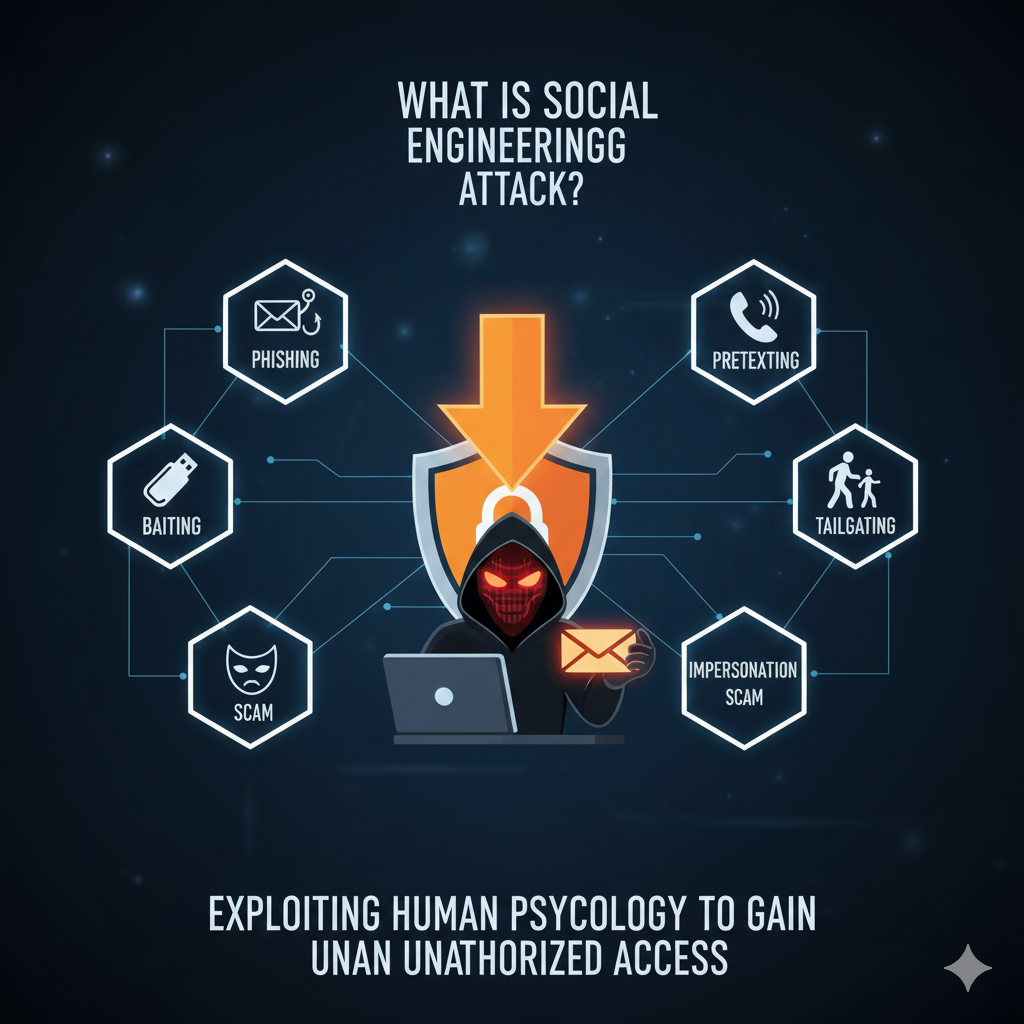
Social engineering attacks exploit human psychology rather than technical vulnerabilities, tricking individuals into revealing sensitive information or granting access.[1][3] In 2025, these “human hacks” remain the leading cause of data breaches, involved in approximately 60% of incidents according to the Verizon DBIR.[2]
Defining Social Engineering: Manipulation Over Malware
At its core, a social engineering attack involves cybercriminals using tactics like trust, fear, urgency, or curiosity to manipulate people into divulging credentials, clicking malicious links, or performing harmful actions.[1][3] Unlike traditional cyberattacks that target firewalls or software, social engineering bypasses technology by focusing on the “human element.” NIST defines it as psychological manipulation exploiting human fallibility.[2]
These attacks feel plausible because they are tailored to the victim’s context, such as impersonating a colleague via email or a delivery service via text.[1] A single successful manipulation can compromise an entire organization, making social engineering one of the most dangerous threats today.[3]
Why Social Engineering Dominates the 2025 Threat Landscape
Social engineering is the number one attack strategy in 2025, outpacing zero-day exploits or malware.[2] The Verizon DBIR reports the human element—including social engineering, user error, and privilege misuse—factors into 60% of breaches.[2] Attackers have shifted strategies: pretexting in business email compromise (BEC) incidents has nearly doubled, with the FBI noting median losses from BEC at significant scales.[2]
AI has revolutionized these attacks. Generative AI enables flawless, personalized phishing emails at scale, with AI-generated phishing rising dramatically since 2023.[2] Voice cloning from seconds of audio powers convincing vishing calls, eroding trust in communications.[2] This democratization allows even non-technical criminals to launch sophisticated campaigns.[1][2]
Cybersecurity Awareness Month 2025 spotlighted social engineering, emphasizing its evolution with AI-generated content and deepfakes.[1]
Common Types of Social Engineering Attacks in 2025
Attackers use diverse channels as email filters improve, pivoting to vishing, smishing, and more.[2] Here are key types to watch:
- Phishing: Fraudulent emails or messages mimicking trusted sources to steal data or install malware. Common via email, fake sites, or social media.[4]
- Spear Phishing: Targeted phishing using researched personal details, often via email or LinkedIn DMs impersonating colleagues.[4]
- Pretexting: Creating fake scenarios (e.g., posing as IT support) via calls or emails to extract info.[2][4]
- Vishing/Smishing: Voice (vishing) or SMS (smishing) phishing exploiting urgency.[2]
- Watering Hole Attacks: Compromising sites targets frequent, infecting visitors.[2]
- Baiting/Tailgating: Offering infected USBs or physically following into secure areas.[1]
98% of ransomware attacks stem from social engineering, averaging $4 million in costs for unprepared organizations.[4]
Real-World Examples and Recent Trends
Phishing often poses as urgent CEO requests or software updates.[4] In BEC, attackers impersonate executives for wire transfers, with losses in billions.[2] AI deepfakes mimic voices or videos of colleagues, demanding actions like fund transfers.[1][2]
High-touch manipulation targets IT or finance via calls. Watering hole attacks, like the 2017 NotPetya spread via software updates, show patience pays off.[2] In 2025, every 11 seconds sees a ransomware hit tied to social engineering.[4]
How Social Engineering Attacks Work: The Step-by-Step Breakdown
1. Research: Gather public data on targets.[3]
2. Impersonation: Contact via plausible channel, building trust.[3]
3. Manipulation: Create urgency (e.g., “Account locked!”) to prompt action like sharing passwords or clicking links.[1][3]
4. Exploitation: Use gained access for breaches, ransomware, or data theft.[3]
AI accelerates this: tools craft perfect lures in minutes.[2]
Prevention Strategies: Defending Against the Human Hack
Protection requires people, processes, and tech:
- Awareness Training: Simulate phishing, cover deepfakes and pretexting. Foster a “question unusual requests” culture.[1]
- Technical Defenses: AI fraud detection, email filters, multi-factor authentication.[2]
- Verification Protocols: Confirm requests via secondary channels; prepare for deepfakes with callback rules.[2]
- Incident Response: Report suspicions without blame.[1]
Organizations must evolve beyond basic simulations to address AI threats.[1][2]
Conclusion
Social engineering attacks in 2025 exploit human trust amid AI advancements, demanding vigilant awareness and robust defenses. By understanding these tactics, individuals and organizations can reduce risks and stay ahead of human hackers.
References
- https://insights.integrity360.com/cyber-security-awareness-month-2025-social-engineering-in-the-spotlight
- https://deepstrike.io/blog/social-engineering-statistics-2025
- https://www.cisco.com/site/us/en/learn/topics/security/what-is-social-engineering.html
- https://www.doppel.com/blog/10-types-social-engineering-attacks-watch-2025
About the Author
InsightPulseHub Editorial Team creates research-driven content across finance, technology, digital policy, and emerging trends. Our articles focus on practical insights and simplified explanations to help readers make informed decisions.