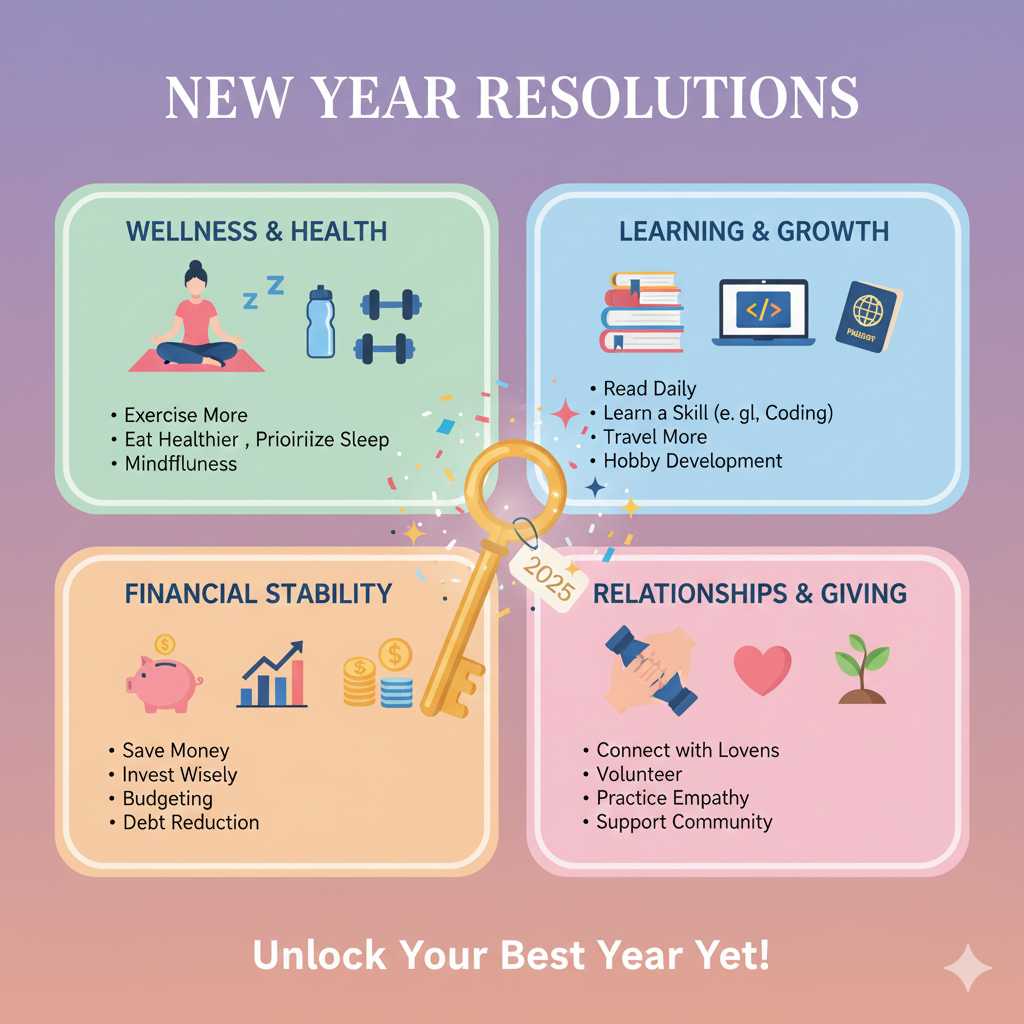
New Year’s resolutions aren’t dead in 2026 – but they are changing. Recent surveys show people are shifting away from extreme, all-or-nothing goals and toward smaller, more sustainable changes, especially around money, mental health, and digital habits.[2][4]
If you want resolutions for 2026 that feel meaningful and realistic, the process you use to create them matters more than the list itself. This guide walks you through a step-by-step, research-informed way to design resolutions you can stick with all year.
1. Start With Reality, Not Wishes
Before deciding what you want to change, get clear on where you are now. Instead of asking, “What should my resolutions be?”, start with, “What’s my real life like today?”
Do a quick life audit
Take 20–30 minutes and rate key areas of your life from 1–10 (1 = very dissatisfied, 10 = thriving):
- Money & financial security
- Physical health (energy, movement, sleep)
- Mental health & stress
- Work & career
- Relationships & community
- Digital life (screen time, social media)
- Personal growth & learning
Circle the 2–3 areas that feel most important to improve in 2026. Research suggests that people who focus on a small number of priorities are more likely to follow through than those who create long wish-lists.
Factor in the 2026 context
Recent surveys show that finances and stress are shaping how people think about 2026:
- A Wells Fargo/Ipsos survey found that among U.S. adults with 2026 resolutions, 97% are considering at least one financial goal, with saving more money the top choice (70%).[4]
- Another tracking study reports that 55% of those making 2026 resolutions are focused on budgeting, saving, investing, paying off debt, or building credit.[3]
- At the same time, a 2026 resolutions survey from Headway shows many people are deliberately choosing smaller, more flexible goals, like slowing down, reducing screen time, and putting less pressure on themselves.[2]
That means you’re not alone if your 2026 priorities are “get my finances under control” and “feel less burned out” rather than “run an ultramarathon by March.” Let your resolutions reflect both your personal reality and the wider economic and social climate.
2. Choose Themes Before You Choose Goals
Instead of jumping straight to specific resolutions, start with themes. Themes are broad directions you want your life to move in during 2026, such as:
- “Financial stability and less money stress”
- “A calmer, less distracted mind”
- “Sustainable health, not crash diets”
This “theme-first” approach has two advantages:
- It keeps you flexible when circumstances change.
- It helps you avoid random, disconnected goals that compete for your time and energy.
Example: Turning a theme into goals
Say your theme is “financial breathing room in 2026.” Based on recent 2026 data, that’s highly aligned with what many people are aiming for: saving more, spending less, improving credit scores, and paying down debt.[4]
You might translate that theme into:
- One savings goal (e.g., build a $1,000 starter emergency fund)
- One spending goal (e.g., cut food delivery spending by 30%)
- One debt or credit goal (e.g., pay off one specific credit card)
3. Use a Simple, Evidence-Based Goal Framework
Many people know about SMART goals (Specific, Measurable, Achievable, Relevant, Time-bound). What matters for 2026 is how you apply them so your goals are challenging but not punishing.
Make them small on purpose
In the Headway 2026 survey, 80% of people still plan to set resolutions, but a large share are dropping intense, traditional goals in favor of smaller, sustainable changes.[2] That’s consistent with behavioral science: we are far more likely to persist with actions that feel doable and rewarding from the start.
To use that insight:
- Cut your first version of a goal in half. If you want to save $4,000, start with $2,000 and reassess mid-year.
- Limit yourself to 1–3 resolutions total.
- Frame goals as behaviors, not just outcomes.
Outcome vs. behavior goals
For each resolution, pair an outcome (what you want to achieve) with a behavior (what you’ll do regularly):
- Outcome: Save $1,000 by October 2026.
- Behavior: Automate $40 from each paycheck into a savings account.
This works for health and wellbeing too. For instance, recent lists of common 2026 resolutions include eating healthier, drinking more water, and sleeping more. Don’t just write “eat healthier” – define behaviors like:
- “Plan 3 home-cooked dinners each week.”
- “Drink a glass of water before every coffee.”
4. Build in Financial Realism
With high cost-of-living pressure, many people say they don’t have the budget for ambitious traditional resolutions such as major career changes, expensive fitness plans, or big-ticket purchases.[2][5] That makes financial realism a central part of any 2026 resolution strategy.
Audit the cost of your resolutions
Before you commit, list the direct and indirect costs of each goal:
- Direct: subscriptions, equipment, memberships, tools, courses
- Indirect: time off work, transport, childcare, eating out more while traveling to the gym, etc.
Then ask:
- “Can I afford this in the first quarter of 2026?”
- “Is there a lower-cost version of the same habit?”
For many financial goals, free or low-cost tools (such as budgeting apps, bank alerts, or online credit education from major financial institutions) can substitute for expensive coaching or courses.
Align with your financial mood
Surveys heading into 2026 show a mixed mood: some Americans feel optimistic, but a sizable share feel anxious or stressed about their finances and worry their situation may worsen.[3][5] Instead of ignoring that emotional reality, design resolutions that:
- Lower financial anxiety (e.g., build a small emergency fund, simplify accounts)
- Reduce future stress (e.g., automatic minimum debt payments plus a small extra amount)
- Are flexible if your income fluctuates (e.g., “save 5–10% of income” instead of a fixed dollar amount)
5. Add “Quiet Resolutions” for Wellbeing
One of the clearest 2026 shifts is toward what some researchers call “quiet goals”: less hustle, more rest and boundaries. Headway’s survey found that many people plan to:
- Live a slower, quieter life in 2026 (68%).[2]
- Reduce screen time (45%) and swap doomscrolling for learning (23%).[2]
- Set stricter work–life boundaries (89%).[2]
You can bake this trend into your resolutions in very concrete ways:
- “No work email after 7 p.m. on weekdays.”
- “One screen-free evening per week for the first three months.”
- “Replace 10 minutes of social media with reading each morning.”
These “quiet resolutions” are not less serious than classic goals like promotions or weight loss. They directly support better sleep, focus, and resilience, which in turn help you stick to your financial and health goals.
6. Design Systems, Not Just Goals
Resolutions fail most often at the level of execution, not intention. To give your 2026 goals the best chance of success, design systems around them:
Use implementation intentions
In behavior science, “implementation intentions” are simple if–then plans that tie a behavior to a cue. For example:
- “If it’s Monday, Wednesday, or Friday at 7 a.m., then I do a 20-minute walk.”
- “If I get paid, then I move 5% of my paycheck into savings.”
This approach can be especially powerful for digital and wellbeing resolutions, such as those around screen time reduction and slow living that are trending for 2026.[2]
Automate where possible
For financial resolutions, automation is your best ally:
- Automatic transfers on payday for savings or debt payments
- Automatic contributions to retirement or investment accounts, if appropriate for your situation
- Bank or app alerts when you hit a budget threshold
That way, you’re not relying on willpower every week.
7. Plan for Setbacks From the Start
According to recent surveys, many people admit they rarely see their New Year’s resolutions through and struggle to appreciate small wins if they miss larger goals.[2] That’s not a character flaw; it’s how most human motivation works.
Redefine success as consistency, not perfection
When you write your resolutions, add a sentence that defines “good enough.” For example:
- “I will consider this resolution a success if I save at least $500, even if I don’t reach $1,000.”
- “I will consider my screen-time goal a success if I complete at least 3 out of 4 weekly digital detox evenings.”
This approach is aligned with the 2026 trend toward lowering self-imposed pressure and embracing small, consistent steps.[2]
Schedule monthly reviews
Put 12 short check-ins on your calendar – one for each month of 2026. During each review:
- Note one win, no matter how small.
- Identify one barrier you hit.
- Decide one adjustment (e.g., smaller step, different time of day, more automation).
If your financial or life circumstances change, give yourself explicit permission to revise your resolutions rather than abandoning them. Flexibility is a feature, not a failure.
8. Put It All Together: A 2026 Resolution Blueprint
Here’s a simple process you can follow over a weekend:
- Reflect: Do a quick life and money audit. Note your biggest pain points and wins from 2025.
- Choose 2–3 themes: For example, “financial breathing room,” “better sleep and focus,” “more learning, less doomscrolling.”
- Draft tiny goals: For each theme, write one small, realistic behavior-based resolution.
- Price them out: Adjust for cost and time so your goals fit your 2026 budget and bandwidth.
- Systematize: Add if–then plans, calendar reminders, and automation where possible.
- Set expectations: Define “good enough” success and schedule monthly reviews.
Conclusion: New Year, New Approach
The best way to come up with New Year’s resolutions for 2026 is to recognize the world – and your life – as they really are: financially pressured, digitally noisy, and often exhausting. Recent data shows that people are responding by prioritizing money goals, healthier boundaries, and slower living over grand, high-pressure transformations.[2][4]
If you anchor your resolutions in that reality, focus on a few key themes, and design simple systems instead of relying on willpower, your 2026 resolutions can be more than a January ritual. They can become sustainable habits that quietly reshape your finances, wellbeing, and daily life throughout the year.
References
- https://www.stagwellglobal.com/what-the-data-say-42-of-americans-making-2026-new-years-resolutions/
- https://makeheadway.com/blog/new-years-resolutions-survey/
- https://www.ipsos.com/en-us/new-survey-reveals-nearly-all-2026-new-years-resolutions-will-have-financial-component
- https://journalrecord.com/2025/12/15/americans-financial-outlook-2026-bankrate-survey/
- https://reclaim.ai/blog/new-year-new-me
About the Author
InsightPulseHub Editorial Team creates research-driven content across finance, technology, digital policy, and emerging trends. Our articles focus on practical insights and simplified explanations to help readers make informed decisions.