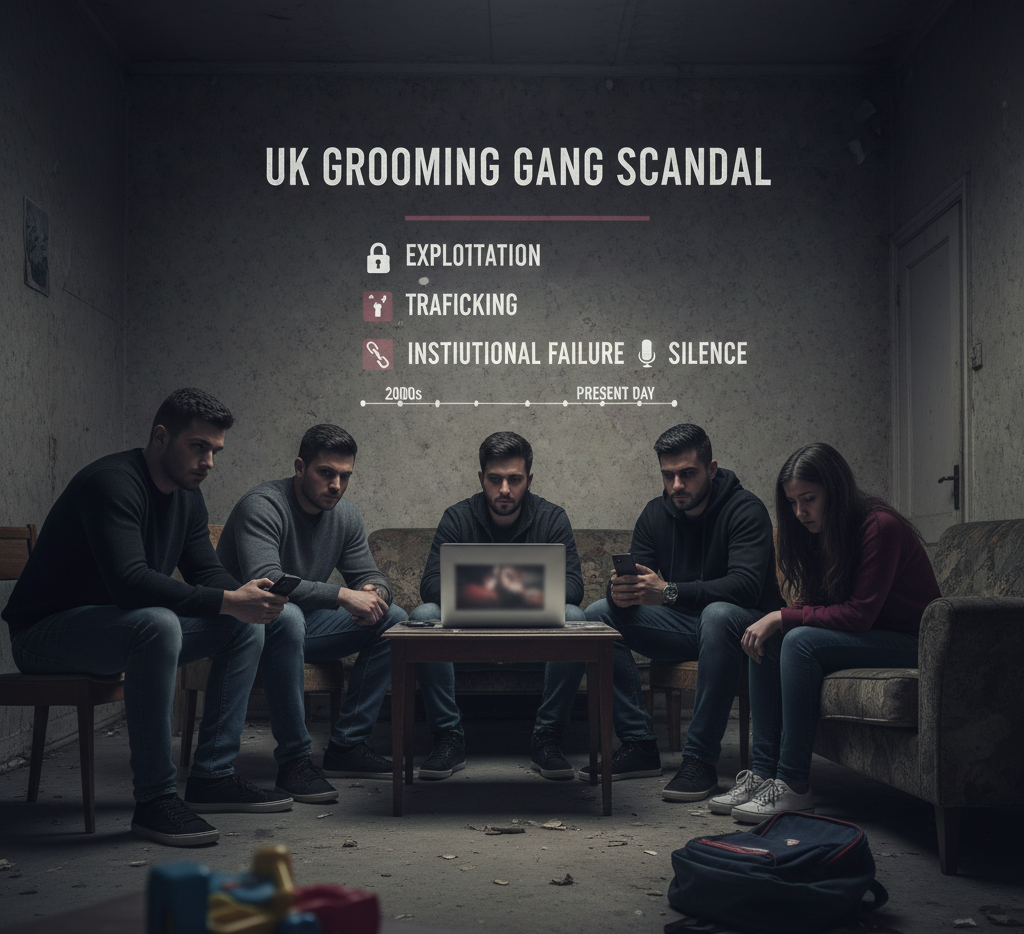
UK grooming gangs refer to organized groups that sexually exploit children, primarily girls, through manipulation, coercion, and violence. A landmark 2025 national audit by Baroness Louise Casey exposed persistent data gaps and institutional failures, prompting the government to launch a statutory inquiry in December 2025.[1][6]
What Are Grooming Gangs?
Group-based child sexual exploitation, often termed ‘grooming gangs,’ involves multiple perpetrators targeting vulnerable children and adolescents. These gangs use grooming tactics—building trust through gifts, attention, or drugs—to coerce victims into sexual acts, creating a false sense of consent. The model typically features loosely interconnected groups operating in social hubs like night-time economy spots, parks, or now vape shops and hotels with anonymous check-ins.[1][4][6]
Historically, high-profile cases emerged in towns like Rotherham, Rochdale, Telford, Oxford, and Newcastle from the 1990s to 2010s. Institutions failed to act due to fears of racism accusations, poor data collection, and victim-blaming, where abused girls were sometimes criminalized.[2][4]
The 2025 Casey audit defines it clearly: ‘multiple perpetrators coercing, manipulating and deceiving children into sex.’ While rare compared to individual or online abuse, it remains one of society’s most horrific crimes.[6]
The Scale of the Problem: Data from 2025 Audit
Police recorded over 100,000 child sexual abuse and exploitation offences in 2024, with 60% involving contact abuse. Of these, about 17,000 contact offences were flagged as exploitation, but group-based cases are underreported. The Complex and Organised Child Abuse Dataset (COCAD) logged around 700 group-based offences in 2023, roughly 4% of exploitation cases—or 28.5% of contact sexual abuse overall.[1][4][6]
Victim profiles show predominantly girls, often from vulnerable backgrounds, aged under 16. Perpetrators vary in age, with 39% of suspects aged 10-15 and 18% 18-29, reflecting rises in child-on-child and online offending. Hotspots persist in areas like Greater Manchester, West Yorkshire, and South Yorkshire.[6]
| Metric | 2024 Data |
|---|---|
| Total child sexual offences | 100,000+ |
| Contact exploitation offences | 17,100 |
| Group-based (2023 COCAD) | ~700 |
Ethnicity data remains inadequate nationally, hampering analysis. Improved local recording in high-risk areas shows overrepresentation of Pakistani men, but Casey stressed data is ‘not good enough’ for national conclusions, fueling misinformation and eroded trust.[4][6]
Institutional Failures and Victim Experiences
The Casey audit highlighted systemic issues: poor ethnicity and nationality recording, reluctance to examine offender demographics, and failures in taxi licensing. Drivers often obtained licenses in low-scrutiny areas to operate in high-risk zones like Rotherham, exploiting night-time economies.[4][6]
Victims were ‘ignored, treated like criminals, and often arrested themselves.’ Baroness Casey recommended expunging criminal records for CSE survivors. Survivors met during the audit described coercion, violence, and institutional neglect.[2][6]
Recent Policy Developments in 2025
The Labour government, initially resistant, commissioned Casey’s rapid audit in early 2025 amid public pressure. Published in June, it urged better data collection, a national inquiry, and addressing ethnicity without taboo.[1][4]
On 14 June 2025, Prime Minister Keir Starmer announced a statutory national inquiry, noting enough convictions of Asian-background groups to warrant scrutiny. On 9 December 2025, Home Secretary Yvette Cooper appointed Baroness Anne Longfield CBE as chair, responding directly to Casey’s recommendation 2.[3][4]
Key recommendations include mandatory ethnicity recording by police, victim record expungement, and tackling enabling factors like out-of-area taxi licensing. The Centre for Women’s Justice welcomed these, praising recognition of victim criminalization.[2]
Challenges Ahead and Ongoing Efforts
Despite progress, data gaps persist. The Office for National Statistics notes no centralized grooming gang conviction totals, relying on surveys like the Crime Survey for England and Wales for prevalence by demographics.[5] The inquiry aims to clarify scale, drivers, and institutional roles.
Examples from recent audits underscore urgency: in areas with better data, specific ethnic patterns emerged, but national improvements are needed to prevent recurrence and rebuild trust.
Conclusion
The UK grooming gangs scandal reveals deep failures, but 2025’s Casey audit and impending national inquiry mark a turning point toward accountability and protection. Enhanced data, victim support, and fearless analysis are essential to safeguard children.
References
- https://learning.nspcc.org.uk/research-resources/2025/summary-national-audit-group-based-child-sexual-exploitation-abuse
- https://assets.publishing.service.gov.uk/media/685559d05225e4ed0bf3ce54/National_Audit_on_Group-based_Child_Sexual_Exploitation_and_Abuse.pdf
- https://www.centreforwomensjustice.org.uk/news/2025/6/17/cwj-welcomes-major-report-on-grooming-gangs-and-home-secretarys-pledge
- https://www.gov.uk/government/collections/independent-inquiry-into-grooming-gangs
- https://en.wikipedia.org/wiki/Grooming_gangs_scandal
- https://www.ons.gov.uk/aboutus/transparencyandgovernance/freedomofinformationfoi/groominggangconvictionsuk
About the Author
InsightPulseHub Editorial Team creates research-driven content across finance, technology, digital policy, and emerging trends. Our articles focus on practical insights and simplified explanations to help readers make informed decisions.