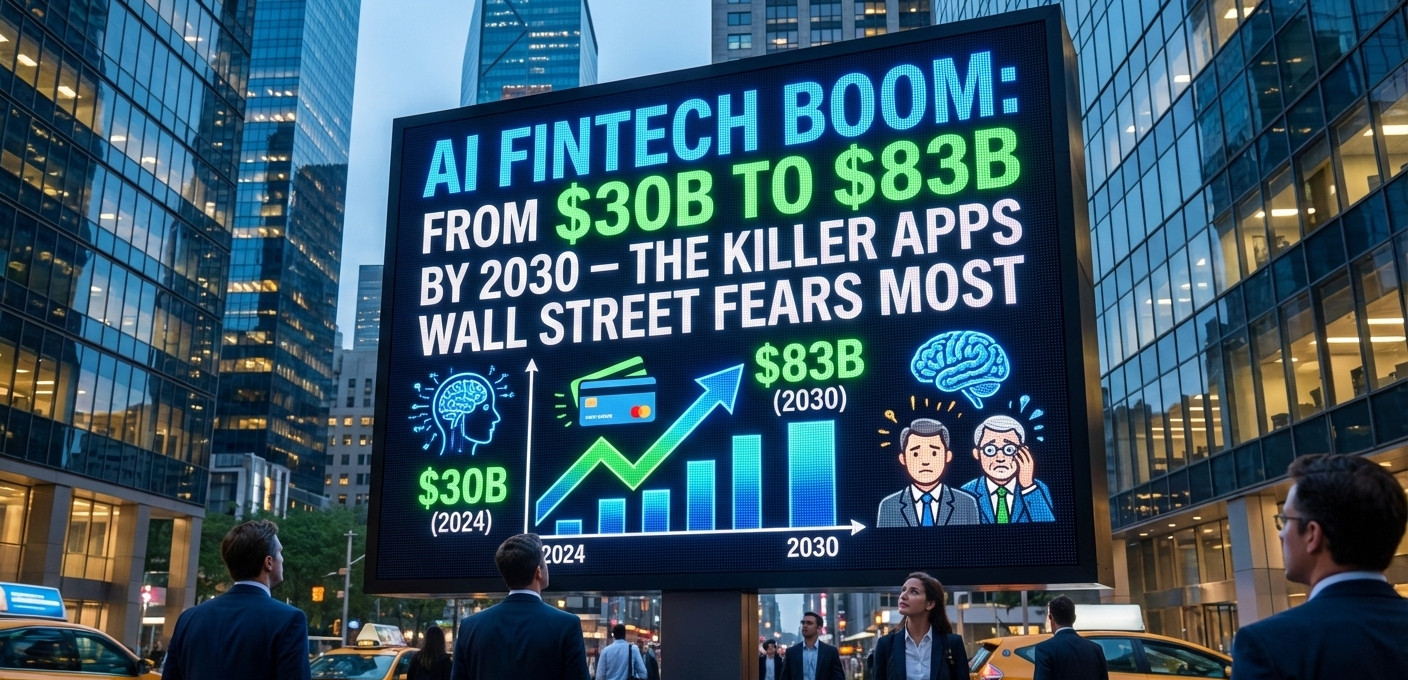
The AI fintech market is exploding from $18.31 billion in 2025 to a projected $53.30 billion by 2030, growing at a compound annual growth rate (CAGR) of 23.82%.[1][2] This surge, driven by generative AI and machine learning, is birthing “killer apps”—innovations like real-time fraud detection and hyper-personalized robo-advisors—that Wall Street incumbents fear could erode their profit margins and market share.
The Explosive Growth Trajectory
Recent reports highlight AI’s transformative role in fintech. The sector’s value is set to nearly triple by 2030, fueled by demand for personalized services, cybersecurity, and operational efficiency.[1] McKinsey estimates generative AI alone could add $200-340 billion annually to global banking revenues, equivalent to 2.8-4.7% of total industry income through productivity gains.[1]
Broader fintech market projections align with this momentum. One analysis forecasts the overall fintech industry expanding from $146.171 billion in 2025 to $690.386 billion by 2030 at a 36.41% CAGR, with AI at the forefront.[4] Another predicts the fintech market reaching $698.5 billion by 2030 with a 20.3% CAGR, propelled by e-commerce, smartphones, and data security needs.[5] These figures underscore a shift from hype to tangible value creation.
Key Drivers Fueling the Boom
Several factors are accelerating AI adoption in fintech:
- Technological Advancements: Generative AI enables predictive analytics, fraud detection, and personalized recommendations, redefining lending, insurance, and payments.[2]
- Consumer Demand: Users expect tailored experiences, leading to AI-driven virtual assistants and robo-advisors that offer 24/7 support and reduce errors.[1]
- Cybersecurity Needs: Rising threats demand proactive AI tools for real-time risk management, surpassing traditional methods.[1]
- Cost Efficiency: Autonomous Research projects AI will cut banking operating costs by 22% by 2030, automating customer service and clerical tasks.[1]
North America leads with over 40% global share, thanks to R&D in the U.S. and Canada, while Asia-Pacific grows fastest due to digital payments and government support.[3]
Killer Apps Wall Street Fears
Wall Street’s traditional models—high-fee advisory, manual trading, and siloed operations—face disruption from these AI-powered applications:
1. AI-Powered Fraud Detection and Prevention
AI monitors transaction patterns in real-time, flagging anomalies traditional systems miss. This reduces fraud losses and builds customer trust, eroding banks’ competitive edge in security services.[2][3]
2. Robo-Advisors and Personalized Financial Planning
These platforms democratize wealth management, offering affordable, data-driven advice. JPMorgan Chase’s COO Daniel Pinto noted gen AI use cases could deliver $2 billion in value, signaling even incumbents are racing to adapt.[1] Consumers bypass expensive human advisors for AI that analyzes spending and suggests investments.
3. Predictive Analytics for Lending and Risk
Machine learning assesses creditworthiness using alternative data, enabling faster approvals for underserved segments. Mid-market lenders leverage this for growth, challenging big banks’ dominance.[2]
4. Embedded Finance and Generative AI Chatbots
AI integrates finance into non-financial apps (e.g., shopping platforms offering instant loans), with gen AI chatbots anticipating needs like tailored loans before users ask.[2][4] This seamless experience threatens Wall Street’s transaction-heavy revenue streams.
Examples abound: Singapore’s Lazeer AI automates Forex trading, eliminating human intervention.[3] Cloud deployments, growing fastest, enhance scalability and security.[3]
Wall Street’s Response and Challenges
Incumbents invest heavily—industry AI spend is projected to rise from $35 billion in 2023 to $97 billion by 2027 at 29% CAGR.[1] McKinsey urges an “AI-first mindset,” estimating up to $1 trillion in annual banking value.[1] Yet, challenges persist: regulatory compliance, data privacy, and AI biases could slow adoption. The World Economic Forum notes 83% of fintechs report customer experience gains and 75% cost reductions from AI.
2025 saw key developments like partnerships and appointments, per FinTech Futures, signaling maturation.[6]
Conclusion
The AI fintech boom promises a “B to B” evolution—from billions today to trillions in impact by 2030—via killer apps that personalize, secure, and automate finance. Wall Street must innovate or risk obsolescence in this AI-driven era.
References
- https://ctomagazine.com/ai-in-fintech-a-new-era-of-innovation-in-financial-services/
- https://www.sigmainfo.net/blog/us-fintech-market-growth-trends-and-forecast/
- https://www.grandviewresearch.com/industry-analysis/artificial-intelligence-in-fintech-market-report
- https://www.euvic.com/us/post/fintech-market-trends
- https://www.coresite.com/blog/top-trends-shaping-the-fintech-industrys-future
- https://www.fintechfutures.com/ai-in-fintech/2025-top-five-ai-stories-of-the-year
- https://reports.weforum.org/docs/WEF_Future_of_Global_Fintech_Second_Edition_2025.pdf
About the Author
InsightPulseHub Editorial Team creates research-driven content across finance, technology, digital policy, and emerging trends. Our articles focus on practical insights and simplified explanations to help readers make informed decisions.