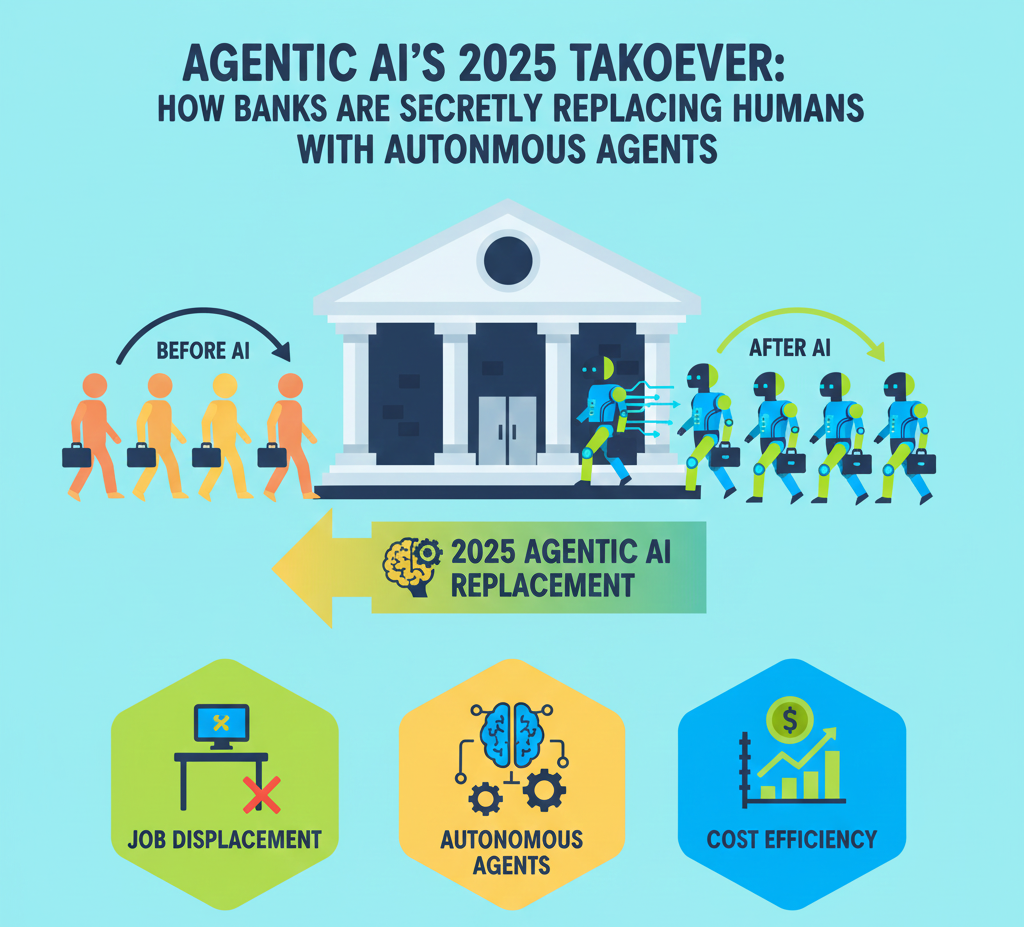
Agentic AI, capable of autonomously reasoning, planning, and executing tasks without constant human oversight, is rapidly transforming banking operations in 2025. While not a complete “replacement” of humans, 70% of banking institutions are already deploying or piloting these systems, automating repetitive and complex workflows in areas like fraud detection, compliance, and customer service.[2][5]
What Is Agentic AI, and Why Banks Are Adopting It Now
Unlike traditional generative AI that generates responses or insights, agentic AI completes tasks independently based on instructions. It analyzes data, makes decisions, and acts—such as routing customer queries, verifying documents, or filing reports.[1] Banks are prioritizing internal applications first due to compliance hurdles, but adoption is accelerating: a 2025 MIT Technology Review survey of 250 banking executives found 70% using agentic AI in deployments or pilots.[2]
This shift addresses rising pressures. US fraud losses are projected at $40 billion, while compliance costs consume up to 5% of banking expenses. Agentic AI enables real-time responses, scaling beyond human limits.[3][6]
Key Use Cases: Where Humans Are Being Augmented or Replaced
Banks are embedding agentic AI across front, middle, and back offices, often starting with high-volume, low-discretion tasks.
Fraud Detection and Security
51% of banks report high agentic AI capability in security, where agents quarantine threats, verify identities, and detect anomalies in real-time. Micro-personalization tailors detection to individual patterns, reducing false positives.[2] Executives prioritize this at 75%, expecting further evolution.[2]
Compliance and KYC
Agentic AI revolutionizes Know-Your-Customer (KYC) processes, targeting 50% cost reductions. Agents handle AML investigations by cross-checking transactions, pulling KYC data, and generating reports—escalating only high-risk cases.[3][6] In one workflow, multiple agents collaborate: one reviews transactions, another documents findings, and a third files reports autonomously for human sign-off.[4]
Credit Decisioning and Onboarding
Manual onboarding delays are history. Agents automate document verification, risk scoring, and approvals at scale, processing loan applications by handling underwriting, financial spreading, and compliance simultaneously.[5] McKinsey notes up to 40% productivity gains in core operations.[5]
Customer Experience and Personalization
41% cite strong capabilities here. DBS Bank uses agents to parse SWIFT messages for quick human review. Virtual personal bankers provide proactive advice, democratizing wealth management—70% of leaders plan personalized advice for mass customers.[5] Agents synthesize client data with market conditions for targeted recommendations.[2]
Real-World Examples from Leading Banks
DBS Bank’s chief data officer predicts AI will touch every business part, from front to back office.[2] They’re deploying agents for SWIFT processing and portfolio monitoring. Leading banks are hiring agentic AI specialists, with tech giants like Salesforce (Agentforce 2dx, May 2025), Microsoft, and Nvidia providing platforms.[4]
nCino highlights how agents transform risk management with continuous portfolio assessment, replacing periodic human reviews.[5] BCG’s 2025 study shows top banks using agentic AI for KYC resilience and growth.[6]
Challenges: Not a Seamless Takeover
Despite momentum, hurdles persist. Compliance, costs, and inertia slow customer-facing apps.[1] Human oversight remains essential for high-stakes decisions, ensuring transparency and auditability. Banks approach incrementally: microservices-style agents (e.g., Akka, Nvidia NeMo) replace legacy software gradually.[4]
Frontline roles evolve too—McKinsey notes agentic AI aids prospecting but requires team readiness. Process redesign is key for full potential, embedding “invisible intelligence” into operations.[4]
The 2025 Outlook: Transformation, Not Elimination
75% prioritize fraud, 64% security, and 51% customer experience for agentic AI growth.[2] This isn’t secretive replacement but strategic augmentation, unlocking efficiencies and personalization. Banks risk falling behind without adaptation.
Conclusion
Agentic AI’s 2025 rise in banking signals a workflow revolution, automating tasks while elevating human roles to strategic oversight. Early adopters gain edges in efficiency and service— the future belongs to those who harness it wisely.
References
- https://www.emarketer.com/content/banks-need-plan-agentic-ai
- https://thefinancialbrand.com/news/artificial-intelligence-banking/bankings-agentic-ai-revolution-how-70-of-institutions-are-already-transforming-operations-192250
- https://www.sprinklr.com/blog/agentic-ai-in-banking/
- https://www.deloitte.com/us/en/insights/industry/financial-services/agentic-ai-banking.html
- https://www.ncino.com/blog/agentic-ai-banking-revolution-autonomous-intelligence
- https://www.bcg.com/publications/2025/know-your-customer-agentic-ai-revolution
About the Author
InsightPulseHub Editorial Team creates research-driven content across finance, technology, digital policy, and emerging trends. Our articles focus on practical insights and simplified explanations to help readers make informed decisions.