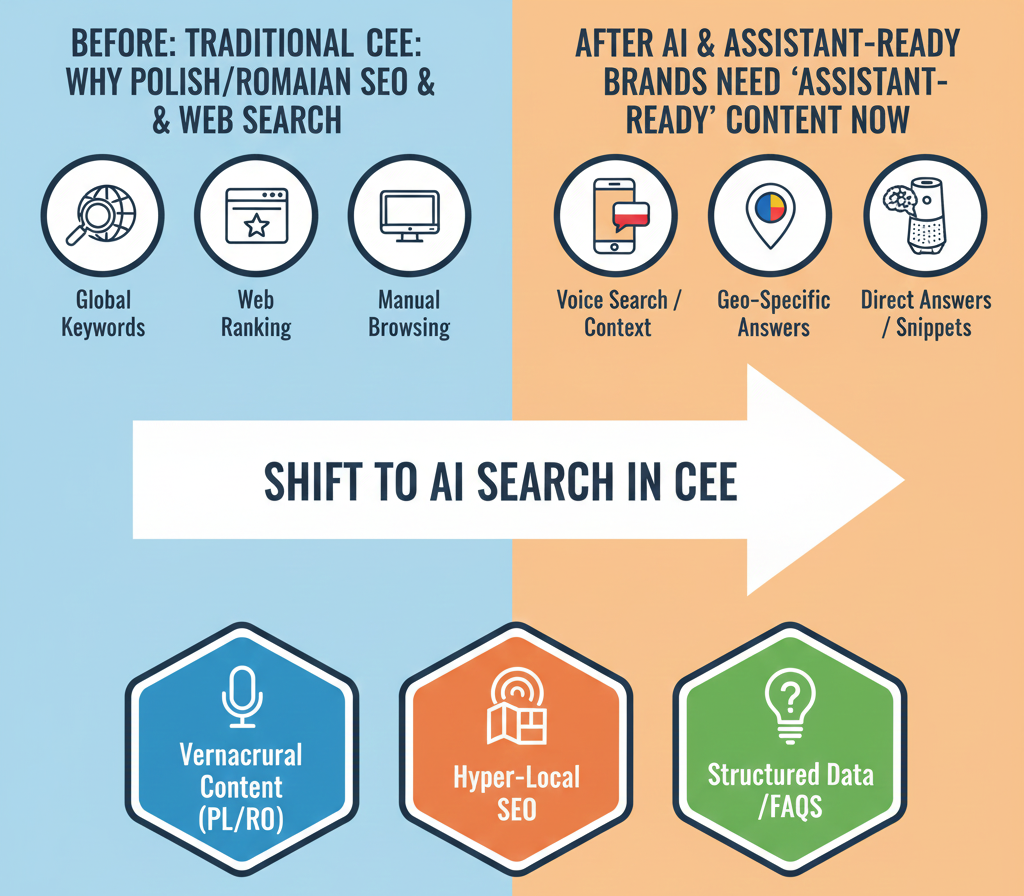
AI Search Hits CEE: Why Polish/Romanian Brands Need ‘Assistant‑Ready’ Content Now
AI-powered search and virtual assistants are rapidly transforming how consumers in Central and Eastern Europe (CEE) discover brands, with Poland and Romania at the forefront of this shift. Brands in these markets must optimize content for AI assistants like generative AI-enhanced Google or ChatGPT to maintain visibility as traditional search evolves.
The AI Boom in CEE: A Foundation for Search Innovation
Central and Eastern Europe is emerging as a hotspot for AI innovation, fueled by substantial venture capital and startup growth. According to The Recursive’s State of AI in CEE 2024 Report, the region’s AI startups raised €1.4 billion in funding from 2023 to August 2024, with standout examples like Poland’s ElevenLabs securing €74 million in Series B funding for voice AI technologies.[1] This investment underscores CEE’s role in Europe’s interconnected tech ecosystem, where AI bridges emerging hubs like Warsaw and established centers like London and Berlin.
Poland leads with 23.3% of CEE’s AI startups, followed by strong activity in Romania and neighboring markets, highlighting a thriving ecosystem primed for AI adoption in consumer-facing applications like search.[2] The EU AI Act, effective since mid-2024, further supports this by harmonizing ethical AI deployment across the region, enabling brands to leverage AI without regulatory silos.[1]
AI Search and Assistants: 2026 Trends Reshaping Discovery
Looking to 2026, AI search is set to dominate user interactions, with generative AI integrations in tools like Google outpacing direct OpenAI usage. eMarketer forecasts that more people will turn to Google’s genAI features for queries than to standalone platforms, emphasizing the need for content optimized for conversational AI.[3]
Europe-wide, AI trends point to agentic commerce, semantic search, and AI-powered discovery as key evolutions. Crystalloids highlights AI shopping agents and generative merchandising, where assistants proactively recommend products based on natural language queries, demanding structured, context-rich content from brands.[6] In marketing, Davies Meyer notes that AI infrastructure is no longer optional for European brands, particularly in competitive regions like DACH, with spillover effects to CEE.[4]
Euronews predicts a shift from ‘AI slop’—low-quality generated content—to sophisticated world models and small language models that power more accurate, efficient assistants, making high-quality, assistant-ready content essential for visibility.[5]
Why Polish and Romanian Brands Face Unique Pressures
Poland and Romania exemplify CEE’s digital growth, with the IT market expanding at 10.9% annually from 2020-2024, driven by investments in infrastructure and AI.[2] Poland prioritizes AI investments and digital competencies, while Romania benefits from similar EU-backed initiatives, positioning both for rapid AI search adoption.
However, challenges persist: skill shortages affect 63% of Czech firms (a CEE peer), with high demand for AI-related roles like data analysts and cloud engineers spilling into Poland and Romania.[2] Emigration of talent exacerbates this, pushing brands to compete not just on products but on discoverability through AI interfaces.
Consumer behavior is shifting toward voice and conversational search via assistants like enhanced Siri or Google Gemini. In CEE, where public trust in AI is building alongside infrastructure upgrades—like Slovakia’s 100 Mbps broadband push—brands risk invisibility if content isn’t phrased for zero-click answers.[2]
What Makes Content ‘Assistant-Ready’?
‘Assistant-ready’ content is structured, factual, and optimized for AI parsing: think schema markup, natural language FAQs, and concise entity-based descriptions that feed directly into knowledge graphs.
- Structured Data: Use JSON-LD for products, events, and reviews to ensure AI assistants pull accurate snippets.
- Conversational Optimization: Answer queries in full sentences, covering who, what, where, when, why—e.g., ‘Best Polish craft beer near Warsaw’ yields direct recommendations.
- Multimodal Assets: High-quality images and videos with descriptive alt text, as AI agents increasingly handle visual search.
- Authoritative Sources: Link to credible data; AI favors E-E-A-T (Experience, Expertise, Authoritativeness, Trustworthiness).
Examples abound: ElevenLabs’ content on voice AI is assistant-primed, featuring clear use cases that surface in tech queries.[1] Romanian e-commerce sites adopting semantic search see boosts in AI-driven traffic, per regional trends.[6]
Strategies for Polish and Romanian Brands in 2026
To thrive, CEE brands should act now:
- Audit for AI Visibility: Test content with tools like Google’s Search Generative Experience; refine low-performing pages.
- Invest in Local AI: Partner with CEE startups for custom assistants, leveraging Poland’s startup density.
- Build Skills: Train teams on AI content tools, aligning with Europe’s push where 60% of workers need upskilling.
- Monitor Regulations: Comply with EU AI Act while experimenting with agentic features.
ING Think warns Europe lags in AI regulation agility, urging faster adaptation to sustain growth. Taylor Wessing predicts 2026 as AI’s ‘growing up’ year, with mature governance benefiting compliant CEE brands.
Conclusion
As AI search permeates CEE, Polish and Romanian brands that prioritize assistant-ready content will capture the next wave of consumer attention. With €1.4B in AI funding and rising infrastructure, the region is poised for leadership—provided businesses adapt proactively.[1][2]
References
- https://complexdiscovery.com/the-rise-of-central-and-eastern-europe-in-venture-capital-and-ai-innovation/
- https://www.blue-europe.eu/analysis-en/full-reports/artificial-intelligence-in-central-and-eastern-europe-opportunities-and-challenges/
- https://www.emarketer.com/content/ai-trends-watch-2026
- https://daviesmeyer.com/en/thinking/blog/2026-marketing-trends-europe
- https://www.euronews.com/next/2026/01/01/from-ai-slop-to-world-models-bubbles-and-small-models-what-to-expect-from-ai-in-2026
- https://www.crystalloids.com/insights/data-ai-trends-for-2026-lessons-from-our-google-cloud-projects?hsLang=en
About the Author
InsightPulseHub Editorial Team creates research-driven content across finance, technology, digital policy, and emerging trends. Our articles focus on practical insights and simplified explanations to help readers make informed decisions.