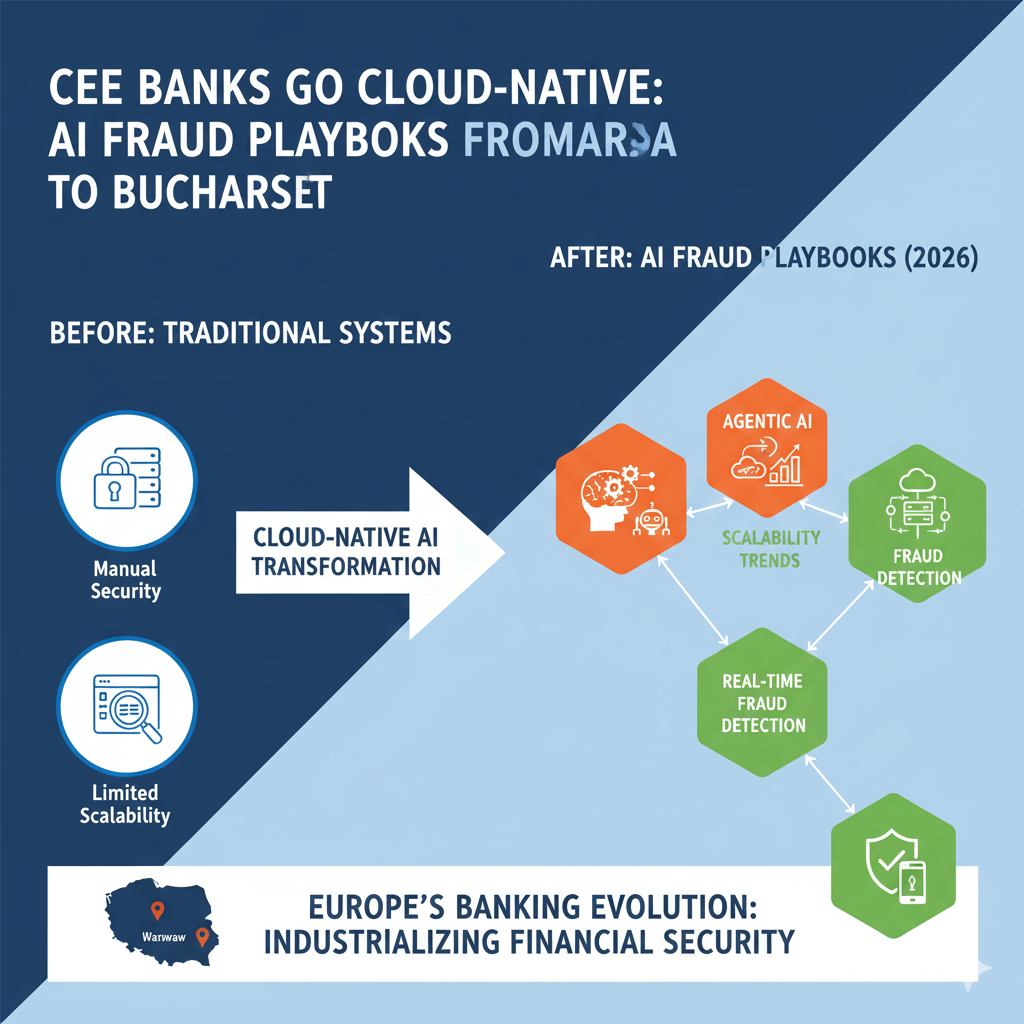
Central and Eastern European (CEE) banks are rapidly transitioning to cloud-native architectures powered by agentic AI to combat sophisticated fraud, enhancing scalability from Warsaw to Bucharest. This shift addresses surging threats like genAI-enabled scams while enabling real-time detection and compliance.
The Rising Fraud Tide in CEE Banking
Fraud in banking is evolving with generative AI automating attacks at scale, including hyper-realistic phishing and deepfakes, outpacing legacy rule-based systems.[4] Deepfake-related fraud attempts have surged 2,137% over the past three years, with genAI-enabled losses projected to reach $40 billion by 2027 in the U.S. alone—a trend rippling into CEE markets.[3] In regions like Poland and Romania, banks face intensified pressure from money laundering networks converging across payments, crypto, and money mules.
Traditional systems generate excessive false positives and operate in data silos, ill-equipped for contextual intelligence. CEE institutions, serving high-volume digital transactions, must adopt proactive AI to protect customers and maintain trust.[2]
Cloud-Native Shift: Scalability for CEE Banks
Cloud-native platforms enable CEE banks to scale fraud detection seamlessly, integrating disparate data sources into unified knowledge graphs. This allows real-time behavioral monitoring, reducing manual investigations and operational costs.[1] For example, platforms unify fraud and anti-money laundering (AML) data—FRAML convergence—revealing hidden criminal pathways that siloed systems miss.[4]
In Warsaw, Polish banks leverage cloud scalability for instant transaction monitoring, while Bucharest institutions use it for cross-border compliance. This infrastructure supports agentic AI, where autonomous agents learn fraud patterns continuously, adapting to new threats without human intervention.[2]
Agentic AI: The Core of Fraud Playbooks
Agentic AI represents autonomous systems that proactively execute fraud playbooks, from KYC verification to anomaly detection. Top use cases include real-time fraud detection, which protects customers by learning criminal behavior in real time, and AI-driven screening for politically exposed persons (PEPs).[1] These playbooks reduce false positives, automate reporting, and ensure regulatory alignment amid escalating AML rules.[2]
CEE banks deploy agentic models combining supervised learning, graph analytics, and biometrics. Behavioral biometrics and continuous verification stop deepfake attacks pre-emptively, fostering trust as a competitive edge.[3] Platforms enable instant lending decisions and churn prediction, enhancing customer experiences across retail and corporate segments.[1]
Real-World Examples and Data-Driven Wins
A top U.S. bank using a similar knowledge graph platform accelerated data mapping from months to days, unraveling a $5.7 million fraud ring in two hours—insights applicable to CEE’s fragmented data landscapes.[4] Feedzai experts highlight how banks must counter AI-powered scams ethically, with law enforcement lagging genAI paces.[5]
In CEE, this translates to Warsaw banks predicting credit risk accurately via AI, while Bucharest firms automate sanctions screening. NICE Actimize notes convergence of fraud types demands holistic strategies, aligning with cloud-native scalability. Coherent Solutions’ roadmap emphasizes data strategy and governance for implementation.[2]
Implementation Roadmap for CEE Institutions
To go cloud-native:
- Assess Data Foundations: Integrate transactional, KYC, and third-party data into knowledge graphs.[4]
- Deploy Agentic Models: Start with real-time monitoring and expand to biometrics.[1][2]
- Ensure Governance: Balance AI ethics, reducing bias in fraud models while meeting regulations.[5]
- Scale with Cloud: Leverage platforms for resilience and real-time transformation.[6]
Backbase predicts trust will define 2026 banking, with unified fraud decisioning across channels.[3] NICE Actimize urges preparation for 2026 fraud convergence.
Challenges and Future Outlook
While agentic AI promises efficiency, challenges include ethical model trustworthiness and legacy integration. Banks missing high-quality data hinder predictive modeling. Yet, early adopters gain market share through lower losses and superior compliance.
By 2026, CEE banks prioritizing cloud-native AI will lead in fraud defense, turning scalability into a strategic moat from Warsaw to Bucharest.
Conclusion
CEE banks’ cloud-native pivot with agentic AI playbooks marks a proactive era in fraud combat, blending scalability, precision, and trust for resilient financial ecosystems.
References
- https://www.getfocal.ai/blog/ai-use-cases-in-banking
- https://www.coherentsolutions.com/insights/ai-financial-fraud-prevention-whitepaper
- https://www.backbase.com/blog/ai-in-banking-10-predictions-that-will-define-2026
- https://datawalk.com/fraud-detection-in-banking-2026-future-trends-predictions/
- https://www.feedzai.com/resource/predictions-for-2026-scams-ai-and-fintech/
- https://www.niceactimize.com/blog/fraud-in-2026-preparing-for-convergence
About the Author
InsightPulseHub Editorial Team creates research-driven content across finance, technology, digital policy, and emerging trends. Our articles focus on practical insights and simplified explanations to help readers make informed decisions.