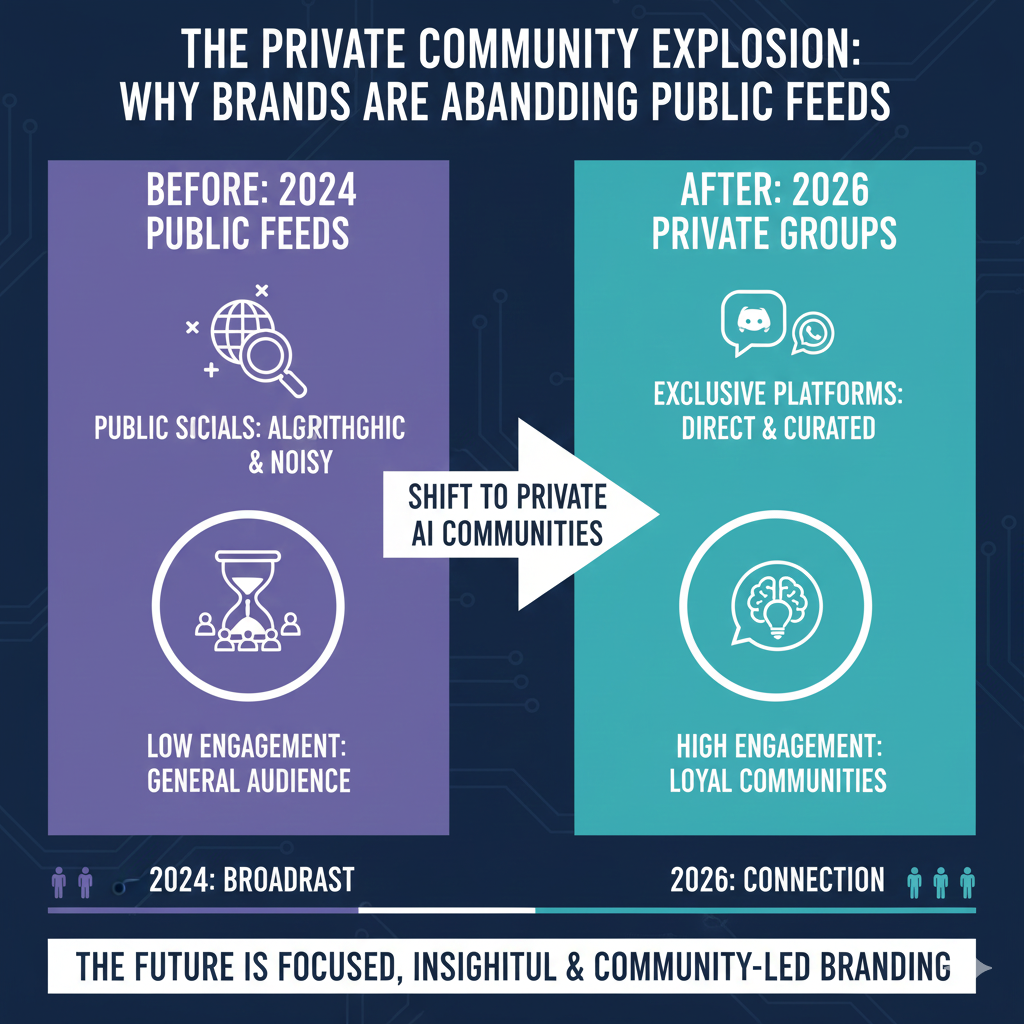
The public social feed is quietly dying as the centre of brand marketing. In its place, private communities on Discord, WhatsApp, Telegram, and niche groups are becoming the real engines of trust, feedback, and revenue. Public platforms still matter for discovery, but the real relationship—and the highest‑value conversations—are moving behind closed doors.futuristsacademy+1
From Megaphones to Living Rooms
Public social has become a noisy megaphone: endless ads, algorithmic volatility, and performative posting. Users increasingly feel watched, judged, and sold to, not listened to. As a result, behaviour is shifting: only a minority still share personal moments on open feeds, and a growing share of “social” now happens in private chats, DMs, and invite-only spaces.bridgeratings+2
Private channels—WhatsApp groups, Discord servers, private Instagram or Telegram communities—feel more like digital living rooms than stages. People can talk honestly, ask “stupid” questions, and share strong opinions without worrying about pile‑ons or context collapse. For brands, getting invited into these rooms is less about reach and more about permission: you earn a seat by being useful, not by buying impressions.linkedin+1
Why Brands Are Walking Away from Public Feeds
Brands are not abandoning public feeds entirely—but they are reallocating time, budget, and creative energy into smaller circles where engagement is deeper and more predictable.
Several forces drive this shift:
- Algorithm fatigue: Organic reach on big platforms has cratered; follower counts no longer equal community or impact.sprinklr+1
- Trust crisis: Users trust peers in small groups far more than polished ads or macro‑influencers. Over 90% of consumers say recommendations from people they know outrank paid promotion.websofttechno
- Signal over noise: Micro‑communities filter for relevance. People join a Discord or WhatsApp group around a specific niche—NFTs, SaaS, new moms, runners—so every message competes with dozens of posts, not millions.futuristsacademy+1
A concrete example: Indian baby‑care brand Baby Forest turned WhatsApp from a support channel into a commerce + community engine, with 7–8% of total revenue now coming directly from WhatsApp‑led engagement. Parents use the groups to ask questions, get recommendations, and share experiences—far more valuable than a one‑way Instagram ad.impactonnet
The Rise of Micro‑Communities and “Brand Tribes”
What is actually growing is not one gigantic “community,” but thousands of smaller, tightly defined micro‑communities—each with its own norms, in‑jokes, and power users.websofttechno+1
These communities typically form around:
- A shared identity or lifestyle (designers, indie hackers, runners)
- A shared problem or goal (growing a D2C brand, breaking into UX, managing PCOS)
- A shared product or ecosystem (Notion, Figma, Web3 games, specific fashion labels)dariaan+1
Brands that win here act more like hosts than advertisers:
- They facilitate conversations instead of driving one‑way broadcasts.innoloft+1
- They give members recognition—highlighting user stories, feedback, and UGC—which triggers loyalty no media budget can buy.dariaan
- They listen obsessively and feed insights back into product, pricing, and positioning.orangeowl+1
This is what “community‑led growth” really means: the community itself becomes a go‑to‑market engine for acquisition, retention, and advocacy, rather than just an “engagement” vanity metric.nogood+1
Why Discord, WhatsApp, and “Dark Social” Win
Discord: Persistent, Structured Communities
Discord has effectively become the default infrastructure for Web3, gaming, and tech‑savvy brand communities. Its advantages go beyond chat: topic‑based channels, roles, gated access, voice rooms, and bots make it easy to run events, feedback cycles, and member programs at scale.pumble+1
- Best for: Large, always‑on communities; developer and creator ecosystems; Web3 and gaming; SaaS power‑users.blockchainappfactory+1
- Why brands love it: Fine‑grained control, rich integrations, and the ability to segment advanced vs beginner users or VIPs.
WhatsApp & Telegram: Intimate, High‑Conversion Groups
WhatsApp and Telegram excel where intimacy and immediacy matter: local commerce, D2C brands, coaching, and “VIP list” experiences.grazitti+1
WhatsApp Communities let brands cluster multiple groups under one umbrella, broadcast announcements, and still keep everyday conversations inside smaller groups. End‑to‑end encryption and non‑forwardable announcements help reduce spam and make members feel safer.grazitti
- Best for: D2C brands, local services, education/coaching cohorts, high‑trust categories like health, baby care, and finance.impactonnet+1
- Why brands love it:
- Open rates similar to SMS.
- Instant feedback loops.
- Direct commerce—links, catalogs, and payment flows right inside chat.impactonnet+1
Dark Social: The Hidden Majority of Sharing
“Dark social” refers to all the sharing that happens through private links, DMs, and chats—hard to track, but often more powerful than public reposts. As feeds become performative, people increasingly share real opinions privately: “Is this skincare brand legit?”, “Has anyone tried this course?”, “Which SaaS is worth paying for?”opmemedia
Brands that invest in private communities, referral programs, and share‑worthy content quietly capture this invisible attention stream, even if their public metrics look “small.”123internet+1
What’s Actually Broken About Public Feeds
Public feeds are not dead, but they’re fundamentally misaligned with how people now want to connect and how brands want to build durable equity:
- Ephemeral reach: A post lives for hours; a Discord channel or WhatsApp group lives for months or years.sprinklr+1
- Algorithm risk: A single change by Meta or TikTok can slash reach overnight, making your “audience” effectively rented.facebook+1
- Shallow engagement: Likes and views don’t automatically translate into feedback, insight, or community identity.123internet+1
By contrast, private groups optimise for:
- Long‑form, contextual discussions
- Repeated interactions with the same people
- Clear identity: “I’m part of this tribe, not just an anonymous follower”innoloft+1
In social terms, it’s a shift from broadcasting at strangers to hosting recurring conversations with regulars.
How Smart Brands Are Using Private Communities Today
Across categories, early movers are using private communities as growth and retention engines rather than side projects.
Some common playbooks:
- VIP and early‑access clubs: Luxury and D2C brands use small WhatsApp/Discord groups to give top customers early access, private drops, or member‑only support.websofttechno+1
- Product co‑creation labs: SaaS tools and creator platforms maintain invite‑only Discord servers where power users test features, file issues, and influence the roadmap.sequel+1
- Education and cohort‑based learning: Courses, bootcamps, and edtech products run cohorts inside Discord/WhatsApp for accountability, peer support, and alumni networks—which are often more valuable than the content itself.futuristsacademy+1
- Creator‑led brand tribes: Fashion and lifestyle brands partner with micro‑creators to host niche groups—Telegram pods, Discord lounges, or private trunk‑show chats—where community identity grows organically.sequel+1
In each case, the measurable impact is not just “engagement,” but:
- Higher repeat purchase rates and LTV.
- Lower CAC via referrals and word‑of‑mouth.
- Rich qualitative insight that would cost 6‑figures in traditional research.nogood+1
How to Build a Private Community That Isn’t Cringe
The hardest truth: most “brand communities” fail because they are thinly veiled broadcast channels. To build a private group people actually want to open daily, a brand has to think like a community architect, not a social media manager.orangeowl+1
Principles that consistently work:
- Start smaller than you think. Communities of 50–200 people are ideal for early stages; too large, and people lurk rather than participate.dariaan+1
- Lead with a belief, not a product. Define a shared, resonant “why” that goes beyond “we sell X”—for example, “D2C founders who want to grow without discounting” or “first‑time parents exploring Ayurvedic baby care.”innoloft+1
- Design the room, not just the logo.
- Make members the protagonists. Highlight their wins, questions, and content more than your own campaigns. Recognition is the currency of belonging.sequel+1
- Close the loop back into the business. Treat community as an always‑on focus group: log themes, feed insights into product, and visibly ship changes based on feedback.nogood+1
Done right, community does not replace performance marketing—but it quietly reduces your dependency on it.
The Next 3 Years: What This Means for Brands
Looking into 2026 and beyond, major trend reports show platforms themselves are leaning into private spaces: Meta doubling down on groups and DMs, Discord expanding beyond gaming, and WhatsApp building Communities and Channels for businesses. Analysts expect more than half of social media users to significantly limit public feed activity, shifting attention into smaller, safer spaces.ignitesocialmedia+3
For brands, the implications are clear:
- Public feeds: still crucial for reach and discovery.
- Private communities: increasingly crucial for trust, retention, and product‑market fit.opmemedia+1
The private community explosion is not a fad—it’s a structural response to a noisy, low‑trust internet. The brands that adapt will be the ones that learn to whisper wisely in the right rooms instead of shouting into the void.opmemedia+1
- https://futuristsacademy.com/new-social-media-trends-to-follow-in-2025/
- https://www.sprinklr.com/blog/social-media-trends/
- https://www.bridgeratings.com/blog/2024/12/18/2025-moving-from-social-media-to-private-chat
- https://www.linkedin.com/posts/gileswcrouch_brandstrategy-brand-marketing-activity-7387133569883656192-hynU
- https://opmemedia.com/dark-social-and-private-communities-the-hidden-future-of-marketing-in-2025
- https://www.facebook.com/TalNavarro2/posts/brands-are-finally-waking-up-to-a-simple-truth-followers-dont-equal-communityfee/1416013950091183/
- https://websofttechno.com/2025/05/15/the-rise-of-micro-communities-the-future-of-digital-marketing-in-2025-and-beyond/
- https://www.impactonnet.com/impact-stories/small-circles-big-influence-how-brands-are-winning-trust-inside-private-communities-12793.html
About the Author
InsightPulseHub Editorial Team creates research-driven content across finance, technology, digital policy, and emerging trends. Our articles focus on practical insights and simplified explanations to help readers make informed decisions.