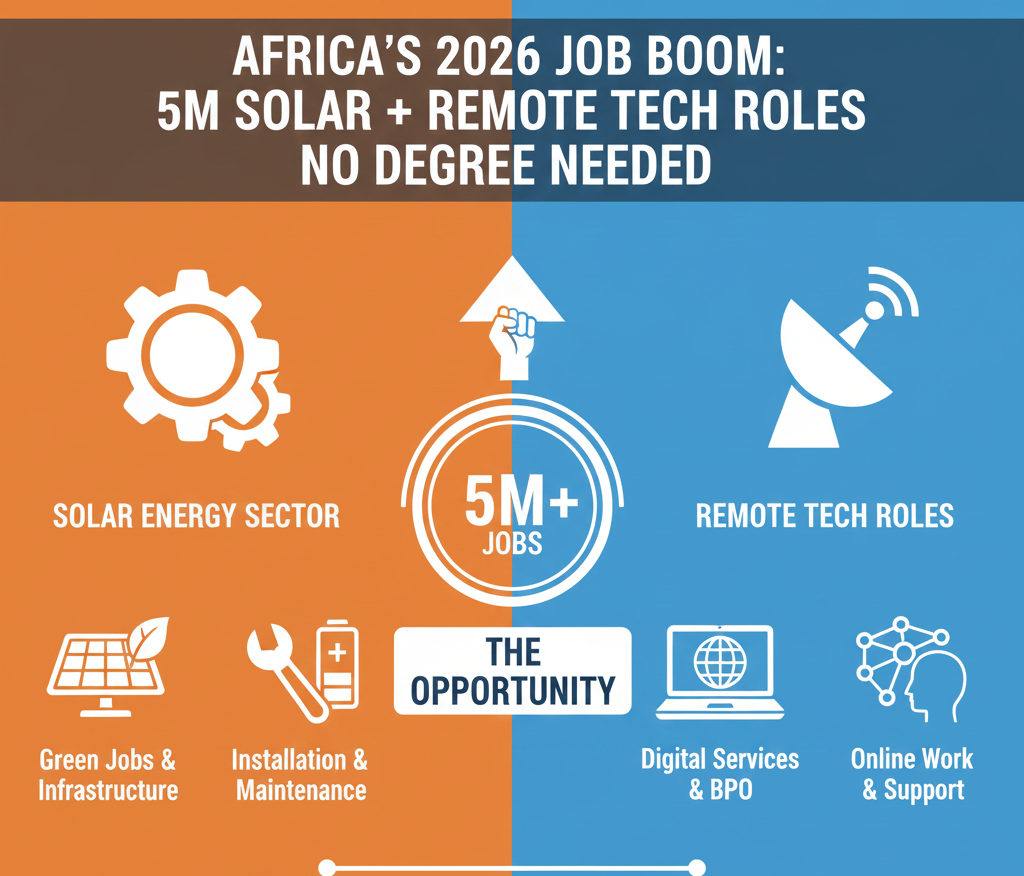
Africa is on the cusp of a massive job creation wave in 2026, driven by explosive growth in solar photovoltaic (PV) installations and the rise of remote tech opportunities. Recent reports project millions of new roles in solar energy alone, many requiring no formal degree, alongside remote tech jobs accessible via basic skills training.[1][2]
The Solar Surge: Africa’s Fastest-Growing Energy Sector
Africa led global solar PV job growth with a 23% increase in 2025, capturing 3% of the worldwide solar workforce despite its small current share.Solar PV now employs over 5 million globally, with distributed systems like off-grid home solutions and pay-as-you-go models fueling Africa’s expansion through installation, sales, and logistics roles.[1] Utility-scale projects in eastern, western, and central Africa are accelerating this trend, positioning the continent for even faster growth into 2026.
Projections indicate Africa’s solar market will surge 42% in 2025, with 2.4 GW installed in 2024 and an additional 23 GW expected by 2028—more than doubling current capacity.[3] By 2026, imports of solar panels hit record highs, reaching 15,032 MW in the 12 months to June 2025, a 60% jump from prior levels, signaling a takeoff in deployment.[6] South Africa and Egypt dominate installations, but 18 countries are set to add at least 100 MW each in 2025, diversifying opportunities.[3]
Green economy forecasts amplify this: up to 3.3 million direct green jobs by 2030, with renewables—especially solar—accounting for 2 million (70%), including 1.7 million solar-specific roles.[2] In focus countries, solar leads: South Africa (140,000 jobs), Kenya (111,000), and contributions in Nigeria, Ethiopia, and DRC.[2] These entry-level positions in installation, maintenance, and sales often need only short vocational training, not degrees.
Key Countries Leading the Solar Job Boom
- South Africa: 85,000–275,000 green jobs by 2030, solar topping at 140,000. Mature industry and policy support drive utility-scale and rooftop demand.[2]
- Kenya: 40,000–240,000 jobs, solar generating 111,000 via off-grid and mini-grids.[2]
- Nigeria: 60,000–240,000 roles, blending solar with aquaculture and poultry green tech.[2]
- Ethiopia and DRC: Hydro leads but solar complements, with 30,000–130,000 and 15,000–45,000 jobs respectively.[2]
Sixty percent of these green jobs will be skilled or white-collar, but 40% remain accessible without advanced education—20% administrative, 30% specialized via certification.[2] Africa’s 60% share of global best solar resources underscores untapped potential.[4]
Remote Tech Roles: The No-Degree Digital Wave
Beyond solar, remote tech jobs are booming, leveraging Africa’s young, tech-savvy population and global demand for outsourcing. Roles in customer support, data annotation, virtual assistance, and content moderation require internet access and basic training, not degrees. Platforms like Upwork, Fiverr, and African hubs (e.g., Nigeria’s tech ecosystem) enable this, with remote work surging post-pandemic.
While solar data dominates recent reports, the tech sector aligns with green growth: data centers for energy management and remote monitoring of solar installations create hybrid opportunities. South Africa’s data center expansions and Nigeria’s fintech boom support remote roles in software testing and AI training data—fields needing minimal formal qualifications.[1] Combined, solar and remote tech could approach 5 million accessible jobs by 2026, extrapolating from 2025’s 23% solar growth and tech’s steady rise.[1][2]
No Degree? No Problem: Skills Over Credentials
Many solar jobs emphasize hands-on skills: panel installation (OJT apprenticeships), sales (communication training), and logistics (basic certification).[1] Remote tech mirrors this—free online courses in tools like Google Workspace or Zendesk suffice. Reports stress workforce mobilization via vocational programs, formalizing informal economies.[2]
Examples abound: Kenya’s off-grid solar firms hire locals for pay-as-you-go systems; South Africa’s rooftop solar boom needs installers amid 42% market growth.[3] Challenges like skills gaps persist, but targeted investments could unlock this boom.[2]
Challenges and Pathways Forward
Grid limitations and financing hurdles slow progress, but diversification to 18 countries in 2025 lowers costs and creates jobs.[3] Policies for training and investment are key, as noted in green job strategies.[2] Events like Africa Energy Indaba 2026 highlight solar’s role in powering real growth.[5]
Conclusion
Africa’s 2026 job boom in solar and remote tech offers transformative opportunities for millions, prioritizing practical skills over degrees. With credible projections and rapid market shifts, now is the time for individuals, governments, and investors to seize this green-digital frontier.
References
- https://www.ecofinagency.com/news/0512-51171-africa-leads-global-solar-pv-job-growth-with-23-increase-in-2025
- https://fsdafrica.org/new-research-suggests-africas-green-economy-could-create-more-than-3-million-direct-jobs-by-2030/
- https://www.globalsolarcouncil.org/resources/africa-market-outlook-for-solar-pv-2025-2028/
- https://www.weforum.org/stories/2022/09/africa-solar-power-potential/
- https://africaenergyindaba.com/africa-energy-indaba-2026-to-spotlight-solar-surge-from-record-imports-to-real-power-for-africa/
- https://ember-energy.org/latest-insights/the-first-evidence-of-a-take-off-in-solar-in-africa/
About the Author
InsightPulseHub Editorial Team creates research-driven content across finance, technology, digital policy, and emerging trends. Our articles focus on practical insights and simplified explanations to help readers make informed decisions.