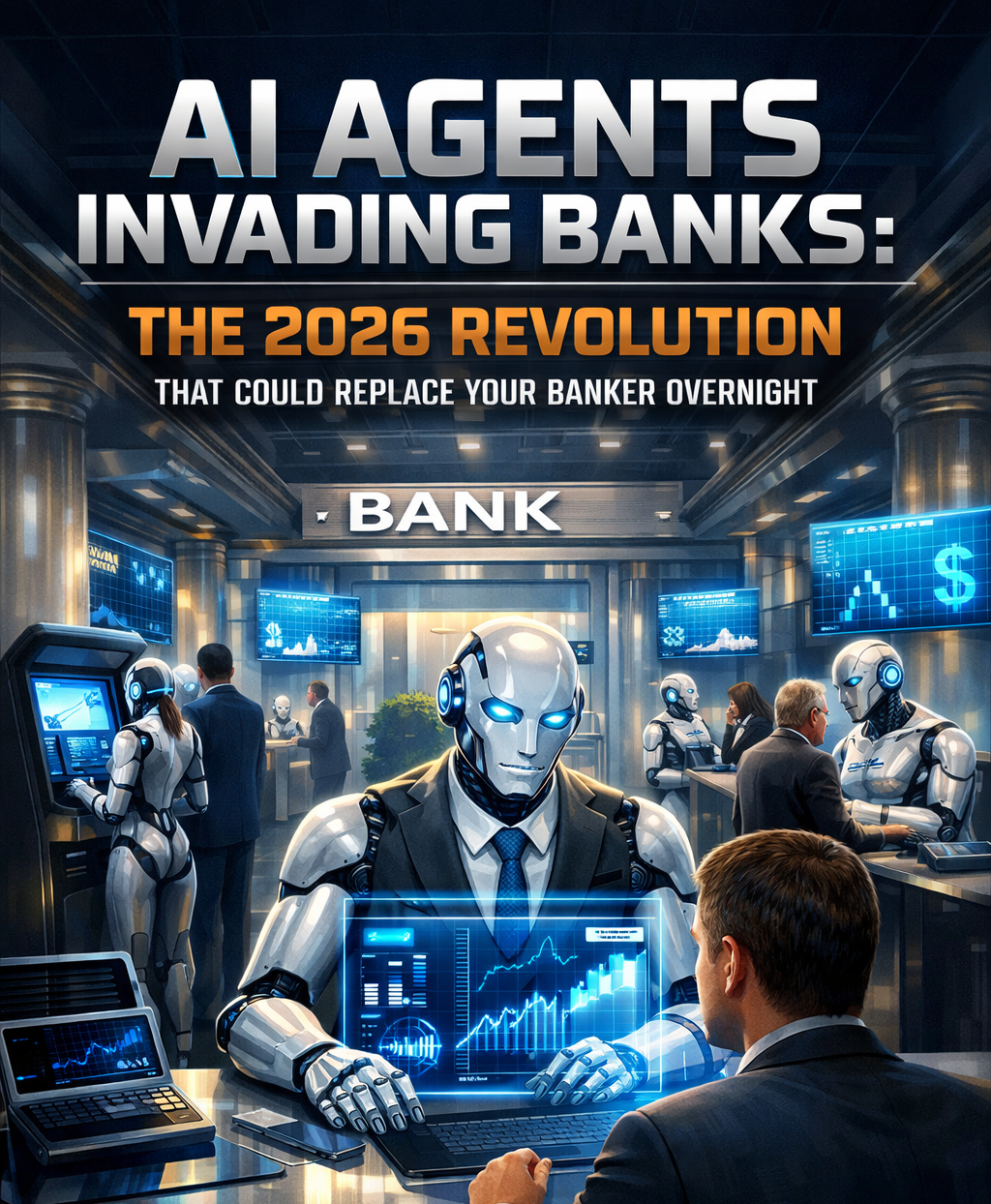
Walk into a bank in 2026 and you may never see the army of operations staff who used to sit behind the scenes. Instead, a fleet of AI agents will be quietly monitoring transactions, approving loans, updating records, and even drafting personalized advice. Human bankers are still there – but more as supervisors and relationship architects than button-pushers.
This is not science fiction. Leading consultancies, technology providers, and banks now agree that agentic AI – autonomous systems that can sense, decide, and act – is fast becoming a new operating layer for financial institutions.[1][2][3][6] The question is no longer whether AI will transform banking, but how far it will go in reshaping jobs, trust, and competition.
What Are AI Agents – And Why Banks Are Embracing Them
AI agents are software entities that can perform multi-step tasks towards a goal with limited human intervention. In banking, they do much more than answer simple queries. They can:
- Detect and block suspicious transactions in real time
- Gather and analyze documents for a loan application
- Reconcile mismatched payments or account entries
- Run compliance checks and flag rule breaches
- Personalize offers based on your behavior and risk profile
Industry research indicates that the shift from static models to agentic AI is a defining feature of banking in 2026. One recent analysis forecasts that banks will deploy fleets of specialized agents – fraud, underwriting, compliance, and personalization – as a new execution layer on top of core systems.[1] CGI’s 2026 banking outlook similarly predicts a rise in agentic AI embedded in transaction correction, account reconciliation, and exception handling, all with humans in the loop.[2]
This transformation is being accelerated by a broader technology trend: by 2026, an estimated 40% of enterprise software applications will include task-specific AI agents, up from under 5% in 2024.[4] Financial institutions see particularly strong returns, with reports of double-digit cost reductions and faster response times when agents take over routine workflows.[3][4][6]
From Experiments to a New Banking Operating System
For much of 2023–2024, many banks treated generative AI as an innovation sandbox – pilots, proofs of concept, and narrow chatbots. That phase is ending.
Recent banking forecasts suggest 2026 as an inflection point where agentic AI becomes an operational fabric rather than a side project. Key shifts include:
1. Real-time, signal-driven decisioning
Analysts argue that in 2026 the gap between AI leaders and laggards will be measured not by model accuracy, but by how quickly banks can activate trusted data at the moment of decision.[1] Instead of nightly batch runs, AI agents ingest live transaction context, customer behavior, risk events, and external credit signals to act instantly. Real-time signals become the primary driver of financial outcomes such as fraud loss, credit losses, and customer retention.[1]
2. From data warehouses to data products
To fuel always-on AI agents, banks are moving away from monolithic data warehouses towards modular “data products” – governed, reusable data sets that agents can query in place.[1] The principle is simple: stop moving data to AI; let AI come to the data. That reduces latency, improves compliance, and makes it easier to plug new agents into existing infrastructure.
3. Semantic layers and AI governance
As dozens of models, copilots, and agents spread across a bank, traditional governance quickly breaks down. A growing consensus is that a semantic layer – a consistent business vocabulary and rules layer on top of data – will become mandatory to keep AI explainable, auditable, and aligned to regulation.[1] Without this, a bank risks inconsistent decisions, opaque risk exposures, and regulatory pushback.
Major technology firms emphasize the same point: banks that succeed with AI are those that combine strong data foundations, governance, and change management with the rollout of agents.[5][6]
Where AI Agents Are Already Replacing Traditional Banking Work
While much of the conversation is about the future, AI agents are already performing tasks that used to require entire teams.
Fraud detection and transaction monitoring
Fraud agents monitor transactions in real time, cross-check devices, locations, histories, and anomaly patterns, and either block or escalate suspicious activity automatically.[1][2] Combined with richer data and continuous learning, banks report significant reductions in fraud losses and much faster response times.[4][6]
Loan origination and underwriting
In commercial and consumer lending, agents can gather documents, verify identity data, analyze financial statements, and run policy checks in parallel. Industry surveys cited by banking providers and consultancies note that AI-enabled underwriting can shrink processing times from days to hours, with early adopters achieving around 20% faster throughput and lower operating costs compared with traditional approaches.[3][6]
Some statistics gathered across bank deployments suggest that using agents in loan origination can cut approval times dramatically while reducing fraud through deeper real-time checks.[4]
Compliance and risk
Compliance agents continuously scan transactions and client data against evolving regulatory rules, flagging or even auto-resolving lower-risk issues. Risk agents can run real-time credit scoring and portfolio monitoring, enabling dynamic pricing and early warning on deteriorating exposures.[1][2][6]
Analyses of AI adoption in commercial banking indicate that around 70% of banks have applied AI in at least one core function, with most reporting positive ROI within 18 months.[6] Agentic operations are an extension of this trend: autonomous workflows for onboarding, KYC, reconciliation, and audit are expected to become normal in large institutions.[6]
Customer service and personalized engagement
Customer-facing AI is also maturing from simple Q&A bots to proactive, agentic assistants. A prominent example is Bank of America’s virtual assistant Erica, which has handled more than 2.5 billion client interactions and serves over 20 million customers, offering not just answers but proactive financial insights.[6] Microsoft similarly reports banks deploying multiple agents for service routing, workflow automation, and cross-team collaboration.[5]
In 2026, these assistants are increasingly tied into back-office agents: the same AI that chats with you can also trigger a card replacement, resize a credit line, or re-route a payment – with human review only where risk thresholds demand it.
Will AI Agents Really Replace Your Banker?
Talk of AI “replacing” bankers overnight is deliberately provocative – but it is not entirely misplaced. Roles are changing quickly.
Tasks vs. jobs
Research across financial services consistently finds that AI agents are best at tasks, not full relationship roles.[3][4][5] They:
- Handle repetitive, high-volume processes more accurately and cheaply
- Surface insights from vast data that humans would miss
- Run 24/7 without fatigue, which is critical for fraud and payments
For many operational and mid-office positions, this means a real reduction in manual workload. Some functions – such as basic reconciliations or straightforward compliance checks – will be largely automated. Banking executives increasingly describe their goal as “releasing capacity” rather than simply cutting headcount, but the pressure to do more with fewer people is clear.[3][4][6]
The rise of the AI-augmented relationship manager
On the customer-facing side, AI is reshaping what human bankers do. CGI and others forecast a model in which banks become more real-time, intelligent, and human-centric: AI runs the background while people focus on complex needs and trust-sensitive conversations.[2][5]
In practice, that may look like this:
- An agent runs a complete financial health check on a client overnight and recommends a tailored restructuring plan.
- The relationship manager reviews, adjusts, and then presents the plan, spending time on trade-offs and scenarios instead of data crunching.
- Post-meeting, an agent schedules follow-ups, generates documentation, and keeps the portfolio in continuous monitoring mode.
Your banker is not removed from the loop – but the parts of their job that feel like a spreadsheet marathon increasingly are.
Risks, Regulation, and the Human-in-the-Loop Imperative
Autonomous systems in a tightly regulated industry bring obvious risks.
Model risk and bias
AI agents are only as reliable as their data and design. Poorly governed systems can amplify bias in lending decisions, misinterpret unusual but legitimate behavior as fraud, or miss subtle compliance breaches. That is why many 2026 outlooks emphasize semantic layers and rigorous, end-to-end AI risk frameworks as a condition for scale.[1][2][6]
Accountability and transparency
Regulators and supervisors increasingly expect banks to explain how AI-driven decisions are made, especially in credit, pricing, and customer outcomes. Microsoft, for example, highlights responsible AI principles and tooling as a core success factor for financial institutions deploying agents at scale.[5] Banks must define clear accountability: when an AI agent blocks a transfer or declines a loan, who answers to the customer and regulator?
Operational resilience
Autonomous ecosystems can make banks more resilient – self-healing payment routing, automatic error correction, and continuous monitoring.[2] But they also create new single points of failure: a misconfigured agent can propagate errors at machine speed. Robust testing, circuit breakers, and human override mechanisms are critical.
What This Means for You as a Customer
For retail and business customers, the AI agent invasion will be most visible in three ways:
- Speed and availability: Decisions on card disputes, loans, and service requests will increasingly be near-instant and 24/7.
- Personalization: Offers, alerts, and advice will feel more tailored – whether that is a warning about overspending or a suggestion to optimize idle cash.
- Fewer visible humans: Routine interactions will happen through apps, chat, or voice assistants. Humans will appear mainly for complex negotiations, complaints, or large-value decisions.
Behind the scenes, however, the human role is not disappearing. Banks are retraining staff, as seen in large-scale AI training mandates at major institutions, to supervise AI, handle exceptions, and manage relationships in an increasingly automated environment.[6]
Preparing for the 2026 Banking AI Reality
If the next two years belong to agentic AI, banks and customers both have homework to do.
- Banks need to upgrade data foundations, clarify governance, invest in AI literacy, and design human-in-the-loop operating models.
- Employees should expect their roles to evolve toward oversight, exception handling, and higher-value advisory work – and seek training accordingly.
- Customers can push for transparency: ask banks how they use AI, how they protect data, and how you can appeal automated decisions.
AI agents may not fully “replace your banker overnight,” but by 2026 they are likely to handle much of what your banker used to do. The institutions that thrive will be those that combine the precision and speed of machines with the judgment and empathy of humans – turning AI from a black-box risk into a trusted part of everyday banking.
References
- https://www.datamanagementblog.com/2026-banking-predictions-from-risk-to-revenue-why-banks-are-re-architecting-ai-around-real-time-signals/
- https://www.cgi.com/en/blog/banking-and-capital-markets/2026-predictions-banking-real-time-intelligent-and-human-centric
- https://www.ncino.com/blog/agentic-ai-banking-revolution-autonomous-intelligence
- https://www.secondtalent.com/resources/ai-agents-statistics/
- https://www.microsoft.com/en-us/industry/blog/financial-services/2025/12/18/ai-transformation-in-financial-services-5-predictors-for-success-in-2026/
- https://www.backbase.com/banking-predictions-report-2026/ai-and-the-future-of-banking