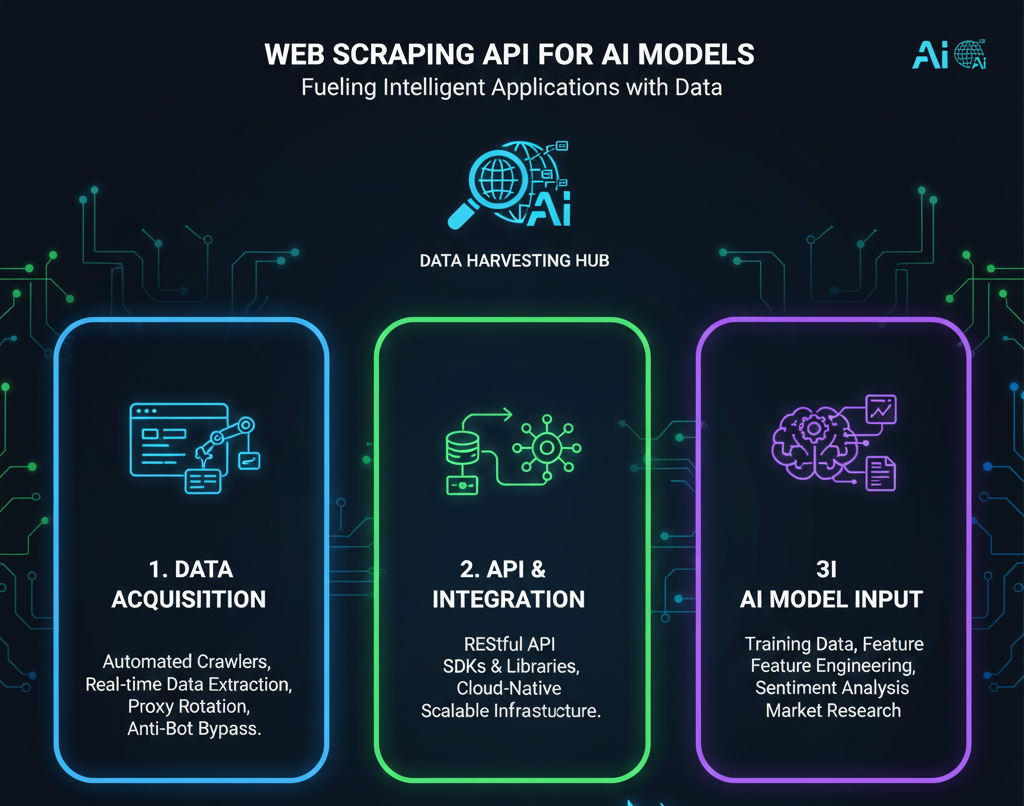
As AI models move from static training sets to live, retrieval-augmented generation (RAG) and agentic workflows, web scraping APIs have become core infrastructure. In 2026, the question is no longer whether you scrape – it’s how reliably, how ethically, and how easily you can turn messy web pages into model-ready data.
This guide walks through the best web scraping APIs for AI workloads in 2026, how they differ, and what to look for if you are powering LLMs, RAG systems, or autonomous agents with real-time web data.
Why AI Teams Need Scraping APIs in 2026
Modern AI products demand fresh, structured web data for tasks like:
- Feeding RAG pipelines with up-to-date documentation, news, and product info
- Training or fine-tuning models on domain-specific web content
- Equipping AI agents to browse, extract, and act on live websites
Recent tooling trends show a clear shift from low-level HTTP + HTML parsing to AI-native scraping platforms that integrate anti-bot handling, JavaScript rendering, and automatic data extraction into a single API.[1][3][5]
Key Evaluation Criteria for AI-Focused Web Scraping APIs
Before choosing a provider, AI teams should evaluate:
- Dynamic site support: Can it handle JavaScript-heavy pages, logins, infinite scroll, and form submissions via cloud browsers or headless automation?
- Anti-bot & geo controls: Built-in IP rotation, residential/mobile proxies, and automatic retry logic to reduce blocks.[3][5]
- Output formats for AI: Clean JSON, Markdown, or structured text that plugs directly into LLM pipelines (vector databases, fine-tuning datasets, etc.).[3][5]
- AI-powered extraction: Ability to infer page structure and return labeled fields without writing CSS/XPath selectors.[1][3][5]
- Scale & latency: Throughput, concurrency limits, SLAs, and response times when scraping thousands of pages per minute.
- Compliance & governance: Controls for robots.txt respect, rate limiting, consent, and jurisdictional data rules.
- Developer ergonomics: SDKs, dashboards, job schedulers, webhooks, and integrations with LLM and data tooling.
1. Bright Data Web Scraper API – Enterprise-Grade for Large AI Pipelines
Bright Data is consistently highlighted as one of the most capable large-scale web scraping APIs in 2026, especially for teams building production AI systems.[1][2][5] Its Web Scraper API combines a mature proxy network with AI-aware extraction and job orchestration.
According to recent 2026 buyer and comparison guides, Bright Data offers:
- Dynamic site support via cloud browsers and JavaScript rendering for complex, interactive pages.[1][2]
- Anti-bot automation with rotating residential and mobile IPs, CAPTCHA handling, and adaptive throttling.[2][5]
- Structured output to JSON and CSV that slots directly into analytics pipelines and LLM workflows.[2][5]
- Global reach with granular geo-targeting across many countries and regions.[2][5]
For AI use cases like large-scale RAG over e‑commerce, travel, or job listings, Bright Data’s infrastructure and compliance posture make it a strong fit. The trade-off is that pricing and complexity tend to be more enterprise oriented, which may be overkill for smaller experiments.
2. Scrapfly – A Universal API with AI-Powered Extraction
Scrapfly positions itself as a universal web scraping platform that can extract from almost any site – including search engine result pages (SERPs) – using AI-powered models that automatically parse and structure content.[3]
Recent 2026 SERP API comparisons highlight these features:[3]
- Single endpoint for many sources (SERPs, articles, product pages) instead of juggling multiple specialized APIs.
- Automatic extraction: Scrapfly’s models detect titles, content blocks, metadata, and entities without manual selector rules.[3]
- Anti-bot bypass with integrated unblocking, rotating residential proxies, and robust failure handling.[3]
- Multi-format output: HTML, JSON, text, or Markdown, which is especially handy for LLM pipelines.[3]
- SDKs for Python and TypeScript, plus integrations with Scrapy and popular no-code tools.[3]
For AI developers who want to minimize scraping boilerplate, Scrapfly’s automatic extraction and flexible formats can dramatically reduce preprocessing overhead when building RAG or search-augmented applications.
3. Firecrawl – AI‑First Scraping for LLM and RAG Workloads
Among newer tools, Firecrawl stands out as a scraping API designed from the ground up for AI and LLM workflows.[5] Instead of delivering raw HTML, Firecrawl focuses on converting web pages into clean, model-ready text.
Recent analyses of 2026 scraping platforms describe Firecrawl’s value proposition as:[5]
- URL in, Markdown out: You send a URL and get back cleaned, structured Markdown that models can consume directly.[5]
- AI-first design: Built primarily to power RAG, documentation search, and AI agents that need to “read” pages rather than extract specific fields.[5]
- Fast-growing ecosystem, with very high GitHub interest as developers adopt it for LLM-centric stacks.[5]
The main trade-off is that Firecrawl is less about granular field extraction (e.g., price, SKU, rating) and more about semantic content ingestion. If you are building an AI knowledge base, contextual search, or analytic summarization, it’s a compelling choice. For tightly structured e‑commerce extraction, a more schema-oriented API may still be better.
4. Apify‑Style AI Agents and No‑Code Scrapers
In parallel to low-level APIs, 2026 has seen the rise of AI web scraping agents and no-code platforms that expose scraping workflows over simple HTTP interfaces. Tools like Apify Actors, Octoparse-style services, and new AI agents let users orchestrate crawlers with natural language and integrate with LLMs.[1][4][6]
Recent overviews of AI scraping tools emphasize that these platforms typically provide:[1][4][6]
- Prebuilt scrapers (“actors”) for common sites like TikTok, Instagram, Google Maps, and major e‑commerce platforms.[1]
- No-code workflow builders and AI assistants where you describe the task in natural language rather than writing code.[1][4][6]
- Scheduling & orchestration to run scrapes periodically and push data into databases, warehouses, or vector stores.[1]
- API and webhook access, so every workflow can be triggered or consumed programmatically by your AI stack.[1][4]
For many AI teams, this model fits best when scraping is just one component of a larger automation pipeline – for example, continuously ingesting competitor pricing into a RAG system or monitoring social feeds and pushing summaries into a CRM.
5. AI‑Native Scraping Services and Buyer’s Guides
Beyond individual products, several 2026 buyer’s guides help teams compare modern scraping services on dimensions important to AI.[5][6] Common themes include:
- AI-powered extraction (sometimes branded as “copilots”) that produce directly usable JSON schemas with minimal setup.[5][6]
- Hybrid no-code + API approaches: design flows visually, then call them via REST from your AI apps.[1][4][6]
- Focus on compliance, with clear documentation on data sources, opt-out policies, and geographic storage.
These guides also flag trade-offs: some long-standing providers score highly on reliability and anti-bot success but may be more expensive and complex, while newer AI-first tools optimize for developer experience and LLM compatibility.[5]
How to Choose the Right Web Scraping API for Your AI Models
The “best” web scraping API in 2026 depends heavily on your workload. A practical way to decide is to map providers to your most common AI patterns.
For RAG and Knowledge Ingestion
- Prioritize APIs that output clean text or Markdown and support automatic boilerplate removal and content extraction, like Firecrawl or universal extraction platforms.[3][5]
- Look for integrations with vector databases or data warehouses to streamline ingestion.
For Structured Data Extraction (Pricing, Listings, Leads)
- Favor providers with mature schema-driven JSON output, strong anti-bot success rates, and SERP/e‑commerce support (e.g., Bright Data, Scrapfly, and AI-powered traditional platforms).[2][3][5]
- Measure success rate, latency, and cost per 1,000 results under realistic load.
For AI Agents That Browse and Act
- Consider AI agent platforms and no-code + API tools that can fill forms, handle logins, and navigate workflows using natural language instructions.[1][4]
- Ensure you have guardrails for where and how agents are allowed to scrape, especially in regulated industries.
Best Practices for Using Web Scraping APIs with AI
Whatever provider you pick, a few best practices can dramatically improve outcomes:
- Respect legal and ethical constraints: Review terms of service, robots.txt, and applicable regulations; implement internal allowlists/denylists.
- Normalize early: Convert scraped output into consistent schemas and text formats near the ingestion point to avoid downstream complexity.
- Cache aggressively: Store results where possible to reduce repeated scrapes and costs while improving latency.
- Monitor quality: Track extraction accuracy, block rates, and model performance against scraped content over time.
Conclusion
In 2026, web scraping APIs have evolved into AI data infrastructure: they don’t just fetch HTML; they deliver structured, model-ready context at scale. Enterprise-focused platforms like Bright Data excel at high-volume, globally distributed scraping. AI-native tools such as Scrapfly and Firecrawl streamline extraction into JSON or Markdown for RAG and LLMs, while Apify-style agents and no-code tools make complex workflows accessible via simple APIs.
The right choice depends on whether your AI models need structured fields, semantic content, or full browsing capabilities. By prioritizing dynamic site support, AI-powered extraction, compliance, and developer ergonomics, you can select a web scraping API that will power your AI products reliably through 2026 and beyond.
References
- https://www.gptbots.ai/blog/web-scraping-ai-agents
- https://dsssolutions.com/2025/12/07/the-best-web-scraping-apis-for-ai-models-in-2026/
- https://scrapfly.io/blog/posts/google-serp-api-and-alternatives
- https://www.gumloop.com/blog/how-to-scrape-data-from-a-website
- https://scrape.do/blog/zyte-alternatives/
- https://tagxdata.com/2026-buyer-s-guide-to-choosing-the-right-web-scraping-services
About the Author
InsightPulseHub Editorial Team creates research-driven content across finance, technology, digital policy, and emerging trends. Our articles focus on practical insights and simplified explanations to help readers make informed decisions.