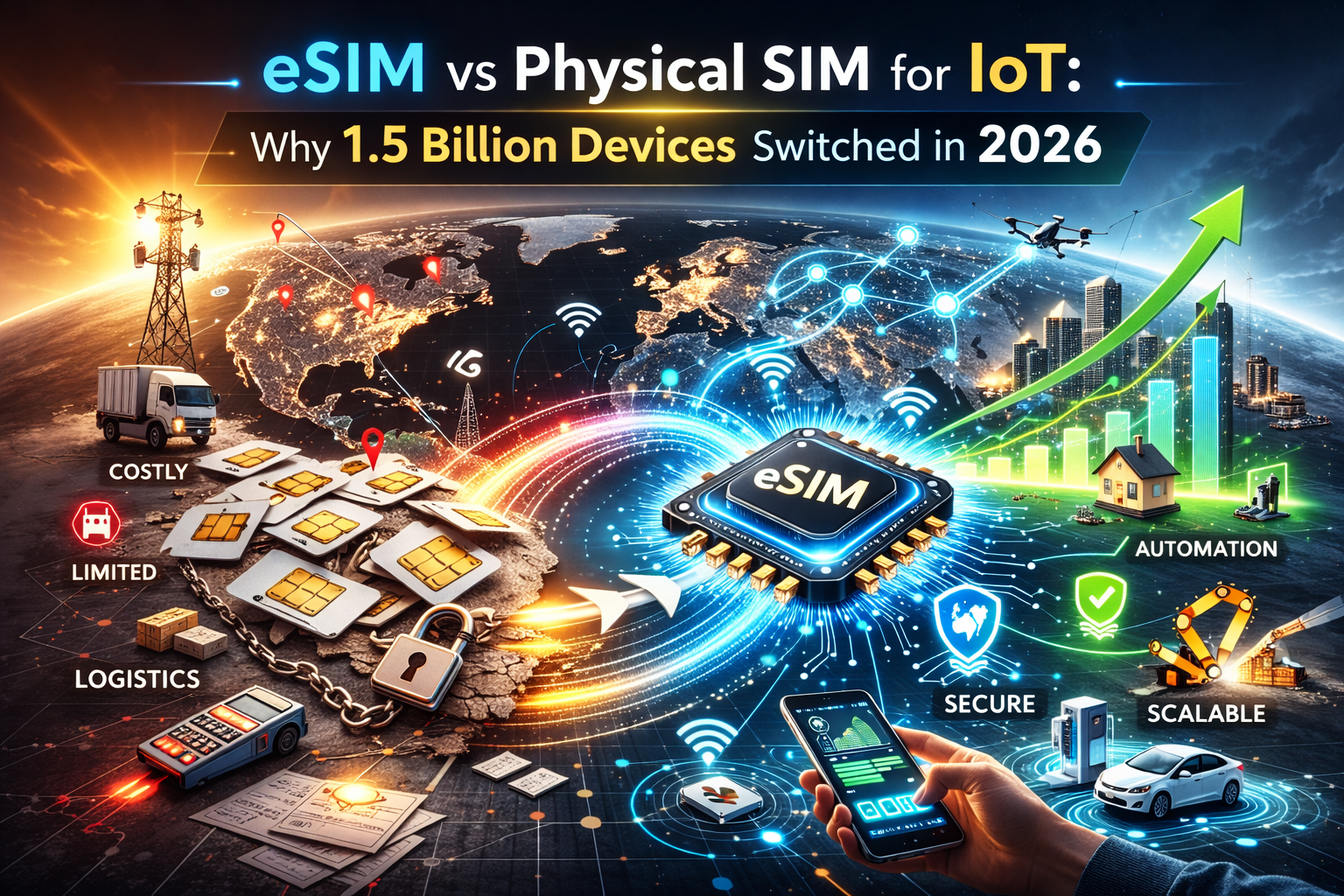
Your fleet of 10,000 delivery trucks just crossed into a new country. With physical SIM cards, that’s a logistical nightmare—technicians, warehouse visits, carrier contracts, and weeks of downtime. With eSIM, it’s a software update that takes seconds. Welcome to the reason 1.5 billion devices switched to eSIM in 2026.
The numbers are staggering. According to Juniper Research, eSIM connections grew 30% in 2026 to hit 1.5 billion devices globally—up from 1.2 billion in 2025. But this isn’t smartphone-driven growth. The real explosion is happening in the Internet of Things, where connected logistics, oil & gas, and smart street lighting are adding 75 million new eSIM connections this year alone.
What’s driving this mass migration? A single technical standard called SGP.32—the GSMA’s eSIM specification for IoT that enables server-driven bulk activation. Released in 2025, it’s transforming how enterprises deploy and manage cellular connectivity at scale.
This guide explains why eSIM is winning, what SGP.32 changes, and whether your IoT deployment should make the switch.
The eSIM Advantage: Five Reasons IoT Is Switching
eSIM (embedded SIM) technology isn’t new—it dates back to 2016. But 2026 marks an inflection point where the business case became undeniable for large-scale IoT deployments. Here’s why:
1. Zero-Touch Deployment at Scale
Traditional SIM deployment requires physical handling: procurement, warehousing, insertion, and activation. For global IoT deployments, this creates massive friction.
Consider the alternative with eSIM auto-provisioning:
- Devices ship from factory with eSIM already embedded
- On first power-up, device connects to connectivity management platform
- Platform instructs remote SIM provisioning server to download appropriate profile
- Device activates automatically—no human intervention
For a fleet of 10,000 vehicles, this eliminates:
- Warehouse storage of multiple SIM SKUs for different regions
- Technician time for physical SIM insertion
- Shipping delays waiting for region-specific SIM cards
- Customs complications with physical SIM imports
As one logistics provider noted: “We went from 6-week deployment cycles to same-day activation across 40 countries.”
2. Remote Carrier Switching Without Truck Rolls
Physical SIMs lock you into a carrier for the device’s lifetime—or require expensive site visits to swap cards. eSIM enables over-the-air carrier changes.
Real-world scenario: Your smart meters are deployed across Europe on Carrier A. Carrier B offers 40% better rates in Germany. With physical SIMs, you’re stuck or facing thousands of truck rolls. With eSIM, you push a new profile remotely. The meters never stop transmitting.
This agility matters when:
- Carriers change pricing or sunset networks
- Devices move between countries with roaming restrictions
- Regulatory requirements mandate local connectivity
- Mergers and acquisitions consolidate carrier relationships
3. Always-On Connectivity with Automatic Failover
IoT devices often operate where cellular coverage is inconsistent—remote industrial sites, moving vehicles, underground utilities. eSIM enables multi-profile devices that automatically switch networks when primary coverage fails.
Modern eSIM routers can:
- Store 5-10 carrier profiles simultaneously
- Monitor signal strength across all available networks
- Automatically fail over to strongest available carrier
- Maintain connectivity during network outages or maintenance
For critical infrastructure—smart grids, healthcare monitoring, industrial safety systems—this redundancy isn’t optional. It’s essential.
4. Enhanced Physical and Network Security
Physical SIM slots create attack surfaces. SIM theft, swapping, and tampering are real threats for devices deployed in unsecured locations—outdoor cabinets, vehicles, remote industrial sites.
eSIM eliminates the physical slot entirely. The chip is soldered to the device board, making it:
- Impossible to remove without destroying the device
- Resistant to environmental damage (vibration, temperature, moisture)
- Protected by hardware secure elements with encryption
- Remotely disableable if device is compromised
Additionally, eSIM profiles are encrypted and transmitted over secure channels. If a device is stolen, the connectivity profile can be remotely wiped—rendering the hardware useless to thieves.
5. Massive Operational Cost Reduction
The financial case for eSIM is compelling. Organizations report:
| Cost Category | Physical SIM | eSIM | Savings |
|---|---|---|---|
| SIM logistics & warehousing | $3-5 per device | $0.50 per device | 80-90% |
| Technician deployment costs | $50-200 per site visit | $0 (remote) | 100% |
| Carrier switching | $50-150 per device | $0 (OTA) | 100% |
| Inventory management | Complex multi-SKU | Single global SKU | Simplified |
| Time to market | 4-8 weeks | Same day | 95% |
For enterprises deploying hundreds of thousands of devices, these savings translate to millions of dollars annually.
The Game Changer: SGP.32 and the Push Model
The 2026 eSIM explosion isn’t just about technology maturation—it’s about a fundamental architectural shift enabled by the GSMA’s SGP.32 standard, launched in 2025.
Understanding the Old vs. New Model
Previous eSIM standards (SGP.02 for M2M, SGP.22 for consumer) used a “pull” model:
- Device requests a profile from the server
- One device at a time
- Requires device-initiated communication
- Inefficient for bulk provisioning
SGP.32 introduces the “push” model:
- Server pushes profiles to multiple devices simultaneously
- Centralized orchestration of deployments
- Bulk activation of thousands of devices
- Enterprise-friendly management interface
As Juniper Research analyst Ardit Ballhysa explains: “Enterprise users demand a completely different set of requirements; primarily a server-oriented approach that allows for centralized orchestration of deployments. For enterprise IoT users, it is inefficient to use a pull model to provision so many devices, and eSIM platforms need to adapt.”
What SGP.32 Enables
| Capability | Before SGP.32 | With SGP.32 |
|---|---|---|
| Bulk provisioning | Limited, device-initiated | Mass activation from central server |
| Deployment speed | Days to weeks | Hours to minutes |
| Management interface | Carrier-specific portals | Unified enterprise dashboard |
| Scalability | Thousands of devices | Millions of devices |
| IoT optimization | Adapted from consumer models | Purpose-built for IoT constraints |
Fastest-Growing SGP.32 Sectors in 2026
Juniper Research identified three sectors driving the 75 million new eSIM connections in 2026:
Connected Logistics
Global supply chains require seamless connectivity across borders. eSIM enables:
- Single SKU for global fleet deployment
- Automatic carrier switching at borders
- Real-time tracking without roaming gaps
- Remote troubleshooting and updates
Oil & Gas
Remote, hazardous environments make physical SIM maintenance expensive and dangerous:
- Offshore platforms with limited technician access
- Pipelines spanning multiple countries and carriers
- Explosive atmospheres where device openings are restricted
- 10+ year device lifecycles requiring carrier flexibility
Smart Street Lighting
Cities deploying thousands of connected luminaires benefit from:
- Bulk activation of entire districts
- Centralized management across multiple carriers
- Long-term flexibility as city contracts evolve
- Reduced maintenance costs (no lamp post visits for SIM issues)
eSIM vs Physical SIM vs iSIM: The Complete Comparison
Not all “eSIM” is created equal. Understanding the differences helps you choose the right technology for your deployment:
| Feature | Physical SIM | eSIM (eUICC) | iSIM |
|---|---|---|---|
| Form Factor | Removable (2FF/3FF/4FF) | Soldered MFF2 (6×5mm) | Integrated in modem chip |
| Profiles | Single, carrier-locked | 5-10 profiles, switchable OTA | Multiple profiles, switchable OTA |
| Provisioning | Physical insertion required | Remote OTA provisioning | Remote OTA provisioning |
| Physical Security | Vulnerable to theft/swapping | Soldered, tamper-resistant | Highest security (no external interface) |
| Power Consumption | Standard | Standard | Lowest (integrated design) |
| Cost | Lowest component cost | Moderate (higher BOM, lower logistics) | Lowest total cost (no separate component) |
| Best For | Consumer devices, short lifecycle | Industrial IoT, global deployments | Small, battery-powered IoT (wearables, sensors) |
Market Projection (GSMA Intelligence): By 2030, eSIM will account for 37% of cellular IoT connections, iSIM for 34%, and traditional SIM for 29%.
The Market Numbers: Understanding the 1.5 Billion
Let’s break down where those 1.5 billion eSIM connections come from:
By Device Type (2026)
| Device Category | Share of eSIM Market | Growth Driver |
|---|---|---|
| Smartphones | ~66% | Apple eSIM-only flagships, carrier adoption |
| IoT/M2M Modules | ~29% | SGP.32, industrial automation, smart cities |
| Connected Cars | ~42% of IoT segment | UN-R155 mandates, telematics, OTA updates |
| Wearables | Growing rapidly | Smartwatches, health monitors, pet trackers |
Regional Breakdown
- North America: 35.7% market share, 90% smartphone eSIM penetration expected by 2030
- Asia-Pacific: Fastest growing at 24% CAGR, driven by China, Japan, South Korea smart city initiatives
- Europe: Harmonized regulatory frameworks favor remote provisioning
Market Size Projections
| Metric | 2025 | 2026 | 2030 | CAGR |
|---|---|---|---|---|
| eSIM Connections (Global) | 1.2 billion | 1.5 billion | 4.9 billion | 30%+ |
| Market Value | $1.76 billion | $2.12 billion | $7.62-16.9 billion | 17-20% |
| IoT eSIM Shipments | 142.7 million | ~185 million | 500+ million | 28.2% |
When to Choose eSIM for Your IoT Deployment
eSIM isn’t right for every use case. Here’s the decision framework:
Choose eSIM When:
- Global deployment: Devices will operate in multiple countries
- Large scale: Thousands to millions of devices
- Long lifecycle: 5-15 year device lifespan with evolving connectivity needs
- Remote/hazardous locations: Physical access is difficult or dangerous
- Carrier flexibility: You need optionality to switch providers
- Security critical: Physical SIM theft/tampering is a concern
Stick with Physical SIM When:
- Consumer devices: Short lifecycle, single-country use
- Low complexity: Small deployments, minimal logistics overhead
- Cost-sensitive: Lowest possible BOM cost is paramount
- Legacy compatibility: Existing infrastructure optimized for removable SIMs
Consider iSIM When:
- Ultra-small devices: Wearables, sensors, asset tags
- Battery-constrained: Every milliwatt matters
- Highest security: No external interfaces to attack
- Cost optimization: Eliminate separate SIM component entirely
Implementation Roadmap: Migrating to eSIM
If you’re considering the switch, here’s the phased approach:
Phase 1: Platform Selection (Months 1-2)
- Evaluate connectivity management platforms (CMPs)
- Assess SGP.32 compliance and push model capabilities
- Negotiate multi-carrier agreements
- Establish global data pools for cost optimization
Phase 2: Pilot Deployment (Months 3-4)
- Deploy 100-500 devices in controlled environment
- Test remote provisioning workflows
- Validate carrier switching procedures
- Measure actual vs. projected cost savings
Phase 3: Scale-Up (Months 5-12)
- Ramp to full production volumes
- Implement bulk provisioning via SGP.32
- Integrate with device management systems
- Train operations teams on new workflows
Phase 4: Optimization (Year 2+)
- Negotiate carrier contracts based on actual usage patterns
- Implement intelligent network selection algorithms
- Explore iSIM for next-generation devices
- Integrate satellite-cellular hybrid connectivity
The Future: Beyond 1.5 Billion
The 1.5 billion milestone in 2026 is just the beginning. Several trends will accelerate eSIM adoption:
Satellite-Cellular Convergence
Hybrid chipsets now roam seamlessly between terrestrial NB-IoT and narrowband NTN satellite. Single-SKU devices can maintain connectivity anywhere on Earth—critical for agriculture, maritime, and remote asset tracking.
China Market Opening
With China Unicom launching eSIM support in early 2026, the world’s largest mobile market adds 1.7 billion potential subscriptions. Chinese OEMs are expected to integrate eSIM across mid-and low-end devices, dramatically expanding the addressable market.
iSIM Mainstreaming
By 2027, iSIM is expected to dominate small, battery-powered IoT devices. The integration of secure elements directly into cellular modem chips reduces cost, power, and size—enabling new categories of connected devices.
AI-Driven Connectivity Optimization
Machine learning algorithms will automatically select optimal networks based on real-time conditions, cost, and application requirements—making multi-profile eSIM devices truly intelligent.
Conclusion: The Switch Is Irreversible
The migration of 1.5 billion devices to eSIM in 2026 isn’t a trend—it’s a fundamental shift in how connectivity is managed at scale. The combination of SGP.32’s push provisioning, operational cost reductions, and enhanced security creates a compelling case that physical SIMs simply cannot match for enterprise IoT.
For organizations deploying connected devices globally, the question is no longer “Should we use eSIM?” but “How quickly can we migrate?” The competitive advantages—faster time-to-market, lower operational costs, greater flexibility—are too significant to ignore.
The 75 million new connections in connected logistics, oil & gas, and smart street lighting are just the beginning. As SGP.32 adoption accelerates and iSIM technology matures, eSIM will become the default connectivity standard for IoT.
The physical SIM’s days are numbered. The future is embedded, remote, and intelligent. The future is eSIM.
References
- Juniper Research – eSIM Connections to Reach 1.5bn Globally in 2026
https://www.juniperresearch.com/press/esim-connections-reach-1bn-globally-in-2026/
Juniper Research study showing 30% growth to 1.5 billion eSIM devices, with 75 million new connections in connected logistics, oil & gas, and smart street lighting. - TechRadar Pro – eSIM adoption could reach a major milestone in 2026
https://www.techradar.com/pro/esim-adoption-could-reach-a-major-milestone-in-2026-but-can-it-cope-with-demand
Analysis of 30% growth to 1.5 billion devices and the shift from consumer to IoT-driven adoption. - Mordor Intelligence – eSIM Market Size, Growth, Trends – Share Analysis 2025
https://www.mordorintelligence.com/industry-reports/embedded-sim-market
Market analysis showing eSIM growing from 0.65 billion units (2026) to 2.12 billion (2031) at 26.27% CAGR, with IoT modules growing at 28.2% CAGR. - Fortune Business Insights – eSIM Market Size, Share, Growth & Forecast Analysis [2034]
https://www.fortunebusinessinsights.com/industry-reports/embedded-sim-esim-technology-market-100372
Market valuation at $2.12 billion (2026) growing to $7.62 billion by 2034, with North America holding 35.7% market share. - ABI Research – eSIM Market Shipments, 2025 to 2030
https://www.abiresearch.com/news-resources/chart-data/esim-market
Forecast showing 490 million eSIM shipments in 2024, with automotive as top IoT segment (60 million shipments, 42% of IoT market). - KORE Wireless – eSIM 101: An Introduction to eSIM for IoT
https://www.korewireless.com/blog/esim-101-an-intro-to-esim-for-iot/
Overview of eSIM benefits for IoT including remote provisioning, carrier flexibility, and global deployment simplification. - KORE Wireless – Remote SIM Card Provisioning for Expansive IoT Networks
https://www.korewireless.com/blog/esim-and-auto-provisioning-a-zero-touch-approach/
Detailed explanation of auto-provisioning, zero-touch deployment, and bulk provisioning capabilities. - Teltonika Networks – Five Reasons to Use an eSIM Router for Your IoT Solutions
https://www.teltonika-networks.com/newsroom/five-reasons-to-use-esim-router-for-your-iot-solutions
Practical benefits including centralized management, automatic failover, carrier switching, security, and faster global rollouts. - IXT – eSIM for IoT: How it works, benefits and implementation
https://ixt.io/esim-for-iot
Technical comparison of eSIM vs traditional SIM vs iSIM, with GSMA Intelligence projections for 2030 market share. - Onomondo – What are eSIMs? And when to use them for IoT
https://onomondo.com/blog/what-is-an-esim/
Clarification of eSIM terminology (embedded SIM form factor vs eUICC software architecture) and selection guidance.
Disclaimer
Important Notice: This article is for informational and educational purposes only and does not constitute professional telecommunications, IoT deployment, or procurement advice. The market projections, cost savings, and adoption statistics are based on publicly available research from Juniper Research, Mordor Intelligence, and other cited sources as of early 2026. Actual results vary based on specific deployment scenarios, carrier agreements, regulatory environments, and technical implementations. SGP.32 standard adoption is ongoing; verify carrier and platform support before making implementation decisions. The cost savings cited are illustrative examples, not guaranteed outcomes. Organizations should conduct their own due diligence and consult qualified telecommunications professionals before making eSIM migration decisions. The author and publisher disclaim any liability for deployment failures, connectivity issues, or financial losses resulting from decisions based on this guide.
About the Author
InsightPulseHub Editorial Team creates research-driven content across finance, technology, digital policy, and emerging trends. Our articles focus on practical insights and simplified explanations to help readers make informed decisions.