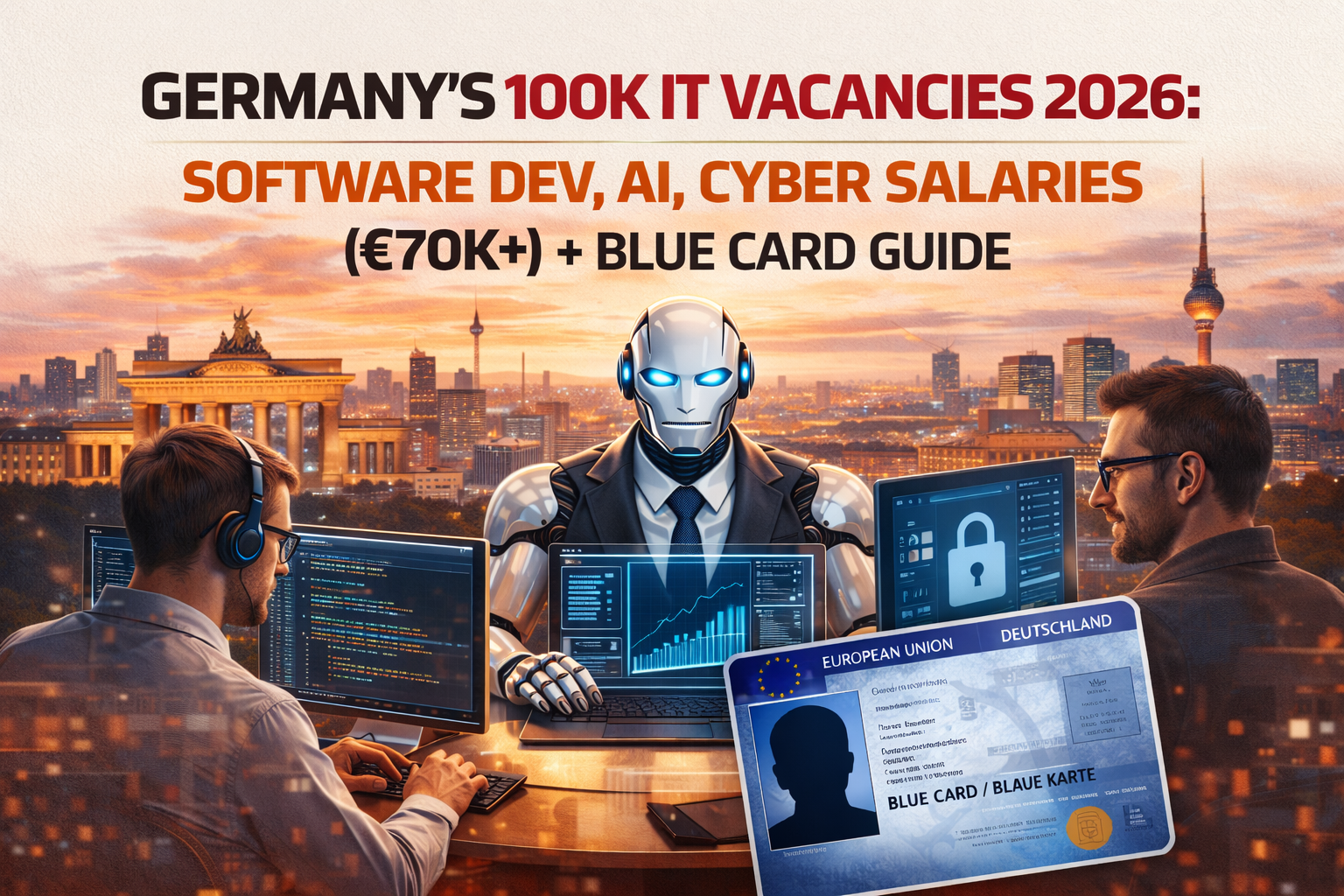
Germany is entering 2026 with a paradox: economic headwinds and planned job cuts in many industries, but a persistent structural shortage of IT professionals. IT roles remain on the official shortage lists, and recent estimates suggest 100,000+ open tech positions spread across software development, AI, data, and cybersecurity by 2026.[1][2]
For skilled international developers, data scientists, and security engineers, that translates into solid salary levels (often €70K+ in senior roles) and comparatively easier access via the EU Blue Card and Germany’s new immigration rules.
1. Why Germany Still Has a Tech Talent Gap in 2026
Germany’s broader labour market is cooling, but IT is one of the few sectors where demand clearly outstrips local supply:
- The Federal Employment Agency counts over 160 occupations with notable worker shortages, with IT and technical roles prominently represented.[3]
- Eurostat data show Germany still has around 1 million job vacancies overall, even after a slowdown, underlining structural gaps in key professions.[6]
- Recent projections for the tech sector point toward hundreds of thousands of IT-related vacancies by the end of 2026, driven by ongoing digitalisation, cloud migration, and AI adoption.[2]
Specialist immigration and career platforms tracking Germany’s market estimate that, within this broader gap, at least 100,000 roles are directly IT-related by 2026, spanning software engineering, cybersecurity, data, and infrastructure.[1][2]
At the same time, a recent survey by Germany’s IW institute found that around one-third of companies plan job cuts in 2026, especially in manufacturing.[5] Yet even these firms often keep or expand budgets for automation, AI, and IT security projects, preserving demand for highly skilled tech staff.
2. Most In‑Demand IT Roles (2026)
Germany’s official shortage occupation lists and current hiring data point to several clear “winner” profiles for 2026.[1][3]
2.1 Software Development & Cloud
- Backend & full‑stack developers (Java, Python, C#, Node.js)
- Cloud engineers (AWS, Azure, Google Cloud), DevOps and platform engineers
- Mobile developers (Kotlin, Swift, cross‑platform)
These roles are widely flagged as shortage occupations (codes 251x and 252x in Germany’s classification), which makes work visa and EU Blue Card processing more favourable.[1]
2.2 Artificial Intelligence, Data & Analytics
- Data scientists and machine learning engineers
- Data engineers (ETL, data pipelines, lakehouse architectures)
- AI specialists focusing on computer vision, NLP, recommendation systems
Germany’s Industry 4.0 strategy and AI research investments keep AI and data roles in high demand, particularly in automotive, industrial manufacturing, and finance.[1][2]
2.3 Cybersecurity & Infrastructure
- Cybersecurity specialists and information security analysts
- Security engineers (cloud security, IAM, SOC, SIEM)
- Network and systems administrators
Growing regulatory pressure, ransomware risk, and critical infrastructure protection are pushing companies to build internal security teams, even while they cut costs elsewhere.[1][3]
3. Salary Levels: Where €70K+ Is Realistic
Germany’s IT salaries vary by location, experience, and company size, but up‑to‑date 2026 estimates and recruiting data sketch a fairly clear range.[1][3]
3.1 Typical Gross Annual Salaries (2026 estimates)
Indicative ranges for Germany-wide salaries (before tax) for full‑time roles:
- Software Developer: ~€55,000–€70,000 mid‑level; €70,000–€90,000 senior, especially in Munich, Berlin, Frankfurt.[1][3]
- Data Scientist / ML Engineer: ~€65,000–€85,000; specialised senior roles in AI can exceed €90,000.[1][2]
- Cybersecurity Specialist / InfoSec Analyst: ~€60,000–€80,000; niche security engineering roles can reach €90,000+ in large enterprises.[1][3]
- Cloud / DevOps Engineer: ~€65,000–€85,000; senior professionals in high‑cost cities often negotiate €90,000+ and strong bonus packages.[3]
These numbers combine 2026 market snapshots from specialist immigration sites, recruiting platforms and labour‑market analyses, all aligned around the point that €70K+ is very realistic for senior IT professionals with 4–6 years of experience and in‑demand skills.[1][3]
3.2 What Drives Higher Offers?
Your position in the range will depend on:
- City: Munich, Frankfurt and Stuttgart generally pay more than smaller cities; Berlin offers strong tech salaries but slightly lower cost of living compared to Munich.
- Industry: Finance, automotive, and enterprise SaaS typically pay more than small agencies or early‑stage startups.
- Skill stack: Modern cloud (AWS/Azure/GCP), containerisation (Docker, Kubernetes), and security skills are clear salary accelerators.
- Language: Strong German (B2+) can unlock client‑facing or lead roles with higher pay.[3]
4. EU Blue Card & New Immigration Rules for IT Workers
Germany has significantly simplified pathways for non‑EU tech professionals via the EU Blue Card and new rules under its Skilled Immigration Act. For 2026, this remains the main route for highly qualified IT talent.
4.1 What Is the EU Blue Card?
The EU Blue Card is a residence and work permit for highly skilled non‑EU nationals. It offers:
- Permission to live and work in Germany for a specific employer
- Fast‑track to permanent residence after a few years
- Easier family reunification
Germany’s official portals and the European Commission maintain updated details on salary thresholds and rules.[4]
4.2 Key Eligibility Criteria for IT Professionals
While exact salary thresholds are updated regularly, current 2025–2026 rules share several consistent elements for IT workers:[4]
- Recognised qualification: A university degree or equivalent qualification; in IT, substantial professional experience can sometimes compensate for a non‑traditional degree.
- Job offer in Germany: A concrete contract or binding offer in a role relevant to your qualifications.
- Minimum salary: A gross annual salary above a defined threshold. For shortage occupations (which include many IT roles), the threshold is lower than for general professions, making Blue Cards more accessible for developers and engineers.
Exact yearly threshold numbers change with inflation and policy updates, so candidates should always check the latest table on the official German and EU information portals before applying.[4]
4.3 Documents Typically Required
Although individual consulates may request additional paperwork, most applicants will need:
- Valid passport
- Signed employment contract or binding offer with salary details
- Degree certificates and transcripts (plus recognition/validation where required)
- CV and professional experience documents
- Proof of health insurance
Processing times vary but tend to be faster for shortage occupations and when employers are familiar with international hiring.
5. Practical Strategy: How to Position Yourself for a €70K+ IT Job
Given the combination of selective hiring and structural demand, your profile and search strategy matter as much as your technical skills.
5.1 Choose the Right Tech Stack
Recruiters and labour‑market reports consistently highlight these technologies for Germany in 2026:[1][2]
- Programming: Java, Python, JavaScript/TypeScript, C#, C++
- Cloud & DevOps: AWS, Azure, GCP, Terraform, Kubernetes, CI/CD
- Data & AI: SQL, Spark, TensorFlow/PyTorch, MLOps tools
- Security: SOC tools, SIEM, IAM, network security and hardening
Deep competence in one or two of these areas often matters more than superficial familiarity with many.
5.2 Target Cities & Sectors with Strong IT Demand
Germany’s tech hubs combine high vacancy levels with international teams and English‑first work cultures:
- Berlin: Startups, fintech, SaaS, AI research labs.
- Munich: Automotive, industrial tech, large corporates, embedded systems.
- Frankfurt: Finance, banking IT, cybersecurity, cloud infrastructure.
- Hamburg, Cologne, Stuttgart: Media, logistics tech, manufacturing.
Large employers like SAP, Siemens, Deutsche Telekom and major banks continuously hire software engineers, cloud specialists and cyber professionals, even as they tighten other parts of their workforce.[2]
5.3 Build a Germany‑Ready Profile
To stand out in the 2026 market:
- Localise your CV: Use a concise, skills‑first CV in English or German, aligning keywords with German job descriptions (e.g. „Agile Arbeitsweise“, „Cloud-Erfahrung“, „DevOps-Kultur“).[3]
- Learn basic German: Even A2–B1 helps with integration and, eventually, promotion to team lead or architecture roles.
- Show real projects: GitHub repos, open‑source contributions, Kaggle projects, security CTF participation or cloud certifications provide strong signals.
- Use specialised portals: In addition to global platforms, explore Germany‑focused job boards and relocation‑oriented sites that highlight roles open to non‑EU candidates.[1][3]
6. Balancing Opportunity and Risk in 2026
It is important to be realistic: Germany’s economy is not in a boom phase. Surveys suggest many companies are cautious, and some sectors expect to cut jobs in 2026, especially in traditional manufacturing and export‑driven industries.[5]
Yet across multiple independent data sources, one message is consistent: qualified IT professionals remain in high demand and are central to Germany’s digital and industrial strategy.[1][2][3] This is why IT roles stay on the shortage lists, and why the EU Blue Card thresholds are calibrated to make it easier for tech workers to relocate.
Conclusion
Germany is heading into 2026 with a challenging macro environment, but for software developers, AI engineers, data experts and cybersecurity professionals, the outlook remains attractive. Market analyses and official data point to over 100,000 IT vacancies within a broader landscape of nearly one million open roles, alongside salary levels frequently exceeding €70,000 for experienced specialists.
If you can align your skills with in‑demand stacks, prepare a Germany‑ready profile, and navigate the EU Blue Card or other skilled immigration routes, Germany’s tech sector still offers one of the most compelling combinations of stability, salary, and long‑term residency options in Europe.
References
- https://www.immigrationxperts.com/blog/work-in-germany-it-job-opportunities-in-2026/
- https://www.careerbee.io/the-most-sought-after-jobs-in-germany-in-2026/
- https://yotru.com/blog/hiring-trends-in-germany
- https://www.make-it-in-germany.com/en/visa-residence/types/european-blue-card
- https://www.iamexpat.de/career/employment-news/one-third-companies-germany-cut-jobs-2026
- https://tradingeconomics.com/germany/number-of-job-vacancies-eurostat-data.html