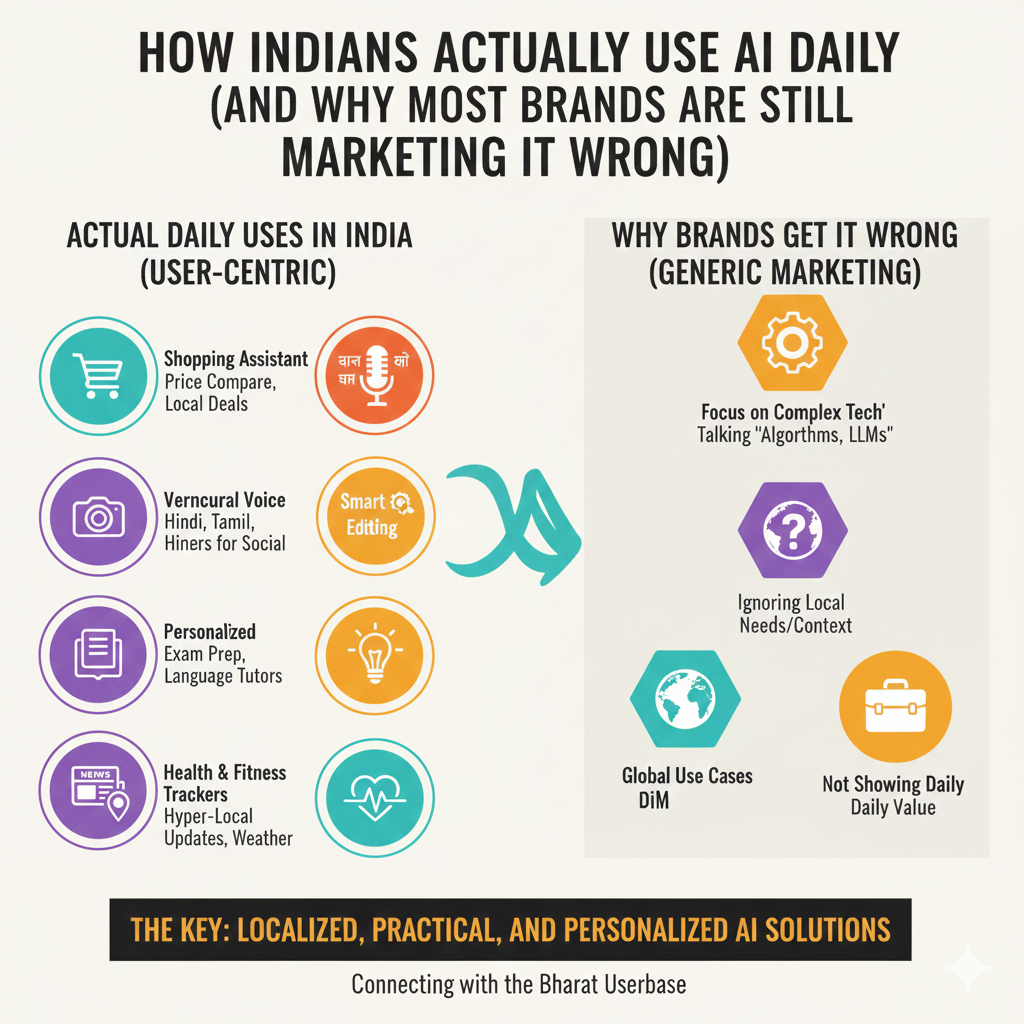
Indians lead global AI adoption with 73% usage rates, primarily for practical tasks like voice search, information queries, and content generation, yet brands often push futuristic hype over these everyday realities.[3] This disconnect stems from marketing that overlooks India’s multilingual, mobile-first habits in favor of generic global narratives.
The Scale of AI in Everyday Indian Life
India ranks as the world’s third most AI-competitive nation, with 87% of enterprises actively deploying AI solutions, scoring 2.45 on the NASSCOM AI Adoption Index.[6] Globally, generative AI daily active users hit 115-180 million in early 2026, but India tops country rankings at 73% usage—far ahead of the US (45%) or UK (29%).[3] With over 1 billion people using standalone AI tools worldwide and India’s 70% internet penetration surging 27.7% year-on-year, AI permeates daily routines for hundreds of millions.[2]
Voice assistants exemplify this: by 2026, 8 billion AI-powered voice devices operate globally, with 50% of US mobile users searching daily—a trend accelerating in India via Hindi and regional languages.[4] Projections show 157.1 million voice search users in 2025-2026, driven by India’s mobile ecosystem.[4] Unlike Western patterns, Indians favor integrated tools like Google Gemini or local platforms over ChatGPT alone, with only 1 in 5 global AI users sticking to OpenAI.[2]
Real Daily Use Cases: Practical, Not Sci-Fi
Indians use AI for mundane efficiency. Globally, ChatGPT handles 450 million daily conversations for specific information—14 billion monthly—with just 2.1% tied to purchases, signaling info-seeking dominance.[2] In India, this translates to quick queries in 22 languages via initiatives like Google’s Project Vaani and MeitY’s Bhashini, fueling startups with annotated local datasets.[1]
- Voice and Search: Daily voice searches for recipes, directions, or news in regional dialects, powered by expanding data centers ($50B+ investments announced).[1][4]
- Content Creation: Millennials and Gen Z (65% of users) generate social media posts, study notes, or job applications; 70% of Gen Z engage regularly.[3]
- Work and Learning: 78% of organizations use AI in at least one function, with IT/telecom at 38% optimizing networks and handling 65% of customer queries via assistants.[5]
- Enterprise Boost: Despite only 4% of employees using AI for 30%+ of work per leaders, employees report triple that, often for task automation.
ChatGPT alone sees 750 million weekly users globally by late 2025, with Indians favoring free tiers amid low-income dominance in paying users (under 2%).[2] This pragmatic adoption mirrors India’s IT boom parallel, with generative AI eyeing $438B revenue by 2030.[1]
Why Brands Get It Wrong: Hype Over Habits
Brands market AI as revolutionary disruption—think autonomous agents or metaverse integrations—but Indians prioritize utility. Global visits to ChatGPT-like sites doubled to 5.85B monthly by August 2025, bypassing traditional search growth, yet marketing clings to premium B2B pitches.[2] In India, with 8,178 AI companies (second globally), focus remains on accessible tools, not elite models.
Common pitfalls include:
- English-Centric Messaging: Ignoring non-English data needs, despite ‘sovereign AI’ pushes for local models at the 2026 Global AI Summit.[1]
- Overemphasis on Purchases: Only 2.1% of AI chats involve products; brands waste ad spend on sales funnels when users seek info first.[2]
- Forgetting Mobile-First: 73% adoption via apps and voice, not desktop demos.[3][4]
- Neglecting Gen Z/Regional: 68% non-users are older; target young, multilingual users building on Bhashini data.[1][3]
Enterprise stats show 71% generative AI use in 2024 (from 33% in 2023), but consumer marketing lags, treating AI as novelty versus India’s embedded tool.[5]
How Brands Can Fix It: Align with Real Behaviors
Succeed by embedding AI in daily flows. Telecoms already route 65% inquiries to AI assistants; e-commerce should integrate voice for regional queries.[5] Leverage 2026’s data center boom and sovereign models for hyper-local personalization.[1] Examples:
- Shopify notes employees use AI far more than reported—brands should enable seamless tools like query-based product discovery.
- Focus on India’s AI talent and 17.79% global population share for billion-user scale.[6]
Testimonials from NASSCOM highlight 87% enterprise pilots succeeding via practical apps, not hype.[6] Brands investing in multilingual datasets will capture the boom akin to IT services.[1]
Conclusion
Indians wield AI daily for voice, info, and creation—73% adoption rooted in practicality—while brands falter with flashy, mismatched campaigns.[3] By mirroring real habits, especially multilingual mobile use, marketers unlock India’s AI goldmine ahead of 2026’s explosive growth.
References
- https://www.whalesbook.com/news/English/Tech/Indias-AI-Future-Ignites-2026-Poised-for-Massive-BOOM-as-Govt-and-Big-Tech-Pour-Billions-into-Tech-Revolution/695477e64342f77179ecca5d
- https://datareportal.com/reports/digital-2026-one-billion-people-using-ai
- https://masterofcode.com/blog/generative-ai-statistics
- https://www.intuition.com/ai-stats-every-business-must-know-in-2026/
- https://www.netguru.com/blog/ai-adoption-statistics
- https://www.pib.gov.in/PressNoteDetails.aspx?id=156786&NoteId=156786&ModuleId=3®=3&lang=1
About the Author
InsightPulseHub Editorial Team creates research-driven content across finance, technology, digital policy, and emerging trends. Our articles focus on practical insights and simplified explanations to help readers make informed decisions.