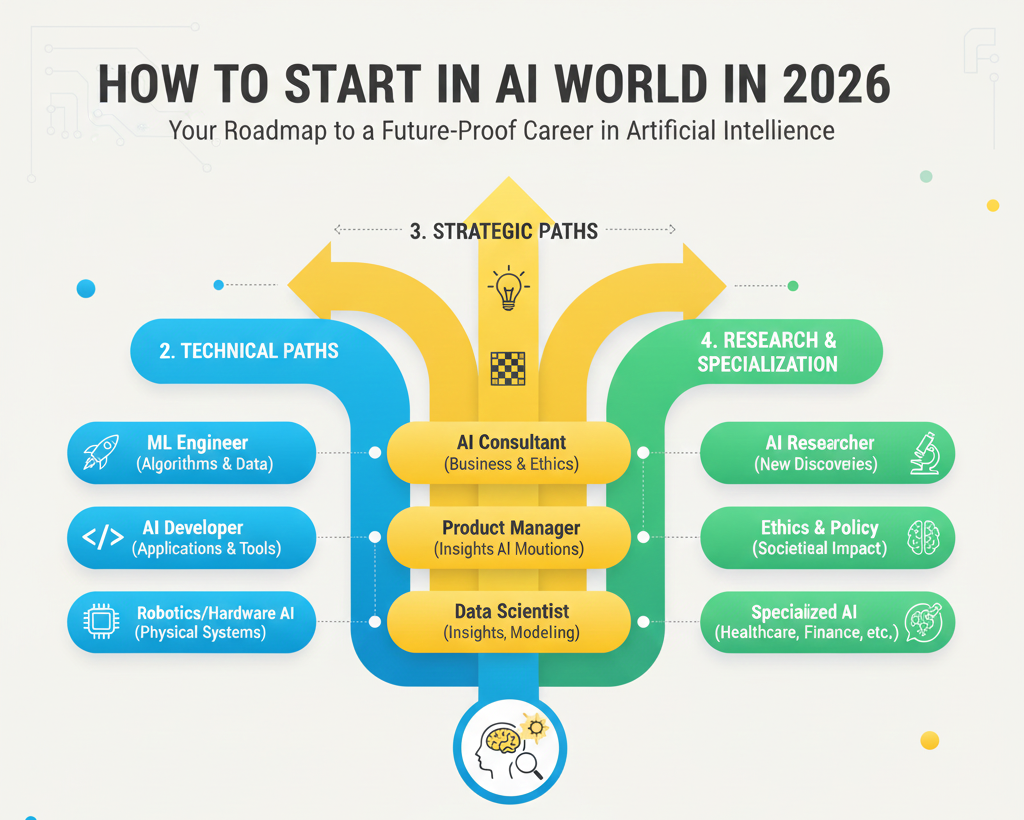
By 2026, artificial intelligence is no longer a niche—it is a core layer of modern software. From autonomous AI agents to multimodal models embedded in everyday products, the demand for developers who can work with AI is accelerating across industries such as banking, healthcare, telecom, and retail.[1][6] If you are a developer in 2026 wondering how to break into AI, the good news is that your existing skills already give you a head start. The key is to focus your learning, align with where the market is growing, and build things that ship.
1. Understand Where the AI Jobs Are in 2026
Before diving into tools and courses, it helps to understand the roles and skills employers are hiring for.
Recent career outlooks for 2026 highlight high demand for roles such as:
- AI / Machine Learning Engineer – designing, training, and deploying ML models into production systems.[1][2]
- Software Engineer (AI-focused) – building applications that integrate AI features (recommendations, copilots, automation).[1]
- Data Scientist – turning data into models, dashboards, and decision-support tools.[1][2]
- Computer Vision Engineer and NLP Engineer – specializing in vision or language tasks like detection, chatbots, or speech.[1]
- AI Research Scientist – working on new architectures, training techniques, and cutting-edge models.[1]
According to projections cited by Coursera, computer and information research roles (which include AI and ML) are expected to grow roughly 26% between 2023 and 2033, far faster than the average for all occupations.[2] This growth is being driven by enterprise adoption of AI copilots, analytics, and automation, not just big tech.
For most developers entering the field, the most accessible roles are AI/ML engineer, AI-focused software engineer, or data scientist. These combine your existing engineering skills with AI-specific knowledge.
2. Build a Modern AI Skill Stack (Not Just Models)
In 2026, successful AI developers combine strong fundamentals with an ability to ship reliable systems. A recent guide on future-proofing AI careers emphasizes that the engineers who thrive are those who blend mathematical foundations with system-level thinking and MLOps capabilities.[3]
2.1 Core technical foundations
Prioritize these skills over chasing every new framework:
- Programming: Solid Python is still non-negotiable for most AI work, with libraries like NumPy, pandas, PyTorch, and TensorFlow widely used.[5]
- Math for ML: Linear algebra, probability, statistics, and basic calculus to understand optimization, loss functions, and model behavior.[3][5]
- Machine Learning basics: Regression, classification, clustering, overfitting, regularization, and evaluation metrics.
- Data engineering literacy: Working with data pipelines, SQL/NoSQL, and cleaning messy datasets so models can learn from them effectively.[1][5]
2.2 Generative AI and agentic systems
By 2026, generative AI is a mainstream platform, not a novelty. Recent analyses highlight rapid growth in areas like:
- Agentic AI: Autonomous assistants that can plan and execute multi-step workflows, dramatically changing productivity.[4][6]
- Multimodal models: Systems that combine text, images, audio, and video for richer user experiences.[6]
- Vertical AI: Industry-specific AI for healthcare, finance, manufacturing, and education.[4][6]
For developers entering AI, this means you should be comfortable with:
- Calling and orchestrating large language models (LLMs) via APIs.
- Prompt engineering and evaluation of generative outputs.
- Using frameworks that support agent-like behaviors, such as tool-calling or workflow orchestration.[6]
2.3 MLOps and production mindset
Modern AI teams need engineers who can move beyond notebooks. Industry guidance stresses the importance of cloud-native MLOps, containerization, and monitoring as essential skills by 2026.[3]
As a developer, focus on:
- Containerization with Docker and orchestration with Kubernetes for scalable deployments.[3]
- Experiment tracking and model lifecycle tools (e.g., MLflow, Kubeflow).[3]
- CI/CD pipelines that include data and model tests, not just code.
- Observability: logging model performance, drift, and user feedback in production.
3. Choose an Entry Path Based on Your Background
You don’t need to become a research scientist overnight. Instead, pivot from your current role into AI-adjacent work.
3.1 If you are a backend or full‑stack engineer
- Start by integrating ready-made AI APIs into existing apps—search, recommendations, chat, summarization.
- Gradually move to fine-tuning smaller models on domain-specific data.
- Own the AI integration end-to-end: auth, latency, caching, monitoring, and billing.
This aligns you with the Software Engineer (AI-focused) track that is in very high demand.[1]
3.2 If you are a data engineer or analyst
- Deepen your ML knowledge: supervised learning, model evaluation, and feature engineering.
- Leverage your existing strength in data pipelines to support model training and real-time inference.
- Transition into ML engineer or data scientist roles focused on predictive and generative models.[1][2]
3.3 If you are early‑career or switching from another domain
- Build strong Python + ML fundamentals first via structured courses.
- Use open-source models and datasets to create small but real projects—recommendation systems, chatbots, image classifiers.
- Consider targeted certifications in AI or generative AI to validate skills for recruiters, particularly in markets where credentials matter.[4]
4. Learn from High‑Quality Resources (Without Drowning)
Given the pace of change, it is important to select resources that stay up to date and are grounded in practice. Reputable platforms and reports include:
- Online learning platforms such as Coursera for industry-aligned AI and ML specializations.[2]
- Vendor and tooling blogs from cloud providers and observability companies, which track emerging trends in AI infrastructure and safety.[6]
- Industry trend reports on generative AI and AI skills, which highlight where investment and hiring are growing.[4]
As you learn, balance foundation-building (math, algorithms) with quick wins (shipping a small AI feature). This combination keeps your portfolio relevant while making interviews easier.
5. Focus on Skills That Will Age Well
AI tools and frameworks in 2026 will not be the same in 2028. The capabilities of LLMs, the structure of agent systems, and the surrounding tooling are evolving quickly. To avoid constantly starting from scratch, prioritize skills that are robust under change.
5.1 Systems thinking and cross‑disciplinary fluency
Experts emphasize that by 2026, AI engineers are valued less for isolated model-building and more for their ability to integrate AI into complex systems and communicate across functions.[3]
This means:
- Understanding how AI components interact with databases, APIs, frontends, and security layers.
- Explaining performance, risk, and trade-offs to non-technical stakeholders in product, legal, and operations.
- Collaborating with designers on AI UX and with domain experts on data quality and fairness.
5.2 Ethics, safety, and compliance awareness
As AI becomes central to decision-making and automation, concerns around bias, privacy, and safety are no longer theoretical. Reports on talent trends stress that organizations increasingly look for developers who can work within responsible AI frameworks, not just build models.
Practical steps include:
- Understanding basic principles of data privacy (such as handling of sensitive data and anonymization).
- Becoming familiar with model evaluation for fairness and robustness.
- Documenting model behavior, limitations, and acceptable use in clear language.
6. Build a Portfolio That Proves You Can Ship AI
In a competitive market, your portfolio is often more persuasive than your CV. Focus on projects that mirror real-world constraints.
6.1 Project ideas for 2026
- Agentic assistant for a narrow domain: For example, an AI that can process support tickets, call external APIs, and update a CRM. This demonstrates understanding of tool-calling and workflow orchestration, which aligns with agentic AI trends.[4][6]
- Vertical AI demo: A small healthcare triage bot, retail demand forecaster, or finance risk scoring tool using tabular and text data. This showcases domain awareness and vertical AI potential.[4][6]
- End-to-end ML system: A model trained on public data, wrapped in an API, deployed on cloud infrastructure with monitoring dashboards.
Document each project with:
- Clear problem definition and assumptions.
- Data sourcing and preparation steps.
- Model choice, evaluation metrics, and limitations.
- Live demo or screenshots and a link to the code repository.
6.2 Contribute to open source
Open-source ecosystems are a major driver of AI innovation. Engineers who contribute to libraries, model hubs, or evaluation tools gain visibility and credibility that direct hiring managers pay attention to.[3][6]
Start with small contributions—documentation fixes, tests, example notebooks—and gradually move into feature work. Even modest pull requests demonstrate that you can work within existing codebases and review processes.
7. Position Yourself Strategically for AI Hiring in 2026
Finally, entering the AI world is as much about how you present your skills as what you know.
- Rewrite your resume to highlight AI-related projects, tools, and measurable impact (e.g., “reduced manual review time by X% using a classification model”).
- Network with AI teams through meetups, online communities, and open-source repositories.
- Target roles where your existing domain knowledge (e.g., finance, healthcare, logistics) amplifies your AI skills.
- Stay current by following a small number of trusted sources like Coursera’s AI career content, Splunk’s AI trend analyses, and annual AI trend or talent reports.[2][6]
Conclusion
For developers in 2026, entering the AI world is less about starting from zero and more about recombining what you already know—coding, systems design, debugging—with focused learning in machine learning, generative AI, and MLOps. The demand for AI engineers, AI-focused software developers, and data scientists continues to rise, driven by agentic systems, multimodal models, and industry-specific AI.[1][2][4][6] If you commit to solid fundamentals, build a portfolio of real projects, and stay close to evolving best practices, you can not only break into AI, but build a career that remains relevant as the technology rapidly advances.
For further reading, you can explore recent overviews of AI careers and skills from platforms like Coursera, as well as trend analyses from industry players tracking AI adoption and hiring.
References
- https://www.digitalregenesys.com/blog/top-ai-careers
- https://www.coursera.org/articles/artificial-intelligence-jobs
- https://machinelearningmastery.com/future-proofing-your-ai-engineering-career-in-2026/
- https://www.usaii.org/ai-insights/generative-ai-trends-2026-to-guide-your-career
- https://www.alignminds.com/top-ai-developer-skills-for-career-success-in-2026/
- https://www.splunk.com/en_us/blog/learn/ai-trends.html
About the Author
InsightPulseHub Editorial Team creates research-driven content across finance, technology, digital policy, and emerging trends. Our articles focus on practical insights and simplified explanations to help readers make informed decisions.