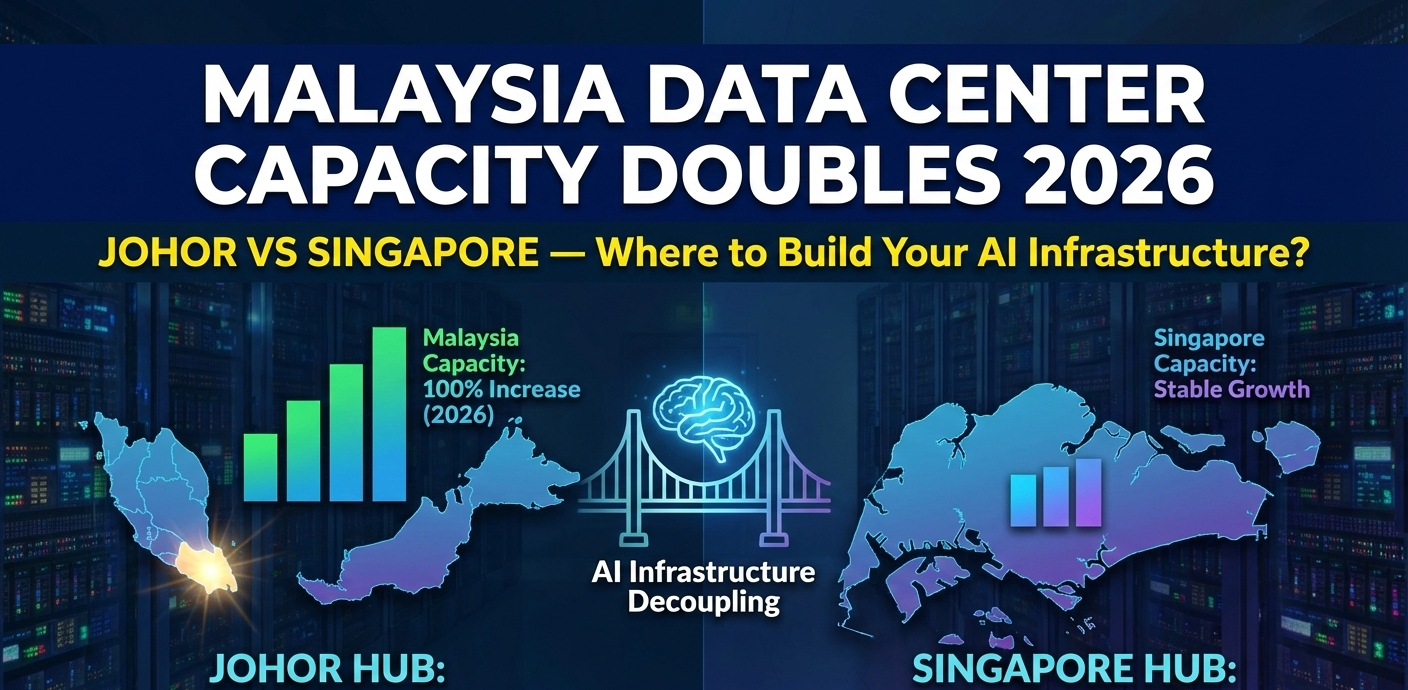
Malaysia’s data center capacity is exploding—from 1,025 MW to 2,100 MW by end of 2026. In the southern state of Johor alone, 1,500 MW of facilities are under construction and another 3.3 GW are planned or announced, making it the fastest-growing data center market in Southeast Asia. With construction costs at $11.37 per watt versus Singapore’s $14.53, and land availability 450 times greater than its neighbor, Malaysia has become the default destination for hyperscalers and AI infrastructure investors priced out of Singapore’s premium market.
The numbers tell a compelling story. Microsoft is investing $236 million to expand its Malaysia West Cloud Region in Johor. Google committed billions for a second cloud region. NTT DATA acquired $88.5 million in land for a six-building campus. Equinix topped out its second Johor facility with $201 million investment. And Saudi-based Magna AI just signed a $700 million deal for a 20 MW AI data center in Sarawak. With 24 submarine cables (6 more planned) and electricity at $0.10/kWh, Malaysia offers the connectivity and power that AI workloads demand—at costs that preserve capital for compute rather than real estate.
Yet Singapore isn’t conceding defeat. The city-state’s second Data Centre-Call for Application (DC-CFA2), launched February 2026, offers 200+ MW of new capacity with strict sustainability requirements—50% green energy, PUE 1.3 or lower, and “best-in-class” efficiency standards. For investors prioritizing regulatory stability, financial hub access, and premium connectivity, Singapore’s $14.53/W construction cost may still justify the premium.
This comprehensive analysis examines Malaysia’s 2026 data center expansion, Johor’s emergence as Southeast Asia’s hyperscale capital, the cost and connectivity comparison with Singapore, and strategic guidance for AI infrastructure investment decisions in the world’s fastest-growing digital infrastructure market.
1. The Malaysian Data Center Boom: By the Numbers
Malaysia’s data center market has reached an inflection point where infrastructure investment, government policy, and AI demand converge to create unprecedented growth.
Market Scale and Trajectory
| Metric | 2024/2025 | 2026 Projection | Growth |
|---|---|---|---|
| Total National Capacity | 1,025 MW | 2,100 MW | +105% |
| Johor Pipeline | ~2.4 GW announced | ~4.0 GW total | +67% |
| Under Construction (Johor) | 422 MW | 700 MW | +66% |
| Market Value | $6.15 billion | $11.40 billion (2031) | 10.85% CAGR |
| Operational Facilities | 51 facilities | 51 additional planned | 100% expansion |
Sources: JLL Research 2026, Arizton Advisory 2026, Nikkei Asia 2026
The Johor Phenomenon
Johor, Malaysia’s southernmost state bordering Singapore, has emerged as the epicenter of this expansion:
- 160 MW added in 6 months (H2 2024 to H1 2025)—a 40% increase in operational capacity
- Under-construction capacity up 87% to 422 MW
- Planned capacity up 61% to 1,324 MW
- On track for 1 GW market by end of 2026
- 47 planned and operational data centers in the state
Key developments driving this growth:
- BrightRay: Completing facility in 8 months using prefabricated modular solutions
- Yondr: Delivered fully fitted, rack-ready asset 6 months ahead of schedule
- STT GDC: 16 MW hyperscale facility in Nusa Cemerlang Industrial Park, completion end-2026
- Currenc Group: 100-acre, 500 MW hyperscale AI campus announced
- Stack Infrastructure: 220 MW campus in Iskandar Puteri, Phase 1 delivery Q4 2026
Geographic Distribution
While Nusajaya/Iskandar Puteri and Sedenak remain primary hubs, emerging locations are gaining traction:
- Kulai, Tebrau, Pasir Gudang: Nearly 400 MW (23% of total pipeline)
- Cyberjaya (Klang Valley): Established hub with existing infrastructure
- Sarawak: New frontier with $700 million Magna AI investment
2. Why Malaysia? The Cost and Capacity Advantage
Malaysia’s data center appeal rests on fundamental structural advantages over regional competitors.
Land Availability and Cost
Compared to Singapore, Malaysia offers:
- 450x greater land area (330,803 km² vs. 728.6 km²)
- Population density 75x lower (99 people/km² vs. 7,500+ people/km²)
- Abundant industrial park availability in Johor and Klang Valley
- Flexible freehold and leasehold options with integrated utilities
This land abundance eliminates the site acquisition challenges plaguing Singapore and enables campus-style hyperscale developments impossible in space-constrained city-states.
Construction Cost Comparison
Turner & Townsend’s 2025 Data Center Construction Cost Index reveals stark regional differences:
| Market | Cost per Watt (USD) | Global Ranking |
|---|---|---|
| Tokyo | $15.00+ | 1 (Most Expensive) |
| Singapore | $14.53 | 2 |
| Silicon Valley | $13.80 | 3 |
| Kuala Lumpur (Malaysia) | $11.37 | Regional Average |
| Jakarta | $11.21 | Regional Average |
| Mumbai | $6.64 | Lower Cost |
| Shanghai | $6.12 | Lowest Cost |
Malaysia’s $11.37/W construction cost represents a 22% discount to Singapore—translating to millions in capital savings for large-scale deployments.
Power Economics
Electricity costs are critical for AI infrastructure:
- Malaysia average: ~$0.10/kWh
- Ranking: Among top 3 lowest power tariffs in Asia Pacific
- July 2025 tariff adjustment: 10-14% increase for data center operators, but still highly competitive
- Grid reliability: Mature national infrastructure with planned 6-8 GW gas-fired capacity addition by 2030
The power cost advantage compounds over the facility lifecycle. For a 100 MW AI data center consuming 876,000 MWh annually, Malaysia’s ~$0.02-0.03/kWh advantage over Singapore represents $17-26 million annual savings.
Connectivity Infrastructure
Malaysia offers robust digital infrastructure:
- 24 operational submarine cables with 6 additional planned
- Extensive domestic fiber networks
- Low-latency connectivity to Singapore (cross-border terrestrial fiber)
- Regional hub status: Gateway to ASEAN markets
3. Singapore’s Response: The Premium Play
Singapore isn’t surrendering its data center dominance—it’s repositioning as a premium, sustainability-focused market with strict entry criteria.
The DC-CFA2 Opportunity
In February 2026, Singapore launched its second Data Centre-Call for Application:
- Capacity available: At least 200 MW (potentially more with innovative green energy)
- Application deadline: March 31, 2026
- Target: “Best-in-class” facilities strengthening Singapore’s AI and data center investment hub status
Stringent Requirements
Singapore’s sustainability mandates exceed regional standards:
- Green energy: Minimum 50% of power from renewable sources
- Acceptable sources: Biomethane, low-carbon ammonia, low-carbon hydrogen, novel fuel cells with carbon capture, or on-site solar
- Energy efficiency: SS 715:2025 standard requiring up to 30% energy reduction
- PUE target: 1.3 or lower (industry-leading efficiency)
- IT efficiency: “Best-in-class” standards
The Sustainability Premium
Singapore’s $14.53/W construction cost—22% above Malaysia—reflects:
- Land scarcity: “Large enough pieces of land” with right connectivity and water access increasingly difficult to find
- Grid congestion: “The grids are really very congested” per Keppel CEO
- Technical intensity: AI-ready, high-density rack deployments (100-120 kW per rack vs. historical 3-4 kW)
- Advanced cooling: Liquid cooling systems (26-50% of current projects, projected 51-75% in 12-24 months)
- ESG premiums: Stricter sustainability, water-reuse, and embodied-carbon requirements
Who Should Pay the Premium?
Singapore remains optimal for:
- Financial services: Proximity to regional headquarters and trading infrastructure
- Regulatory-sensitive workloads: Stringent data governance and legal frameworks
- Low-latency applications: High-frequency trading, real-time analytics
- Brand positioning: “Singapore-based” as credibility signal for enterprise customers
- Sustainability commitments: ESG-focused corporates requiring green energy verification
4. The AI Infrastructure Imperative: Why Now?
The 2025-2026 surge isn’t generic data center growth—it’s AI-driven infrastructure transformation.
AI Workload Requirements
Modern AI infrastructure demands:
- High-density compute: 100-120 kW per rack (vs. 3-4 kW traditional)
- Advanced cooling: Liquid cooling essential for GPU clusters
- Massive power draw: AI training clusters consume megawatts continuously
- Scalable fiber: Low-latency, high-bandwidth connectivity for distributed training
These requirements favor Malaysia’s:
- Power availability: Abundant, affordable electricity for energy-intensive AI training
- Land for expansion: Campus-style development enabling phased growth
- Cooling efficiency: Tropical climate suitable for liquid cooling deployment
- Cost structure: Lower CapEx and OpEx preserving budget for compute hardware
Hyperscaler Commitments
Major cloud providers are betting on Malaysia:
- Microsoft: $236 million expansion for Malaysia West Cloud Region in Johor (3 availability zones, operational 2026-2027)
- Google: Multi-billion dollar commitment for second cloud region
- Amazon Web Services: Continued expansion in existing Malaysia regions
- Oracle: Part of YTL-NVIDIA green AI data center partnership
- NTT DATA: $88.5 million land acquisition, 6-building campus, first facility 2027
- Equinix: $201 million second Johor facility (JH2), 2,225 cabinets, Q3 2027 launch
Sovereign AI Ambitions
Malaysia’s government is actively cultivating AI infrastructure:
- RM 2 billion ($490 million): Sovereign AI cloud development
- RM 5.9 billion ($1.44 billion): Total AI R&D, commercialization, and innovation commitment
- National AI Office (NAIO): Established under Ministry of Digital
- AI Technology Action Plan 2026-2030: Continuation of National AI Roadmap 2021-2025
- NVIDIA H100 GPU-as-a-Service: Southeast Asia’s first, via YTL partnership
Prime Minister Anwar Ibrahim has explicitly committed to making Malaysia “a leading AI hub in Southeast Asia.”
5. Strategic Considerations: Johor vs. Singapore Decision Matrix
Choosing between Johor and Singapore requires systematic evaluation across multiple dimensions.
Table 2: Johor vs. Singapore Comparison
| Factor | Johor, Malaysia | Singapore |
|---|---|---|
| Construction Cost | $11.37/W (22% lower) | $14.53/W (global #2) |
| Land Availability | Abundant, campus-scale | Severely constrained |
| Power Cost | ~$0.10/kWh (top 3 APAC) | Higher, grid-constrained |
| Capacity Pipeline | 4.0 GW planned | 200 MW (DC-CFA2) |
| Sustainability Mandate | Emerging standards | Strict (50% green, PUE 1.3) |
| Regulatory Stability | Developing framework | Mature, predictable |
| Connectivity | 24 submarine cables + 6 planned | 70+ facilities, dense fiber |
| Latency to Singapore | Low (cross-border fiber) | N/A (in-market) |
| Talent Pool | Growing (JTDC programs) | Established, deep |
| Best For | AI training, hyperscale, cost optimization | Financial services, latency-sensitive, ESG leadership |
Decision Framework
Choose Johor when:
- Primary workload is AI training or high-performance computing (power-hungry, cost-sensitive)
- Hyperscale deployment requiring campus-style expansion (100+ MW)
- Capital efficiency is paramount (lower construction and operating costs)
- Singapore latency is acceptable (cross-border fiber provides adequate performance)
- Talent can be developed or imported (JTDC programs, regional recruitment)
Choose Singapore when:
- Workload requires ultra-low latency (financial trading, real-time applications)
- Regulatory or compliance requirements mandate Singapore jurisdiction
- ESG commitments require verified green energy and industry-leading efficiency
- Brand positioning benefits from “Singapore-based” signaling
- Existing Singapore infrastructure enables operational synergy
The Hybrid Strategy
Many operators are deploying both:
- Singapore: Front-end, latency-sensitive, customer-facing workloads
- Johor: Back-end AI training, data lakes, batch processing, disaster recovery
- Cross-border connectivity: Low-latency fiber enables seamless workload distribution
This “Singapore-Johor corridor” strategy captures Singapore’s regulatory and connectivity advantages while leveraging Johor’s cost and scale benefits.
6. Challenges and Risks: The Malaysia Reality Check
Malaysia’s data center boom isn’t without challenges that investors must navigate.
Infrastructure Strain
Rapid growth is stressing resources:
- Water shortages: Johor and Selangor water constraints have forced authorities to slow data center approvals—water is critical for cooling
- Grid pressure: Electricity demand surging faster than generation capacity expansion
- Carbon intensity: Majority of grid powered by coal and gas, creating tension with net-zero commitments
The government is responding with 6-8 GW of planned gas-fired capacity by 2030, but this creates carbon lock-in risks.
Talent Constraints
Data centers create fewer permanent jobs than anticipated:
- Typical facility: 30-50 permanent jobs (up to 200 for largest facilities)
- Construction phase: Thousands of temporary roles, then sharp decline
- Skill gaps: Limited local expertise in hyperscale operations and AI infrastructure
- Foreign worker dependence: Research and engineering roles often filled by non-Malaysians
The Johor Talent Development Council (JTDC) launched a Data Centre Technician Programme in March 2025 targeting 200 vacancies, but this addresses only a fraction of the need.
Policy Uncertainty
Prime Minister Anwar Ibrahim has signaled selective approval criteria:
- Statement: “Investments in data centers should not be pursued unless they bring tangible added value to the rakyat [ordinary people], such as high-paying job opportunities and knowledge transfer”
- Shift in focus: “Ensuring that the support provided yields economic spillovers that directly benefit the rakyat and the nation, rather than merely serving the profit motives of investor companies”
- Implementation: Proposals for non-AI data centers rejected for “almost two years”
This suggests future approvals may prioritize AI-focused projects with clear local benefit demonstration.
Geopolitical Considerations
Malaysia navigates complex international dynamics:
- U.S.-China tensions: Risk of technology transfer restrictions or sanctions affecting Chinese hyperscaler investments
- Data sovereignty: Government emphasis on “sovereign AI” may create operational constraints
- Regional competition: Indonesia, Thailand, and Vietnam also competing for data center investment
7. The Investment Outlook: 2026 and Beyond
Malaysia’s data center trajectory remains strongly positive despite challenges.
Near-Term Catalysts (2026)
- Microsoft Malaysia West Cloud Region launch: Q3 2026 operational target
- Johor 1 GW milestone: End-2026 capacity target
- New submarine cable landings: Enhanced connectivity
- JS-SEZ (Johor-Singapore Special Economic Zone): Formalized cross-border economic integration
Medium-Term Developments (2027-2030)
- NTT DATA campus: First facility operational 2027
- Equinix JH2: Q3 2027 launch
- National AI cloud: RM 2 billion sovereign infrastructure
- Grid expansion: 6-8 GW new gas-fired capacity
- Renewable transition: Solar and potential nuclear (SMR) development
Long-Term Vision (2030+)
- AI hub status: Regional leader in AI training and inference infrastructure
- Digital economy contribution: Significant GDP share from data center services
- Talent ecosystem: Developed local expertise in hyperscale operations
- Sustainability leadership: Transition to low-carbon power mix
8. Strategic Recommendations for Investors
Navigate the Malaysia-Singapore decision with structured analysis.
Immediate Actions (0-90 days)
- Assess workload latency requirements and AI compute intensity
- Evaluate ESG commitments and sustainability reporting obligations
- Model total cost of ownership (TCO) for 10-year facility lifecycle
- Engage with Malaysia Digital Economy Corporation (MDEC) and Singapore EDB
- Review DC-CFA2 application requirements (deadline: March 31, 2026)
Site Selection Process (90-180 days)
- Conduct Johor site visits (Nusajaya, Sedenak, Kulai, Tebrau)
- Evaluate power availability and water supply at specific locations
- Assess fiber connectivity and latency to target markets
- Review regulatory requirements and approval timelines
- Negotiate land/power/fiber agreements
Partnership and Development (180+ days)
- Secure local construction and operations partners
- Develop talent acquisition and training programs
- Design for sustainability (liquid cooling, renewable energy procurement)
- Plan phased expansion aligned with demand growth
- Establish cross-border connectivity to Singapore if hybrid strategy
Conclusion: The New Southeast Asia Data Center Order
Malaysia’s data center capacity doubling to 2,100 MW by end-2026 represents more than infrastructure growth—it signals a fundamental reordering of Southeast Asia’s digital economy geography. Johor’s emergence as a 1 GW+ hyperscale hub, with 4.0 GW in pipeline and costs 22% below Singapore, establishes Malaysia as the default destination for AI training infrastructure and cost-optimized cloud capacity.
Singapore’s response—premium positioning with strict sustainability standards and limited 200 MW DC-CFA2 allocation—creates a bifurcated market. Singapore captures latency-sensitive, ESG-focused, and financial services workloads. Malaysia absorbs AI training, hyperscale expansion, and cost-optimized growth.
The “Singapore-Johor corridor” strategy enables operators to capture both markets’ advantages: Singapore’s regulatory stability and financial hub proximity with Johor’s land, power, and cost abundance. Cross-border fiber makes this integration seamless.
For investors, the 2026 window is critical. Malaysia’s infrastructure is scaling rapidly, government support remains strong (particularly for AI-focused projects), and first-mover advantages in prime Johor locations are diminishing as land is absorbed. The DC-CFA2 deadline (March 31, 2026) creates urgency for Singapore decisions.
The data center boom isn’t ending—it’s shifting. The question isn’t whether to invest in Southeast Asia AI infrastructure, but whether to pay Singapore’s sustainability premium or capture Malaysia’s cost advantage. For most AI workloads, the math favors Johor. For regulatory-sensitive, latency-critical applications, Singapore remains unmatched.
Bottom line: Malaysia’s data center doubling is the infrastructure story of 2026. With 2,100 MW capacity, $11.37/W construction costs, and hyperscaler commitments from Microsoft, Google, and NVIDIA, Johor has become Southeast Asia’s AI infrastructure capital. Singapore’s $14.53/W premium is justified for specific use cases, but Malaysia’s cost and scale advantages are reshaping regional investment flows. The smart money is building in Johor—while the sustainability-conscious money secures limited Singapore capacity.
References
- Nikkei Asia: Malaysia’s data center capacity set to double by end-2026 (2026) – JLL research showing 1,025 MW to 2,100 MW growth, 1,500 MW under construction in Johor, and 600 MW additional facilities. https://asia.nikkei.com/business/technology/malaysia-s-data-center-capacity-set-to-double-by-end-2026
- Arizton Advisory: Malaysia Data Center Market Surges Past USD 11.4 Billion (2026) – Market analysis showing $6.15 billion (2025) to $11.40 billion (2031) trajectory, 10.85% CAGR, 4.0 GW Johor pipeline, and $11.37/W construction costs vs Singapore. https://www.arizton.com/market-reports/malaysia-data-center-market-size-analysis
- Data Center Dynamics: Singapore opens call to develop 200MW of data center capacity (2026) – DC-CFA2 announcement with 200 MW availability, March 31, 2026 deadline, 50% green energy requirement, and PUE 1.3 standard. https://www.datacenterdynamics.com/en/news/singapore-opens-call-to-develop-200mw-of-data-center-capacity/
- White & Case: What is propelling Malaysia’s data centre boom? (2025) – Legal and business analysis of Malaysia’s 450x land advantage, $0.10/kWh power costs, construction cost differentials, and regulatory framework. https://www.whitecase.com/insight-our-thinking/what-propelling-malaysias-data-centre-boom
- VnExpress: Singapore ranked world’s 2nd-most expensive market for data center construction (2025) – Turner & Townsend cost index showing Singapore at $14.53/W (global #2), Malaysia at $11.37/W, and 5% YoY Singapore cost increase. https://e.vnexpress.net/news/tech/tech-news/singapore-ranked-world-s-2nd-most-expensive-market-for-data-center-construction-4961567.html
Disclaimer
Important Notice: The information provided in this blog post is for educational and informational purposes only and does not constitute investment, legal, or business advice. Data center construction costs, power tariffs, and market projections are estimates subject to change. Infrastructure investments involve significant capital commitments and regulatory risks. Malaysia’s data center policies are evolving, and approval requirements may shift. Readers should conduct their own due diligence and consult with qualified professionals before making infrastructure investment decisions. The author and publisher disclaim any liability for any loss or damage arising from reliance on the information contained herein.
About the Author
InsightPulseHub Editorial Team creates research-driven content across finance, technology, digital policy, and emerging trends. Our articles focus on practical insights and simplified explanations to help readers make informed decisions.