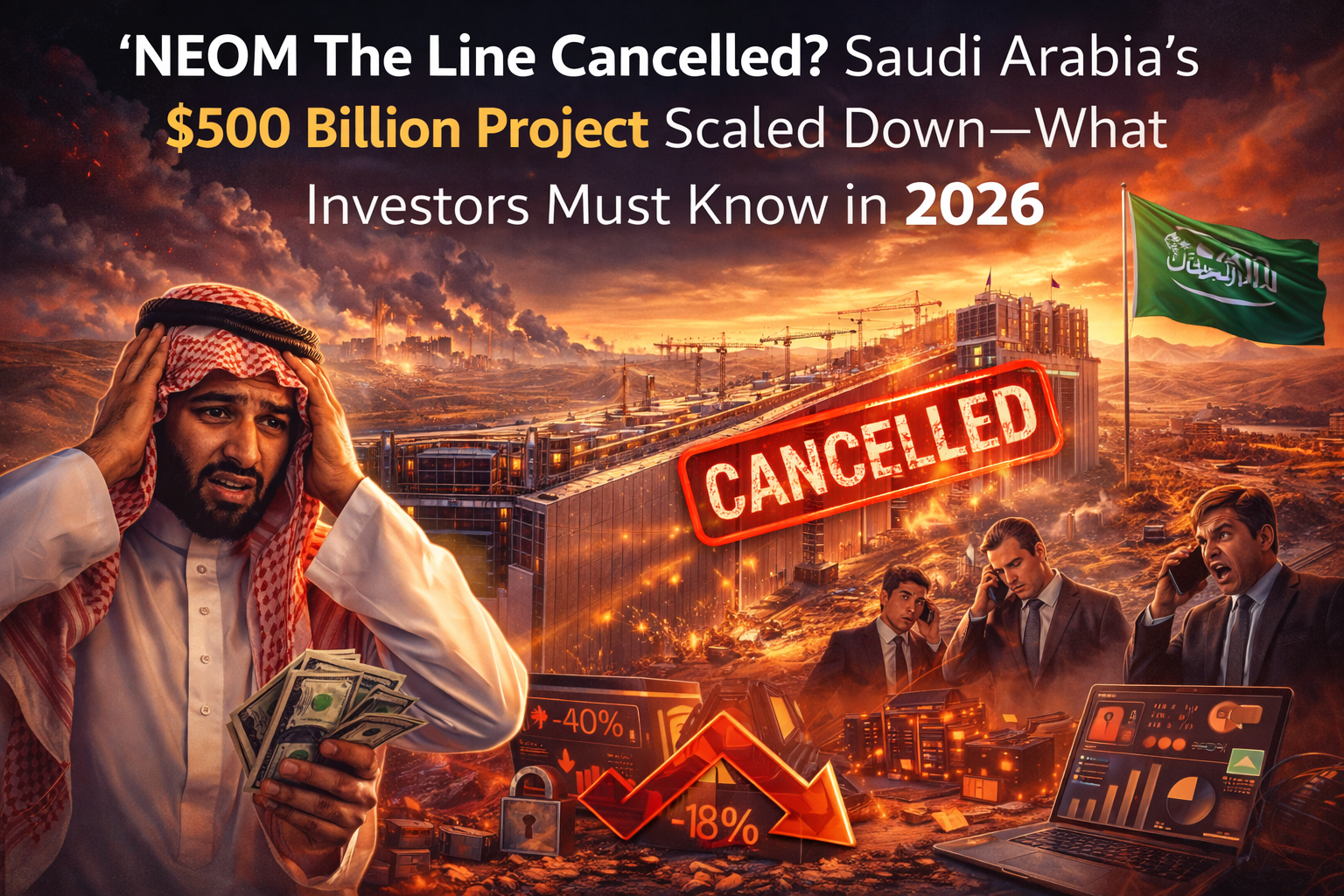
The 170-kilometer mirrored city in the desert is now a 2.4-kilometer coastal strip. In January 2026, Saudi Arabia officially acknowledged what industry insiders had suspected for months: NEOM’s flagship “The Line” project has been drastically scaled back from a $500 billion, nine-million-resident megacity to a modest “Hidden Marina” development. With $50 billion already spent, oil prices hovering at $60 per barrel (far below the $96 needed to balance Saudi budgets), and the Public Investment Fund (PIF) cutting project budgets by up to 60%, the kingdom’s Vision 2030 transformation is entering its most critical phase.
The numbers tell a stark story. What was marketed as a 170-kilometer linear metropolis stretching from the Red Sea into the Hejaz mountains—complete with flying taxis, robot butlers, and zero-carbon living—will now extend just 2.4 kilometers by 2030. The population target has collapsed from 1.5 million residents by 2030 to fewer than 300,000. The Asian Winter Games scheduled for Trojena in 2029 have been indefinitely postponed. And the PIF, with assets of $925 billion, has approved cuts of up to 60% across more than 100 portfolio companies.
For investors, contractors, and global observers, this isn’t a project cancellation—it’s a strategic recalibration with profound implications. Saudi Arabia isn’t abandoning its diversification goals; it’s pivoting from “vision-led development to outcome-led development” as the PIF enters “a phase of proving returns.” Understanding this shift is essential for anyone with capital, contracts, or careers tied to the kingdom’s transformation.
This comprehensive analysis examines the scale of NEOM’s downsizing, the financial and political drivers behind the pivot, the specific projects affected, and what investors must know to navigate Saudi Arabia’s new reality in 2026.
1. The Scale of the NEOM Downsizing: From Vision to Reality
The January 2026 announcements represent the most significant retreat from Saudi Arabia’s giga-project ambitions since Vision 2030 launched in 2016. The specific reductions are staggering:
The Line: 170km → 2.4km (98.6% Reduction)
The original vision presented in 2021 featured:
- 170 kilometers of parallel 500-meter-tall mirrored skyscrapers
- 200 meters wide, creating a continuous urban corridor
- Nine million residents by 2045
- No cars, no streets, no emissions—100% renewable energy
- 95% of land preserved for nature
- Flying taxis and robot butlers as standard infrastructure
The revised 2026 plan:
- 2.4 kilometers of actual construction by 2030 (down from 1.5 miles/2.4km previously reported, now potentially even less)
- Hidden Marina—a coastal segment rather than the inland mountain-to-sea stretch
- Fewer than 300,000 residents by 2030 (down from 1.5 million)
- Data center hub potentially replacing residential towers
- Phased, “deliverable” approach rather than simultaneous construction
As one source close to the plans noted: “The Line is now undergoing its execution design phase, and that will by definition be a more modest enterprise.”
Trojena: Asian Winter Games Postponed
The mountain ski resort intended to host the 2029 Asian Winter Games has been indefinitely postponed. The project, roughly the size of Belgium and featuring year-round skiing, was a centerpiece of NEOM’s tourism ambitions. Its suspension signals broader retrenchment across the entire NEOM portfolio.
Red Sea Global: Phase Two Halted
The Red Sea luxury resort development—envisioned as 81 resorts by 2030—will halt construction at the end of 2026 after completing just 27 resorts in Phase One. Sources report that “current operating costs exceed revenues in a way that has become unsustainable” and that completed resorts are “mostly sitting empty.”
Table 1: NEOM Project Scale-Back Summary (2026)
| Project | Original Plan | 2026 Revised Plan | Status |
|---|---|---|---|
| The Line | 170km, 9M residents, $500B | 2.4km, 300K residents, phased | Drastically scaled down |
| Trojena | 2029 Asian Winter Games host | Indefinitely postponed | Suspended |
| Red Sea Phase 2 | 81 resorts by 2030 | Construction halt end of 2026 | Paused |
| Oxagon | Floating industrial city | Continues but timeline slipped | Delayed |
| Sindalah | Yachting resort (opened Oct 2024) | Transfer to Red Sea Global | Reassigned |
| The Mukaab | 400m cube-shaped Riyadh building | Rumored on hold | Potentially shelved |
2. The Financial Reality: Why Now?
The scaling back isn’t a sudden crisis—it’s the culmination of mounting pressures that have been building for years. Three factors converged in late 2025 and early 2026 to force the pivot:
Oil Price Collapse
Saudi Arabia’s fiscal model depends on oil revenues to fund Vision 2030. Current prices make this impossible:
- Brent crude: ~$60 per barrel (February 2026)
- 2024 average: $81 per barrel
- Budget break-even: $96 per barrel (Bloomberg Economics estimate)
- Vision 2030 funding requirement: $113 per barrel
With Saudi Aramco profits falling for 11 straight quarters, the kingdom simply cannot sustain previous spending levels without jeopardizing fiscal stability.
$50 Billion Already Spent
By November 2024, NEOM’s chief development officer disclosed that $53 billion had been spent on the giga-project. The Financial Times estimated The Line’s budget alone at $1.6 trillion in late 2021, rising to $4.5 trillion by spring 2022. Some estimates suggest the full NEOM development could ultimately cost $9 trillion—figures that dwarf Saudi Arabia’s entire sovereign wealth fund.
Investor Resistance
Foreign investment has failed to materialize at the scale envisioned. NEOM had been pitching financiers with “stabilisation guarantees” and debt-service coverage structures, but “attracting private money seems to have required sweeteners that the kingdom was not willing to pay.” As Mohammed AlWabely, assistant deputy mayor for iconic projects at Riyadh Region Municipality, admitted in 2024: “We faced some resistance” over risk concerns.
The PIF Pivot
The Public Investment Fund’s December 2024 board meeting approved cuts of up to 60% across more than 100 companies. Governor Yasir Al Rumayyan stated: “We don’t want to go to all and every investment with the same priority. This would help us in prioritising our capital deployment with the timelines.”
This represents a fundamental shift from the PIF’s previous “announcement phase” to a “proving returns phase.”
3. The Strategic Pivot: From Spectacle to Sustainability
Saudi officials are framing the scale-back as “mature policymaking” rather than failure. Finance Minister Mohammed Al-Jadaan, speaking at Davos in January 2026, emphasized: “There is no issue, no shame, no ego in adjusting [and] slowing down certain sectors or projects so the economy can grow with you.”
The New Priorities
The revised Vision 2030 strategy prioritizes:
- Artificial Intelligence: “Less Neom, more AI” according to Bloomberg reports; data centers positioned as new NEOM focus
- Advanced manufacturing: Sectors with clearer, quicker returns
- Mining: Resource extraction with established revenue models
- Logistics: Infrastructure supporting trade rather than tourism
- 2034 FIFA World Cup and 2030 Expo: Internationally binding commitments that cannot be delayed
The Data Center Strategy
NEOM’s coastal location with access to abundant seawater for cooling is now being repositioned as ideal for massive data center operations. “There will be a big push for data centres,” one person briefed on the changes explained. This pivot from residential towers to server racks represents a pragmatic shift from “concept car” urbanism to revenue-generating infrastructure.
4. What Investors Must Know: Risk Assessment
The NEOM recalibration creates a complex risk landscape for international investors, contractors, and suppliers.
Contractor and Supplier Risks
The construction industry faces immediate fallout:
- Job losses: Dozens at Red Sea Global, hundreds at contracting firms, with more expected as Phase Two halts
- Payment delays: Contractors on The Line report “half-finished foundations and paused bids”
- Relocation requirements: Over 1,000 NEOM employees being moved to Riyadh
- Contract renegotiations: Existing agreements being reviewed for “phasing and prioritisation”
As one architect who recently stopped working on NEOM commented: “It was a weird couple of lucrative years, while it lasted.”
Real Estate and Hospitality Investors
The “build it and they will come” assumption is now questionable:
- Occupancy rates: Completed Red Sea resorts “mostly sitting empty”
- Demand overestimation: “They massively overestimated how many people would pay these prices”
- Alcohol restrictions: Cited as factor limiting international tourism appeal
- Proof of concept: Phase One now treated as test rather than foundation
Financial Market Implications
The construction sector value of GCC contracts dropped nearly 40% year-on-year to $67 billion in the first five months of 2025, from $110 billion in 2024. This contraction reflects the broader Saudi pullback and signals reduced opportunities for international construction firms.
Opportunity Sectors
Despite the downsizing, specific areas offer continued opportunity:
- Data center construction: NEOM’s new focus area
- World Cup 2034 infrastructure: Internationally mandated, politically protected
- Expo 2030 Riyadh: Fixed deadline requiring completion
- AI and gaming investments: New priority sectors
- Existing operational assets: Sindalah and operational Red Sea resorts require ongoing management
5. The Geopolitical Context: Vision 2030’s Credibility
The NEOM scale-back occurs against a backdrop of broader questions about Saudi Arabia’s transformation strategy.
Leadership Changes
NEOM CEO Nadhmi al-Nasr was sacked in late 2024 after Crown Prince Mohammed bin Salman was reportedly “unimpressed” by the expensive Sindalah opening party featuring Will Smith and Alicia Keys—an event that cost three times its budget and opened three years late. This personnel change signals dissatisfaction with execution, not just ambition.
International Perception
The scaling back affects Saudi Arabia’s global image:
- From visionary to pragmatic: The shift from “rewriting urbanism” to “phasing and prioritisation” damages the kingdom’s reputation for delivering on bold promises
- Investor confidence: Risk that delays and cancellations deter institutional capital from future projects
- Competitor advantage: Other Gulf states (UAE, Qatar) may benefit from Saudi retrenchment
Domestic Political Considerations
Vision 2030 remains personally associated with Crown Prince Mohammed bin Salman. The scale-back represents a calculated risk to his reputation, balanced against the greater danger of fiscal instability. The framing as “mature policymaking” attempts to convert retreat into responsible governance.
6. The Engineering and Feasibility Reality
Industry experts had long questioned The Line’s technical feasibility. The scale-back confirms these concerns.
Architectural Skepticism
Imperial College London visiting professor Mike Cook told New Civil Engineer in October 2024: “I think it’s such a crackpot idea, as surely everyone agrees who is involved in city planning, to have something of such a scale, to think that you’re going to build it within a few years is unrealistic.”
Even The Line’s own architects reportedly questioned whether the structure could ever be built as imagined.
Construction Progress
Despite $53 billion spent, physical progress is limited:
- Satellite imagery: Shows “large-scale earthworks, completed buildings, grid-like infrastructure layouts and support facilities” but not the continuous mirrored wall promised
- Google Earth comparison: From barren landscape in 2018 to construction site in 2024, but no vertical city
- Foundation work: “Half-finished” according to contractor reports
The “Concept Car” Defense
NEOM advisory board member Ali Shihabi offered a retrospective justification: “When The Line was announced and presented, it was the equivalent of a ‘concept car’ introduced at a motor show, more ideas than practicality, and that concept was always going to be adjusted for actual execution, but messaging was not clear, and the market did not understand that.”
This framing attempts to rebrand the scale-back as planned evolution rather than failed execution.
7. Comparative Analysis: Other Giga-Projects
NEOM isn’t the only Vision 2030 project being reassessed.
Qiddiya
The entertainment city continues, with UK Chancellor Rachel Reeves securing £90 million in export opportunities for UK businesses working on the Six Flags theme park. This suggests continued momentum for projects with clearer revenue models and international partnerships.
Diriyah
The historical restoration and new downtown development appears protected, with staff being transferred from scaled-back projects to accelerate Diriyah’s completion.
New Murabba
The Riyadh downtown project featuring the 400-meter Mukaab cube-shaped building (designed by Atkins) is reportedly under construction, though rumors suggest it may be on hold. KPF has won an international design competition for residential elements, indicating continued activity.
Table 2: Vision 2030 Giga-Project Status (2026)
| Project | Status | Investment Implication |
|---|---|---|
| NEOM (The Line) | Drastically scaled down | High risk; contract renegotiations likely |
| Red Sea Global | Phase 2 halted | Operational assets only; limited expansion |
| Trojena | Postponed indefinitely | Avoid; no near-term opportunity |
| Qiddiya | Continuing | Moderate opportunity; international partnerships active |
| Diriyah | Accelerating | Protected priority; staff being transferred here |
| New Murabba/Mukaab | Uncertain | Monitor closely; potential hold status |
| World Cup 2034 | Protected priority | High opportunity; internationally binding commitment |
| Expo 2030 Riyadh | Protected priority | High opportunity; fixed deadline |
8. Investment Strategy for 2026 and Beyond
Navigating the post-scale-back Saudi market requires adjusted strategies.
For Construction and Engineering Firms
- Focus on operational excellence: Delivering existing contracts flawlessly is more valuable than winning new megaproject bids
- Diversify beyond Saudi: The 40% contraction in GCC construction contracts requires geographic expansion
- Pursue World Cup and Expo work: These are politically protected and internationally mandated
- Expect payment delays: Build working capital buffers for extended payment cycles
- Renegotiate existing contracts: Proactive engagement on phasing and deliverables
For Real Estate and Hospitality Investors
- Demand proof of demand: Don’t invest based on “build it and they will come” assumptions
- Focus on operational assets: Existing resorts with actual occupancy are safer than development plays
- Avoid speculative land purchases: Values may not appreciate as projected
- Consider data center opportunities: NEOM’s new focus area may offer better risk-adjusted returns
For Technology and AI Investors
- Increased opportunity: The “less Neom, more AI” pivot creates new investment avenues
- Government partnerships: PIF is actively seeking AI and gaming investments
- Data center demand: NEOM’s coastal cooling advantages are genuine
- Regulatory clarity: AI governance frameworks are developing rapidly
For Sovereign Wealth and Institutional Investors
- PIF co-investment opportunities: The fund is seeking partners for revised priorities
- Due diligence intensity: Require proof of feasibility, not just ambition
- Phased commitment structures: Milestone-based investments rather than upfront capital
- ESG considerations: The environmental and social impact of scaled-back projects requires assessment
9. The Broader Lesson: Megaproject Feasibility
The NEOM scale-back offers lessons extending beyond Saudi Arabia.
The “Concept Car” Problem
NEOM’s challenge reflects a broader pattern in urban development: masterplans often fail not from lack of ambition, but from lack of flexibility. When pressure sits on one grand, unchangeable design, every delay becomes a crisis. The smarter path—prototype, learn, iterate, then scale—is less glamorous but more likely to succeed.
Spectacle vs. Substance
As one analysis noted: “Spectacle alone isn’t enough anymore; people want proof that these places can be lived in, afforded, and sustained.” The desert mirrors may still rise, but they’ll likely do so as a shorter, denser, more grounded experiment.
The Role of Oil Prices
The Saudi experience demonstrates that even sovereign wealth-funded megaprojects remain dependent on underlying economic fundamentals. When oil prices fall, even $925 billion sovereign wealth funds must prioritize.
10. Conclusion: The New Saudi Reality
The NEOM scale-back is not the end of Saudi Arabia’s transformation—it’s a maturation. The kingdom is learning, painfully and expensively, that “the future has to survive contact with budgets, labor shortages, and engineering reports.”
For investors, the key takeaway is differentiation: Saudi Arabia remains committed to diversification, but the projects, timelines, and risk profiles have fundamentally changed. The Line as envisioned—a 170-kilometer mirrored megacity—will not be built. What emerges instead will be smaller, phased, and potentially more successful for its realism.
The $50 billion already spent is sunk cost. The question for 2026 is not whether to engage with Saudi Arabia, but how to engage with the revised priorities: AI, data centers, advanced manufacturing, and the internationally binding commitments of World Cup 2034 and Expo 2030.
The “feeding frenzy” for architects and contractors is over. In its place is a more disciplined, returns-focused approach that may ultimately prove more sustainable—for Saudi Arabia and for its partners.
Bottom line: Saudi Arabia isn’t canceling its future; it’s editing it. The investors who thrive in this new environment will be those who adapt faster than the sand shifts, recognizing that in the desert, as in markets, survival belongs to the flexible.
References
- The Independent: Saudi Arabia ‘scales back plans for 100-mile desert megacity’ after concerns raised over billions spent (2026) – Financial Times investigation revealing $50 billion spent on NEOM, Crown Prince’s “far smaller” vision, and shift to data center focus. https://www.the-independent.com/news/world/middle-east/neom-megacity-desert-saudi-arabia-mbs-b2907508.html
- Arab Gulf States Institute: Saudi Arabia is scaling back its plans for a 100-mile desert megacity after mounting concerns over the billions already spent (2026) – Comprehensive analysis of The Line reduction from 170km to 2.4km, phased building approach, and shift from “spectacle to sustainability.” https://www.charlesyoungcentre.org.uk/24-168468-saudi-arabia-is-scaling-back-its-plans-for-a-100-mile-desert-megacity-after-mounting-concerns-over-the-billions-already-spent/
- AGBI: Neom restructure part of Saudi’s Vision 2030 shake-up (2026) – PIF budget cuts of up to 60%, Finance Minister Mohammed Al-Jadaan’s “mature policymaking” statement, and strategic pivot to AI and data centers. https://www.agbi.com/giga-projects/2026/01/neom-restructure-part-of-saudis-vision-2030-shake-up/
- The New Arab: Saudi Arabia downscales flagship Red Sea giga-project (2026) – Red Sea Global Phase Two halt, 40% drop in GCC construction contracts, and “mostly sitting empty” resort occupancy. https://www.newarab.com/news/saudi-arabia-downscales-flagship-red-sea-giga-project
- Wired Middle East: Saudi Arabia’s Giga Projects Are Getting A Reality Check (2026) – Oxford Economics analysis, $1.6 trillion to $4.5 trillion cost escalation, and “concept car” defense by NEOM advisory board member Ali Shihabi. https://www.wired.me/story/saudi-arabias-giga-projects-are-entering-their-reality-check
Disclaimer
Important Notice: The information provided in this blog post is for educational and informational purposes only and does not constitute investment, legal, or business advice. Saudi Arabian government projects are subject to rapid change and political considerations. Construction contract values, oil price projections, and project timelines are estimates based on publicly available information. The author and publisher disclaim any liability for any loss or damage arising from reliance on the information contained herein. Always conduct independent due diligence and consult with qualified professionals before making investment decisions related to Saudi Arabian projects.
About the Author
InsightPulseHub Editorial Team creates research-driven content across finance, technology, digital policy, and emerging trends. Our articles focus on practical insights and simplified explanations to help readers make informed decisions.