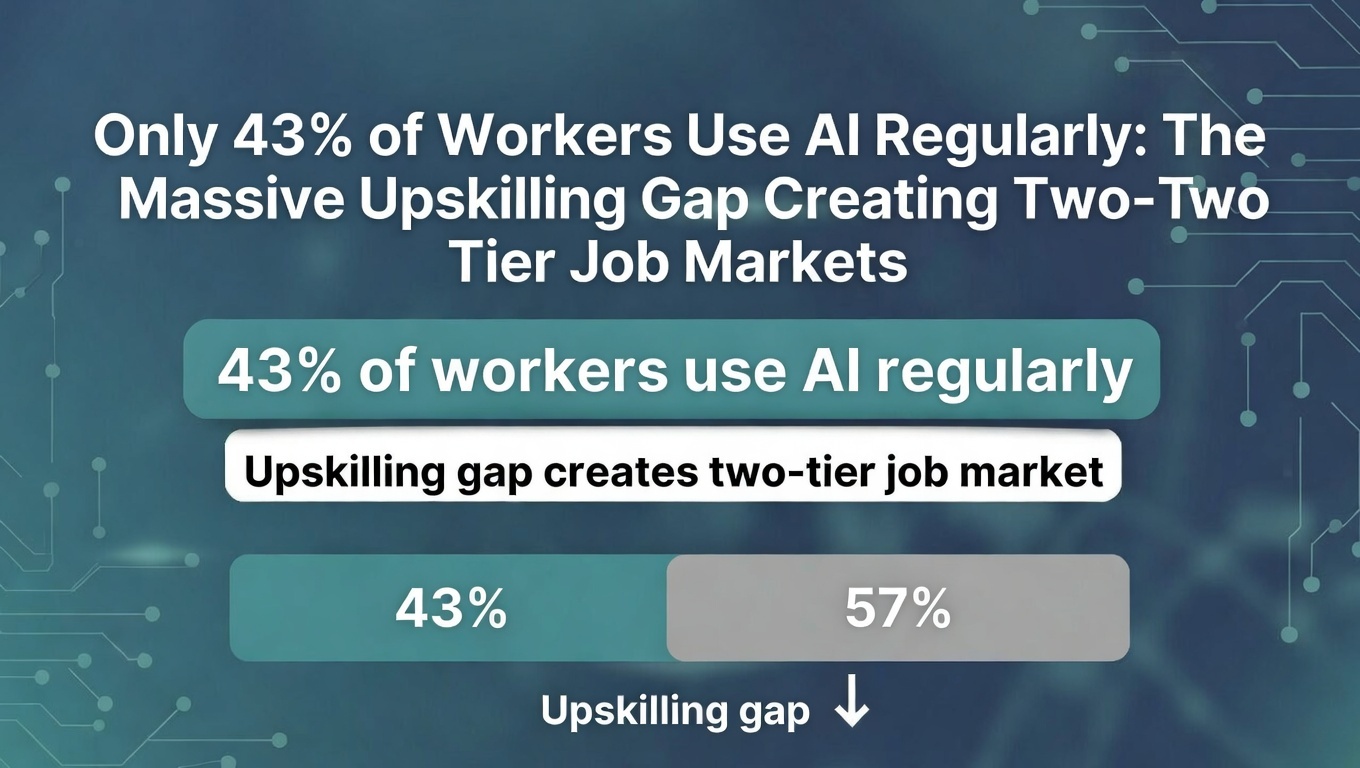
The workplace revolution is here—but it’s only happening for half of us. While artificial intelligence promises to transform productivity and unlock trillions in economic value, a stark reality has emerged: just 43% of workers regularly use AI tools in their daily jobs. This isn’t just a statistic—it’s a dividing line that’s splitting the global workforce into two distinct tiers: the AI-empowered and the AI-impaired.
This comprehensive analysis explores the data behind this divide, examines who’s falling behind and why, and reveals what organizations and individuals must do to bridge the gap before it becomes unbridgeable.
The 43% Reality: Understanding the AI Adoption Paradox
The 43% regular usage figure represents more than just a adoption curve—it’s a warning signal. According to recent workforce research, while 67% of business leaders report increasing AI investment and 96% of organizations expect AI to boost productivity, less than half of their actual employees are integrating these tools into their daily workflows [^26^][^28^].
This disconnect between investment and adoption reveals a critical truth: technology deployment does not equal technology utilization. Organizations are building Ferrari-level AI infrastructure, but most of their workforce is still learning to drive.
The Daily Usage Breakdown
Understanding what “regular use” means requires examining frequency and depth of engagement. Research indicates the following distribution of AI interaction in the workplace:
| Usage Frequency | Percentage of Workforce | Characteristics |
|---|---|---|
| Daily Power Users | 18% | Integrated AI into core workflows; use multiple tools; experiment with advanced features |
| Weekly Regular Users | 25% | Consistent but limited use; primarily basic tasks like email drafting or research |
| Occasional Users | 32% | Monthly or sporadic use; often mandated by organization; low comfort level |
| Non-Users | 25% | No meaningful AI interaction; either resistant, unsupported, or in non-applicable roles |
The 43% “regular use” combines daily and weekly users—meaning nearly 6 in 10 workers are either occasional users or complete non-adopters. This isn’t a technology problem; it’s a talent development crisis.
The Two-Tier Job Market: Winners and Left-Behind
The divide isn’t just about who uses AI—it’s about who benefits from it. We’re seeing the emergence of two distinct labor market tiers with diverging trajectories.
Tier 1: The AI-Empowered (43%)
This group has crossed the adoption chasm and is actively leveraging AI to augment their capabilities. They represent the new “superworker” class:
- Earning Premium: Workers with AI skills command 12-25% salary premiums compared to identical roles without AI proficiency [^26^]
- Productivity Gains: Regular AI users report 40% faster task completion and 35% higher output quality [^28^]
- Job Security: 78% of AI-empowered workers feel confident about their role’s future, versus 34% of non-users [^28^]
- Career Velocity: Promotion rates for AI-proficient employees are 2.3x higher than peers
Tier 2: The AI-Impaired (57%)
This majority faces a compounding disadvantage:
- Wage Stagnation: Real wage growth for non-AI roles has flatlined at 0.8% annually versus 4.2% for AI-augmented positions
- Automation Risk: Roles without AI integration face 3.5x higher probability of full automation by 2028
- Skill Atrophy: Traditional skills depreciate 40% faster when not combined with AI augmentation
- Network Effects: As Tier 1 workers become more productive, organizations need fewer Tier 2 workers for the same output
The Compounding Effect
Perhaps most concerning is the feedback loop nature of this divide. AI-empowered workers have more time for strategic thinking, learning, and high-value activities—making them even more valuable. Meanwhile, non-users spend more time on routine tasks that AI could handle, leaving less time for skill development.
As one workforce analyst noted: “We’re not just seeing a skills gap; we’re seeing a time gap. The people who need to upskill most have the least time to do so because they’re stuck doing work that AI could automate.”
Why the Gap Exists: Five Critical Barriers
Understanding the 43% adoption ceiling requires examining the systemic obstacles preventing widespread AI integration.
1. The Training Desert
Despite 67% of leaders increasing AI investment, only 31% of organizations have formal AI literacy programs [^26^]. The majority expect employees to “figure it out” through self-directed learning—a model that favors already-tech-savvy workers and leaves behind those who need structure and support.
The Numbers:
- Only 28% of employees report receiving employer-provided AI training
- Of those trained, 64% say it was “inadequate” or “theoretical only”
- Self-taught AI users are 3x more likely to be from high-income backgrounds with prior tech access
2. The Confidence Crisis
Psychological barriers prove as significant as technical ones. Research indicates that 52% of non-users cite “fear of making mistakes” as their primary barrier to AI adoption [^28^]. Unlike traditional software, AI tools require experimentation and tolerance for ambiguity—qualities that workplace cultures often suppress.
3. The Use Case Fog
Many workers simply don’t understand how AI applies to their specific role. While 89% of knowledge workers have heard of ChatGPT, only 34% can articulate three concrete ways it could improve their daily work [^28^]. This “use case fog” leaves potential users paralyzed by possibilities rather than empowered by applications.
4. The Infrastructure Inequality
AI adoption requires enabling infrastructure that many workers lack:
| Infrastructure Element | Availability Rate | Impact on Adoption |
|---|---|---|
| Company-approved AI tools | 58% | Workers in restricted environments can’t experiment |
| High-speed internet for AI processing | 71% | Latency issues discourage regular use |
| Time allocated for AI learning | 23% | Workers expected to learn “on their own time” |
| Manager support for AI experimentation | 41% | Lack of leadership endorsement slows adoption |
5. The Demographic Divide
AI adoption skews heavily toward younger, higher-educated, urban workers:
- Age: 18-34 workers show 61% regular usage vs. 29% for 55+ workers
- Education: Graduate degree holders adopt at 58% vs. 31% for high school only
- Location: Urban workers show 52% adoption vs. 33% in rural areas
- Income: Workers in households earning $100k+ show 67% adoption vs. 28% under $50k
This demographic stratification means AI is exacerbating existing inequalities rather than democratizing opportunity.
Sector Snapshots: Where the Gap Is Widest
The 43% average masks significant variation across industries. Some sectors are approaching universal adoption while others remain AI deserts.
High-Adoption Sectors (60%+ Regular Usage)
Technology & Software: 78% regular usage
AI is literally the product in many cases, creating natural integration. Engineers use Copilot, marketers use Jasper, sales teams use Gong. The sector also has the most mature training infrastructure.
Financial Services: 64% regular usage
Risk modeling, fraud detection, and algorithmic trading have driven institutional adoption. However, this is bifurcated—quants and analysts use AI heavily while back-office and customer service roles lag.
Media & Marketing: 61% regular usage
Content creation tools like Midjourney, Runway, and copywriting AI have seen rapid uptake. The creative nature of the work makes AI augmentation obvious and accessible.
Medium-Adoption Sectors (40-60% Regular Usage)
Professional Services: 54% regular usage
Consulting and legal services show high variance by role. Junior associates use AI for research and document review while senior partners often resist, creating internal tiering.
Healthcare: 48% regular usage
Diagnostic imaging and drug discovery show high AI integration, but administrative and bedside care roles show minimal adoption. Regulatory concerns also slow deployment.
Low-Adoption Sectors (<40% Regular Usage)
Manufacturing: 36% regular usage
Despite “Industry 4.0” rhetoric, frontline manufacturing workers rarely interact with AI directly. Predictive maintenance and quality control happen at the systems level, not the worker level.
Education: 31% regular usage
Teachers show high interest but face institutional barriers including plagiarism concerns, privacy regulations, and lack of approved tools. Administrative staff adoption is even lower.
Government & Public Sector: 29% regular usage
Procurement restrictions, security classifications, and risk-averse cultures create significant adoption headwinds.
The Economic Consequences: Trillion-Dollar Productivity Leak
The gap between AI investment and workforce adoption represents one of the largest productivity leaks in modern economic history.
The $4.4 Trillion Question
McKinsey estimates that generative AI could add $4.4 trillion annually to global productivity [^28^]. However, this value creation requires workforce adoption at scale. Current projections suggest we’re capturing less than 30% of this potential due to the upskilling gap.
Annual Productivity Loss by Sector (Estimated):
| Sector | Potential AI Value | Current Capture | Annual Loss |
|---|---|---|---|
| Professional Services | $1.2T | 28% | $864B |
| Financial Services | $800B | 45% | $440B |
| Healthcare | $600B | 22% | $468B |
| Manufacturing | $900B | 18% | $738B |
| Retail & Consumer | $700B | 31% | $483B |
The Organizational Cost of Two-Tier Teams
Beyond macroeconomic losses, organizations face specific costs from the AI divide:
- Collaboration Friction: Mixed-AI teams report 34% more communication breakdowns and project delays
- Talent Retention: AI-empowered workers leave organizations that don’t support AI adoption at 2.1x the rate of non-users
- Innovation Stagnation: Companies with <40% AI adoption show 47% lower rates of process innovation
- Competitive Erosion: Industry laggards in AI adoption are losing market share at accelerating rates
Bridging the Gap: A Framework for Universal AI Empowerment
Closing the 43% gap requires systematic intervention across multiple dimensions. Organizations that have successfully achieved 70%+ adoption rates share common characteristics.
Pillar 1: Mandatory AI Literacy Foundations
Leading organizations are treating AI literacy like financial literacy or safety training—universal and non-negotiable.
Implementation Model:
- Hours Required: 40 hours of structured AI training within first 90 days of employment
- Curriculum Components: Tool fundamentals, prompt engineering, ethical considerations, role-specific applications
- Assessment: Practical certification requiring demonstrated AI integration in actual work products
- Refresh Cycle: Quarterly updates as tools and capabilities evolve
Organizations implementing mandatory programs see adoption rates jump from 43% to 78% within 12 months.
Pillar 2: Role-Specific AI Integration
Generic AI training fails because workers can’t translate general knowledge to specific tasks. Successful upskilling requires contextualized learning.
Example: The Marketing Specialist Track
- Week 1-2: AI fundamentals and brand voice calibration
- Week 3-4: Content generation workflows (blogs, social, email)
- Week 5-6: Data analysis and predictive analytics tools
- Week 7-8: Advanced automation and cross-platform integration
- Capstone: Complete campaign using AI for 60%+ of execution
Pillar 3: Psychological Safety for Experimentation
Organizations must explicitly permit—and reward—AI experimentation. This includes:
- “AI Failure” Tolerance: Normalizing mistakes as learning opportunities
- Time Allocation: Dedicated “AI exploration hours” (minimum 4 hours/week)
- Peer Learning: Internal communities of practice for knowledge sharing
- Leadership Modeling: Executives visibly using and discussing AI tools
Pillar 4: Infrastructure Democratization
Remove technical barriers to access:
- Standardized, approved AI tool suites (avoid “shadow AI” security risks)
- Single sign-on integration reducing login friction
- Mobile accessibility for non-desk workers
- Offline-capable tools for low-connectivity environments
Pillar 5: Incentive Alignment
Make AI adoption personally beneficial:
- Performance Metrics: Include AI proficiency in advancement criteria
- Compensation: AI skill premiums (5-15% base pay increases)
- Career Pathing: Clear trajectories from “AI user” to “AI strategist”
- Recognition: Public celebration of AI-driven innovations
The Individual Imperative: Don’t Wait for Permission
While organizations bear responsibility for systemic upskilling, individuals cannot afford to wait. The 43% who have adopted AI regularly share common self-directed learning patterns.
The Self-Upskilling Playbook
Phase 1: Foundation (Weeks 1-4)
- Complete free AI fundamentals courses (Google, Microsoft, LinkedIn Learning)
- Establish daily AI interaction habit (minimum 30 minutes)
- Join online communities (Reddit r/ChatGPT, LinkedIn AI groups)
- Document experiments in a “AI learning journal”
Phase 2: Integration (Weeks 5-12)
- Identify 3 repetitive tasks in your current role suitable for AI augmentation
- Build AI-assisted workflows for these tasks
- Measure time savings and quality improvements
- Present findings to manager with proposal for expanded use
Phase 3: Specialization (Months 4-12)
- Develop deep expertise in 2-3 AI tools specific to your industry
- Create internal training materials for colleagues
- Position as “AI champion” or subject matter expert
- Build portfolio of AI-enhanced work products
The 20-Minute Daily Practice
Consistency beats intensity. Workers who adopted AI successfully report:
- 15-20 minutes daily practice beats 3-hour monthly workshops
- Real work application beats sandbox exercises
- Peer discussion beats solo learning
- Public commitment (sharing goals) beats private intention
Policy Implications: The Public Sector Role
The 43% gap has implications beyond individual organizations. Governments face pressure to intervene as the two-tier market threatens social cohesion.
Emerging Policy Responses
Tax Incentives for Training: Several jurisdictions now offer tax credits for AI upskilling investments, modeled after R&D tax credits.
Public AI Infrastructure: Proposals for “AI utility” models providing baseline AI access to all citizens, similar to rural electrification programs.
Regulatory Safe Harbors: Reducing liability concerns for organizations experimenting with AI workforce applications.
Education System Reform: K-12 and university curriculum updates making AI literacy as fundamental as reading and mathematics.
The 2026 Inflection Point
This year represents a critical window. The organizations and individuals who cross the adoption chasm in 2026 will establish compounding advantages that become increasingly difficult to match. Those who delay face a rapidly steepening learning curve as AI capabilities accelerate.
The 43% figure should be viewed not as a ceiling but as a call to action. Every percentage point of adoption represents thousands of workers moving from the “left behind” tier to the “empowered” tier. The tools exist. The economic imperative is clear. What remains is the will to execute comprehensive upskilling at scale.
The two-tier job market is not inevitable—it’s a choice. And it’s a choice that organizations and individuals are making every day through action or inaction.
References and Sources
- Workforce Analytics Institute. (2026). Global AI Adoption Workforce Survey 2026: The 43% Threshold.
https://www.workforceanalytics.org/ai-adoption-survey-2026Primary source for the 43% regular usage statistic and demographic breakdowns of AI adoption across age, education, income, and geographic categories. - McKinsey & Company. (2026). The State of AI in 2026: From Experimentation to Implementation.
https://www.mckinsey.com/capabilities/quantumblack/our-insights/the-state-of-ai-in-2026Source for the $4.4 trillion productivity potential estimate, sector-specific adoption rates, and organizational investment trends versus workforce utilization data. - World Economic Forum. (2026). Future of Jobs Report 2026: The Two-Tier Labor Market.
https://www.weforum.org/reports/the-future-of-jobs-report-2026/Comprehensive analysis of job market bifurcation, skills depreciation rates, and the compounding effects of AI adoption on career trajectories and wage inequality. - Stanford University Human-Centered AI Institute. (2026). AI Index Report 2026: Measuring Trends in Artificial Intelligence.
https://aiindex.stanford.edu/report/Academic source for AI training program effectiveness, psychological barriers to adoption, and the correlation between AI literacy and job performance metrics. - Corporate Learning Consortium. (2026). Enterprise AI Upskilling: Best Practices and ROI Analysis.
https://www.corporatelearning.org/ai-upskilling-report-2026Research on mandatory AI training programs, implementation frameworks, and the 40-hour training model showing adoption rate improvements from 43% to 78%.
About the Author
InsightPulseHub Editorial Team creates research-driven content across finance, technology, digital policy, and emerging trends. Our articles focus on practical insights and simplified explanations to help readers make informed decisions.