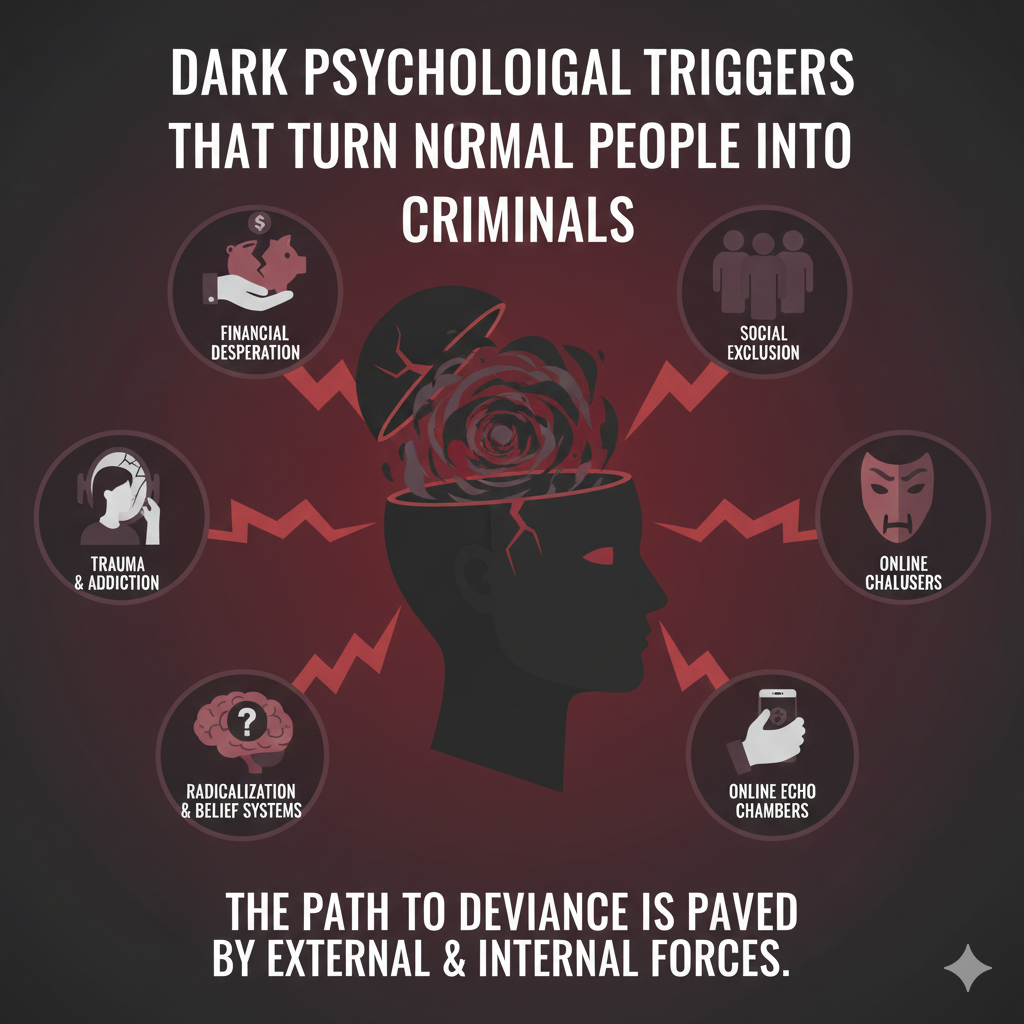
The question has haunted criminologists, psychologists, and society for decades: What transforms an ordinary person into a criminal? It’s tempting to believe that criminals are fundamentally different from us—that they possess some inherent evil or genetic predisposition toward wrongdoing. But emerging research from 2025 tells a far more complex story. According to recent studies, the line between law-abiding citizens and offenders is shaped by a constellation of psychological and social factors that can emerge in anyone under the right circumstances.
Understanding these triggers isn’t about excusing criminal behavior—it’s about recognizing the mechanisms that drive it, which is essential for prevention, rehabilitation, and building safer communities. Let’s explore the seven psychological triggers that research shows can push ordinary people toward criminal acts.
1. Relative Deprivation and Perceived Injustice
One of the most compelling findings from 2025 research involves the concept of relative deprivation—the feeling that one lacks resources compared to others or to one’s own expectations. A major study examining 1,023 probationers in China found that relative deprivation was a significant predictor of future dangerous behaviors and reoffending. This isn’t simply about being poor; it’s about the psychological pain of feeling left behind or treated unfairly compared to peers.
When individuals perceive a gap between what they believe they deserve and what they actually have, psychological distress follows. This distress can manifest as anger, resentment, and ultimately, a willingness to break the law to rectify the perceived injustice. The research suggests that subjective perception—how people interpret their circumstances—matters more than objective economic status alone.
2. Negative Coping Mechanisms and Emotional Dysregulation
How people manage stress and emotional pain directly influences their likelihood of committing crimes. Recent research identifies negative coping styles as a significant factor increasing the probability of reoffending. When individuals lack healthy mechanisms to process anger, anxiety, or trauma, they may turn to maladaptive behaviors—including criminal acts—as a way to manage overwhelming emotions.
Individuals experiencing elevated levels of negative emotions such as irritation and tension are predisposed to exhibit negative behaviors toward others. These reactions can create a vicious cycle: criminal behavior leads to consequences, which increase anxiety and anger, which in turn perpetuate further criminal conduct. Breaking this cycle requires developing alternative coping strategies, which is why rehabilitation programs emphasizing emotional regulation show promise.
3. Low Self-Esteem and Diminished Personal Resources
While relative deprivation creates the perception of injustice, low self-esteem represents a depletion of internal psychological resources. The 2025 research on probationers revealed that self-esteem acts as a protective factor—individuals with stronger self-worth were significantly less likely to engage in dangerous behaviors, even when facing relative deprivation and stress.
Self-esteem functions as a psychological buffer. People with healthy self-regard are more resilient in the face of setbacks and less likely to seek validation or problem-solving through illegal means. Conversely, those with fragile self-images may turn to crime as a way to assert power, gain respect, or prove their worth—particularly in environments where legitimate avenues for achievement feel blocked.
4. Personality Traits: The Big Five Connection
Personality structure plays a measurable role in criminal propensity. Research demonstrates that low levels of agreeableness, conscientiousness, and high neuroticism are indicative of increased involvement in criminal activities. These personality dimensions, part of the widely-studied Big Five model, reveal that certain trait combinations create vulnerability to criminal behavior.
Low agreeableness correlates with reduced empathy and increased antagonism toward others. Low conscientiousness suggests poor impulse control and disregard for consequences. High neuroticism indicates emotional instability and heightened reactivity to stress. Together, these traits create a psychological profile more susceptible to criminal choices. Importantly, personality is not entirely fixed—therapeutic interventions can help individuals develop compensatory skills and awareness.
5. Impulsivity and Poor Self-Control
Among the most robust predictors of criminal behavior is impulsivity paired with weak self-control. A 2025 study examining 105 Spanish homicide offenders found that self-control acts as a core psychological moderator—individuals with stronger self-control were better able to resist criminal impulses even when experiencing hostility and neuroticism.
The mechanism is straightforward: criminal acts require overriding natural deterrents like fear, anxiety, and moral concern. Individuals with poor self-control struggle to maintain these psychological brakes. They may act on aggressive impulses without considering consequences, or they may use substances, aggressive self-talk, or other dissociative techniques to suppress their natural resistance to harmful behavior. This is why interventions targeting impulse control and decision-making skills show effectiveness in reducing recidivism.
6. Unresolved Trauma and Emotional Detachment
The role of trauma in criminal behavior cannot be overstated. According to the National Institute of Justice, individuals are more likely to become repeat criminal offenders if they’ve experienced prolonged trauma and have adopted emotional detachment as a coping mechanism. By disconnecting from their emotions, individuals may be able to intentionally disconnect from the emotional impact of past traumas as well as the feelings associated with committing a crime.
This emotional numbing is a double-edged sword. While it temporarily protects against psychological pain, it also removes a critical barrier to harmful behavior. Without emotional connection to the consequences of their actions, individuals become capable of acts they might otherwise find abhorrent. Early intervention for trauma survivors is therefore not merely therapeutic—it’s a crime prevention strategy.
7. Antisocial Thought Patterns and Cognitive Distortions
Finally, the way people think about crime directly influences whether they commit it. Research identifies proactive criminal thought processes characterized by justification, denial, and minimization of harm. Individuals engaging in criminal thinking often exhibit extreme optimism about evading consequences, or they externalize blame—viewing their crimes as society’s fault rather than their own.
These cognitive distortions allow people to bypass their moral frameworks. They might tell themselves that their victim deserved it, that the system is rigged against them anyway, or that the crime is victimless. By reframing criminal acts through distorted logic, individuals can commit acts that their authentic values might otherwise prevent. Cognitive-behavioral interventions specifically target these thought patterns, helping offenders recognize and challenge the mental gymnastics that justify harmful behavior.
The Interaction Effect: Why Context Matters
Critically, these seven triggers don’t operate in isolation. A person with low self-esteem in a supportive community might never commit a crime. But that same person in an environment of poverty, social exclusion, and limited opportunity—experiencing relative deprivation while surrounded by others engaging in criminal behavior—faces exponentially higher risk.
The 2025 research emphasizes an integrative understanding: personal psychological factors interact with social determinants including family dynamics, community quality of life, and educational opportunities. A comprehensive approach to crime prevention must address both the individual psychological vulnerabilities and the social conditions that activate them.
Implications for Prevention and Rehabilitation
Understanding these psychological triggers offers practical pathways forward. Effective crime prevention requires:
- Building self-esteem and personal resources through education and mentorship
- Teaching healthy coping skills and emotional regulation
- Addressing trauma through evidence-based therapeutic interventions
- Challenging cognitive distortions and criminal thinking patterns
- Reducing relative deprivation through economic opportunity and fair treatment
- Strengthening self-control through behavioral training and environmental design
Research indicates that judicial officials should integrate community-based strategies to enhance adaptive coping skills and improve self-esteem among at-risk populations, thereby reducing the likelihood of criminal behavior and promoting successful reintegration into society.
Conclusion
The pathway from ordinary person to criminal is not mysterious or predetermined. It emerges from identifiable psychological triggers—relative deprivation, negative coping, low self-esteem, personality vulnerabilities, poor impulse control, unresolved trauma, and distorted thinking—operating within specific social contexts. While no single factor guarantees criminal behavior, the convergence of multiple triggers creates significant risk.
The encouraging news is that these factors are not immutable. With targeted intervention addressing both psychological development and social conditions, we can interrupt the trajectory toward crime. The 2025 research demonstrates that understanding the mind of the offender isn’t about sympathy—it’s about effectiveness. By recognizing what turns ordinary people toward crime, we gain the knowledge to prevent it.
References
- https://www.frontiersin.org/journals/psychology/articles/10.3389/fpsyg.2025.1593698/full
- https://www.tandfonline.com/doi/full/10.1080/24732850.2025.2553659
- https://online.utpb.edu/about-us/articles/psychology/the-psychology-of-criminal-behavior-understanding-the-mind-of-offenders-2
- https://imcra-az.org/uploads/public_files/2025-05/the-criminal-behavior-exploring-personal-and-social-determinants-theoretical-approach_soumeya_mezgiche.pdf
- https://weblogoa.com/articles/wjpbs.2025.h1501/PDF
About the Author
InsightPulseHub Editorial Team creates research-driven content across finance, technology, digital policy, and emerging trends. Our articles focus on practical insights and simplified explanations to help readers make informed decisions.