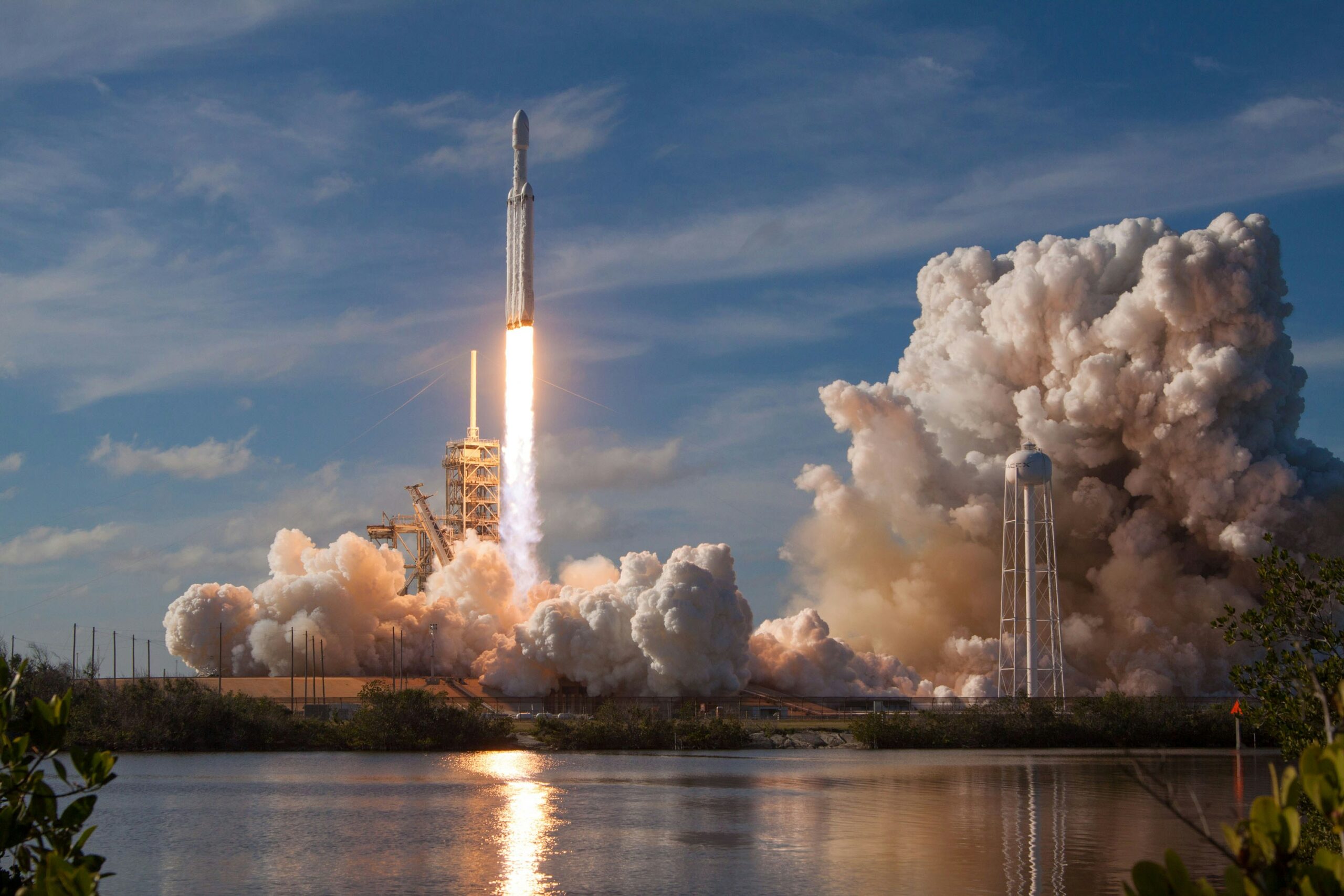
The new space race isn’t about flags and footprints—it’s about data and dominance. In low-Earth orbit, 2,000 kilometers above the planet’s surface, three mega-constellations are battling to become the internet’s backbone. SpaceX’s Starlink has already won the first round with 9,000+ satellites and 9 million customers. But 2026 is the year the competition finally arrives: Amazon’s Project Kuiper is launching heavy, and China’s Guowang is deploying at a pace that threatens to reshape global connectivity.
The stakes are planetary. The satellite internet market, valued at $9.5 billion in 2026, is projected to hit $33-64 billion by 2034-2036. But this isn’t just about broadband subscriptions. Control of low-Earth orbit means control of global communications, financial transactions, military command, and the emerging “space economy” that Morgan Stanley predicts could reach $1 trillion by 2040.
Three powers. Three strategies. One orbital battleground.
The Combatants: A Tale of Three Constellations
| Constellation | Operator | 2026 Satellites | Planned Total | Key Advantage |
|---|---|---|---|---|
| Starlink | SpaceX (USA) | 9,000+ | 42,000 | First-mover, vertical integration |
| Project Kuiper | Amazon (USA) | 200+ | 7,700 | AWS integration, enterprise focus |
| Guowang | China SatNet (PRC) | 154 | 13,000-200,000 | State backing, ITU filings |
Sources: Company reports, FCC filings, ITU database
Starlink: The Undisputed King
Five years after its first customer connected, Starlink has become the most successful satellite constellation in history. The 2026 numbers are staggering:
- 9 million subscribers in 155 countries
- 300 Falcon 9 launches dedicated to Starlink deployment
- 41 million additional users via aviation and maritime (1,400+ commercial aircraft equipped in 2025 alone)
- 600+ Gen2 satellites with direct-to-cell capability
- Projected 18.4 million subscribers by end of 2026
The Moat: Vertical Integration
Starlink’s advantage isn’t just being first—it’s being integrated. SpaceX manufactures satellites at $250,000-500,000 each, launches them on its own reusable rockets at marginal cost, and controls the entire stack from factory to user terminal. Competitors must buy launches at market rates ($50-100 million per mission) and rely on external manufacturers.
The economics are brutal: Starlink’s cost per satellite in orbit is a fraction of any competitor’s. And with Starship coming online—capable of launching 400 satellites at once—that advantage will widen.
The Cellular Frontier
Starlink’s most disruptive 2026 move is Direct to Cell. Partnering with T-Mobile in the US, Rogers in Canada, and others globally, Starlink is turning every smartphone into a satellite phone. The service offers:
- Text messaging anywhere (operational)
- Voice calls (rolling out 2026)
- Data for optimized apps (in testing)
This isn’t just rural broadband—it’s the elimination of cellular dead zones globally. AT&T’s partnership with AST SpaceMobile (launching 2026) is a direct response, but Starlink is 650 satellites ahead in the direct-to-device race.
Amazon Kuiper: The Sleeping Giant Awakens
Amazon entered the satellite race in 2019, filed its FCC application before Starlink had 1,000 satellites, and then… waited. Delays, launch contract disputes, and manufacturing challenges kept Kuiper earthbound while Starlink built an insurmountable lead.
2026 is the year Amazon finally fights back.
The February Offensive
On February 10, 2026, the FCC approved Amazon’s request to expand its constellation to 7,700 satellites—nearly doubling its previous authorization. The approval came with strict deadlines: 50% deployed by 2032, 100% by 2035. Amazon has invested $10 billion and plans to spend $1 billion more in 2026 alone.
The launch cadence is accelerating:
- February 12, 2026: First heavy-lift Ariane 64 mission (LE-01) deploys 32 satellites from French Guiana
- 18 Arianespace missions contracted, the largest commercial launch deal in European history
- 80+ heavy-lift launches planned through 2027
- 20+ launches in 2026, 30+ in 2027
By July 2026, Amazon expects 700 satellites in orbit—enough for limited commercial service. By comparison, Starlink had 7,500 operational satellites at the same stage.
The AWS Advantage
Amazon isn’t competing on consumer broadband alone. Kuiper is designed as infrastructure for Amazon Web Services—enabling edge computing, hybrid cloud-satellite solutions, and enterprise connectivity that Starlink can’t match.
Early customers reveal the strategy:
- AT&T: Business customer backhaul (announced February 2026)
- JetBlue: In-flight WiFi (2027 launch)
- Hunt Energy, Connected Farms, Crane Worldwide: Industrial IoT and logistics
The “Ultra” terminal—delivering 1 Gbps down, 400 Mbps up—targets enterprise, not consumers. Amazon is building the internet backbone for the machine economy while Starlink serves digital nomads and rural households.
The Terminal Gap
Starlink’s user terminal costs $599 (down from $3,000 originally). Amazon hasn’t revealed Kuiper pricing, but analysts expect aggressive subsidies to gain market share. The question is whether Amazon can manufacture terminals at scale—Starlink produces 10,000+ per week. Kuiper’s first production line in Florida is still ramping.
Guowang: China’s Orbital Ambition
While American companies dominate commercial space, China is playing a different game. Guowang (国网—”National Network”) isn’t a startup; it’s state infrastructure with strategic, military, and economic objectives. And in 2026, it’s accelerating dramatically.
The ITU Bombshell
In the final week of 2025, China filed paperwork with the International Telecommunication Union for 193,428 satellites across two new constellations (CTC-1 and CTC-2). Added to existing filings:
- Guowang: 13,000 satellites (state-owned China SatNet)
- Qianfan (Thousand Sails): 15,000 satellites (Shanghai Yuanxin)
- CTC-1/CTC-2: 193,428 satellites (new joint government-industry body)
- China Mobile: 2,664 satellites
- GalaxySpace: 91-187 satellites
Total Chinese ITU filings: 224,000+ satellites. For context, Starlink’s ultimate target is 42,000. China is claiming orbital real estate for a century of space development.
The “Use It or Lose It” Deadline
ITU rules are strict: file, then launch, or lose priority. For Guowang—filed September 2020—the “Bring Into Use” deadline is September 2027. China must launch 10% of its constellation (1,300 satellites) by then or forfeit spectrum rights.
The 2026 deployment plan is aggressive:
- 310 satellites in 2026 (up from 154 currently)
- 900 satellites in 2027
- 3,600 satellites annually from 2028
- 13,000 total by early 2030s
January 19, 2026 saw the 19th Guowang launch, with 9 satellites reaching orbit. The constellation now has 154 spacecraft, with commercial satellite maker GalaxySpace producing batches for state-owned China SatNet.
The Strategic Objective
Guowang isn’t primarily about consumer broadband. It’s about:
- 6G infrastructure: Space-air-ground integrated networks
- Belt and Road connectivity: Serving Chinese projects globally
- Military resilience: Communications independent of Western systems
- Orbital denial: Occupying prime LEO slots before competitors
Starlink has colonized the “prime real estate” at 530-550 km altitude—low enough for low latency, high enough for orbital stability. China’s filings target similar orbits, but Starlink’s first-mover advantage forces competitors to higher, less efficient altitudes or the challenging “Very Low Earth Orbit” below 400 km.
The Commercial Front: Qianfan
While Guowang serves state interests, Qianfan (Thousand Sails) is China’s commercial answer to Starlink. Operated by Shanghai Yuanxin Satellite Technology, it has:
- 108 satellites in orbit (as of early 2026)
- 15,000 satellite ultimate target
- $932 million Series A funding (2024)
- Phase 1: 648 satellites by end of 2025 (delayed), 648 more by 2027
Qianfan has faced setbacks—14 of 108 satellites have failed and are decaying, and launch procurement has been difficult. But in late 2025, Yuanxin diversified beyond state provider CASC, awarding $187 million in contracts to private launchers Landspace, Space Pioneer, and CAS Space.
The goal: regional service by 2027, global by 2030. At prices undercutting Starlink, targeting Asia, Africa, and Latin America.
The Battlegrounds: Where the War Is Fought
1. Regulatory Capture
The FCC’s February 2026 approval of Amazon’s expansion came days after China filed its 193,000-satellite ITU paperwork. The timing wasn’t coincidental—regulators are racing to allocate spectrum before it’s claimed by strategic competitors.
The FCC’s conditions on Kuiper—50% deployment by 2032—mirror ITU “use it or lose it” rules. The U.S. is formalizing orbital property rights before China can exploit regulatory gaps.
2. Launch Capacity
The satellite internet war is constrained by rocket supply. SpaceX’s Falcon 9 flew 134 times in 2025—more than any other vehicle in history. China’s Long March family launched 92 times (a national record). But demand exceeds supply:
- Amazon has booked 83 launches across Blue Origin, ULA, Arianespace, and even SpaceX
- China’s private launchers (Landspace, i-Space, Galactic Energy) are scaling but remain unreliable
- Europe’s Ariane 6 is finally operational but has a backlog of government missions
Analysts warn of a “launch supply bottleneck” through 2027. The constellation that secures launch slots wins.
3. Direct-to-Device
The next battlefield is cellular. Starlink’s Direct to Cell (with T-Mobile) is operational for texting, expanding to voice and data in 2026. AST SpaceMobile (partnering with AT&T and Verizon) launched its first five BlueBird satellites in September 2025, with 45-60 more planned by end of 2026.
China’s response: China Mobile has applied for 2,664 satellites specifically for direct-to-device service, filing with China’s Ministry of Industry and Information Technology in 2025.
The winner of direct-to-device eliminates cellular dead zones globally—and captures billions of subscribers who’ve never had reliable connectivity.
4. Enterprise vs. Consumer
Starlink dominates consumer broadband. Amazon targets enterprise and government. China focuses on strategic infrastructure and developing markets.
| Segment | Starlink | Amazon Kuiper | China Guowang/Qianfan |
|---|---|---|---|
| Consumer Broadband | Dominant | Secondary | Limited (rural China) |
| Enterprise/Government | Growing | Primary focus | State priority |
| Developing Markets | Active (Brazil, Africa) | Planned | Strategic priority |
| Direct-to-Device | Leading | Unknown | Developing |
The Geopolitical Dimension
Ukraine and the Militarization of LEO
Starlink’s role in Ukraine—providing battlefield communications after Russian cyberattacks—transformed satellite internet from commercial service to strategic asset. The U.S. military’s $1.8 billion Starshield contract (2024) formalized this, creating a classified Starlink variant for national security.
China watched closely. Guowang’s military applications are explicit in Chinese defense planning. The constellation provides:
- Global communications independent of Western infrastructure
- ISR (intelligence, surveillance, reconnaissance) capabilities
- Navigation backup to BeiDou
- Anti-satellite targeting data
The Orbital Debris Threat
With 224,000 satellites potentially launching, space sustainability is collapsing. Current LEO capacity is estimated at 60,000 satellites before collision risks become unmanageable. China’s 193,000-satellite filing alone exceeds this limit threefold.
The FCC and ITU are adding collision avoidance and deorbiting requirements, but enforcement is weak. The tragedy of the commons looms: whoever launches fastest occupies the orbital slots, leaving debris and congestion for later entrants.
The Economics: Who Makes Money?
Starlink achieved cash-flow positive status in late 2023, with 2026 revenue estimated at $6-8 billion. The path to profitability required:
- Vertical integration (manufacturing + launch)
- Consumer terminal subsidies (recouped via subscription)
- High-margin aviation/maritime services
- Government contracts (Starshield)
Amazon Kuiper is burning $1 billion annually with no revenue yet. The bet: AWS integration creates enterprise value that justifies losses. If Kuiper becomes the default infrastructure for cloud edge computing, profitability follows.
China’s constellations are state-funded strategic investments, not profit centers. The metric isn’t ROI—it’s orbital control, 6G dominance, and Belt and Road influence. This asymmetry makes China a dangerous competitor: it can sustain losses indefinitely for strategic gain.
2026: The Tipping Point Predictions
Based on current trajectories:
- Q2 2026: Amazon Kuiper begins limited commercial service (enterprise only)
- Q3 2026: Starlink Direct to Cell expands to voice calls in North America
- Q4 2026: China launches 300+ satellites across Guowang and Qianfan
- 2027: First “orbital congestion incident”—collision or near-miss between major constellations
- 2027: Regulatory crackdown on mega-constellation filings; ITU reforms “use it or lose it” rules
Conclusion: The Orbital Oligopoly
The satellite internet war won’t have one winner. Starlink will dominate consumer broadband in the West. Amazon Kuiper will own enterprise and cloud connectivity. China’s Guowang and Qianfan will control developing markets and strategic infrastructure.
The real question is whether this oligopoly stabilizes or collapses into orbital chaos. With 224,000 satellites filed and only 60,000 orbital slots sustainable, the math doesn’t work. Either regulators impose hard limits, or the low-Earth orbit becomes a debris field that ends the space age.
For now, 2026 is the year of acceleration. Starlink consolidates. Amazon scales. China mobilizes. And the planet below becomes increasingly dependent on three corporate (and one state) powers for the connectivity that runs modern civilization.
The internet was supposed to democratize information. Instead, it’s being orbitalized by oligopolies. The final frontier isn’t space—it’s the control of space itself.
References
- EFT Media. (2026, January 3). Starlink hits 9 million customers in five years, ready to compete with Amazon LEO in 2026. https://eftm.com/2026/01/starlink-hits-9-million-customers-in-five-years-ready-to-compete-with-amazon-leo-in-2026-270384
Starlink 2025 progress report: 9 million customers, 9,000 satellites, 41 million via aviation/maritime, 1,400 aircraft equipped.
- CNBC. (2026, February 10). Amazon gets FCC approval to launch 4,500 Leo internet satellites. https://www.cnbc.com/2026/02/10/amazon-gets-fcc-approval-to-launch-4500-leo-internet-satellites.html
FCC approves Kuiper expansion to 7,700 satellites; $10 billion invested, $1 billion 2026 spend, 20+ launches planned.
- SkyLinker. (2026, January 12). GuoWang – Overview of the Chinese State-Owned LEO SatCom Constellation. https://www.skylinker.io/p/guowang-xingwang-gw-a59-china-satnet-chinese-leo-satcom-constellation-overview-eng
Guowang state infrastructure project: 13,000 satellites, military applications, 6G integration, and ITU “use it or lose it” deadline September 2027.
- China in Space. (2026, January 19). Second Commercially Made GuoWang Group Reaches Orbit. https://www.china-in-space.com/p/second-commercially-made-guowang
154 Guowang satellites in orbit; 2026 plan: 310 satellites, 2027: 900, 2028+: 3,600 annually; 19th launch January 2026.
- Baiguan News. (2026, January 15). Space Race 2.0? 2026 is China’s “SpaceX Moment”. https://www.baiguan.news/p/china-spacex-moment-2026-commercial-space-ipo-satellite-constellation-starlink-competition-reusable-rockets-galaxyspace-landspace
China ITU filing for 193,428 satellites (CTC-1/CTC-2), ITU deadlines, orbital real estate competition, and commercial space IPO “green channel”.
Disclaimer: This article analyzes commercial space developments and regulatory filings. Satellite deployments and service availability change frequently. Investment in space companies carries significant risk.
Tags: Starlink, Amazon Kuiper, Guowang, Satellite Internet, LEO Constellation, SpaceX, China SatNet, Project Kuiper, Orbital Warfare, 6G, Direct to Cell
About the Author
InsightPulseHub Editorial Team creates research-driven content across finance, technology, digital policy, and emerging trends. Our articles focus on practical insights and simplified explanations to help readers make informed decisions.