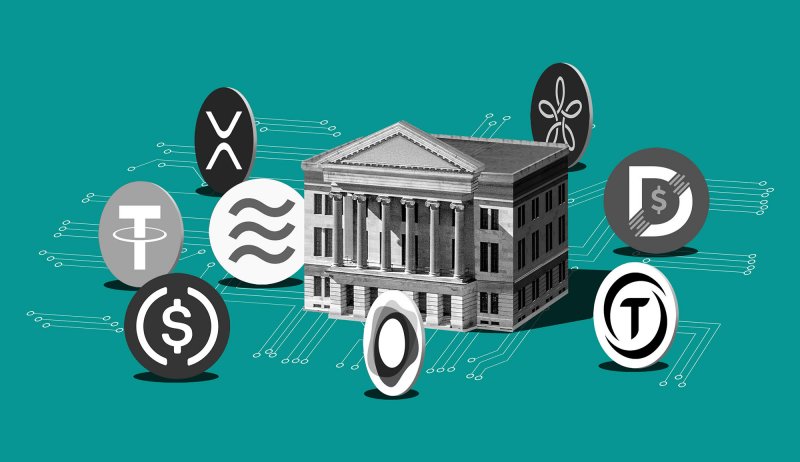
Stablecoins are on the cusp of mainstream dominance in 2026, fueled by regulatory breakthroughs, explosive market growth, and enterprise adoption, but they won’t fully “crush” fiat currencies anytime soon. Instead, they complement traditional money with superior speed and efficiency in payments and liquidity management.[1][2]
The Surge in Stablecoin Adoption
Stablecoin supply has skyrocketed, reaching $250-300 billion in late 2025, up from $120 billion 18 months prior, with forecasts hitting $400 billion by year-end 2025 and $2 trillion by 2028. Daily on-chain transactions now process $20-30 billion, primarily in remittances and settlements, though this remains under 1% of global volumes.[1][4] Monthly transactions averaged $1.1 trillion over the six months ending November 2025, marking a breakout year.[4]
Enterprise interest is booming: 100% of surveyed firms are familiar with stablecoins, 60% expect rising interest in the next 12 months, and 58% of corporates plan adoption within two years, driven by cost savings and speed.[2] Venture capital in stablecoin infrastructure exceeded $1.5 billion in 2025, compared to under $50 million in 2019, backing firms like Tempo, MeshConnect, and Paxos, which powers tokens for PayPal and Fiserv.[3]
Regulatory Clarity: The GENIUS Act and Global Frameworks
The U.S. GENIUS Act, signed July 18, 2025, provides a foundational framework for USD stablecoins, mandating reserve requirements, issuer approvals, tax guidance, and custodial standards. This has heightened optimism, aligning issuers with regulators and spurring compliance efforts, including Tether’s plans for a new compliant stablecoin and USDT updates.[2][3]
Globally, the EU’s MiCA, Hong Kong’s licensing, Singapore’s MAS guidance, and frameworks in the UK, UAE, and others lower barriers for banks and managers. These rules emphasize reserve backing, custody, governance, and disclosure, making stablecoins “enterprise-ready.”[1][5] S&P Global Ratings notes this will accelerate adoption alongside tokenization in 2026.[7]
Real-World Use Cases Driving 2026 Momentum
Stablecoins are evolving into “the internet’s dollar,” enabling seconds-fast settlements at lower costs than ACH or cards. Key 2026 trends include:
- Tokenized liquidity for cross-border payments: Bypassing correspondent banking’s delays, stablecoins offer 24/7 movement, ideal for B2B, remittances, and emerging markets like Latin America, Africa, and Southeast Asia.[3][5]
- Enterprise treasury and payouts: Platforms in gig economies, gaming, and creator networks adopt stablecoins for instant, predictable payouts, reducing FX exposure.[5]
- Stablecoin-as-a-Service: Infrastructure helps corporates launch regulated tokens for payments and settlement.[3]
- Institutional integration: Expect stablecoins in cross-border services, derivatives collateral, corporate balance sheets, and even consumer payments as credit card alternatives. Prediction markets will boost demand.[4]
Visa predicts significant growth in emerging markets with volatile currencies (e.g., Argentina) for store-of-value and cross-border flows, potentially scaling to $4 trillion by 2030—though some view this as aggressive.[6]
Will Stablecoins Crush Fiat?
The hype of stablecoins obliterating fiat overlooks realities. While they excel in programmable, borderless efficiency, fiat remains dominant for everyday stability, government backing, and broad acceptance. Stablecoins handle under 1% of global transfers today, focusing on niches like remittances where fiat falls short.[1]
Hybrid models are emerging: banks issue fiat-backed tokens, CBDC pilots in Asia, Europe, and Latin America converge with private innovation. Public-private alignment via connected infrastructure—custody, reserves, and reporting—ensures scalability without replacing fiat entirely.[1] Silicon Valley Bank foresees stablecoins as payment backbones alongside institutional crypto growth, not fiat’s demise.[3]
Challenges persist: full global interoperability, risk management, and financial stability concerns amid rapid growth. Yet, with clearer rules, stablecoins integrate into TradFi, enhancing rather than erasing it.[7]
Looking Ahead to 2026 and Beyond
2026 heralds stablecoins’ institutional era: permissioned DeFi yields, in-platform swaps, and expanded issuer partnerships. Grayscale anticipates practical integrations driving blockchains like ETH and SOL.[1][4] Thunes emphasizes stablecoin-to-local-rail connectivity for frictionless global payouts.[5]
In summary, 2026 is a tipping point for mainstream stablecoin use, propelled by regulation and utility, but fiat endures as a resilient partner in the evolving monetary landscape.
References
- https://zodia-custody.com/2026-predictions-stablecoins-from-payment-rails-to-institutional-liquidity-engines/
- https://www.ey.com/en_us/insights/financial-services/cost-savings-and-speed-drive-stablecoin-adoption
- https://www.svb.com/industry-insights/fintech/2026-crypto-outlook/
- https://research.grayscale.com/reports/2026-digital-asset-outlook-dawn-of-the-institutional-era
- https://www.thunes.com/insights/trends/stablecoin-trends-shaping-global-payments/
- https://corporate.visa.com/en/sites/visa-perspectives/trends-insights/2026-predictions.html
- https://www.spglobal.com/ratings/en/regulatory/article/stablecoins-financial-stability-and-treasuries-whats-next-for-money-and-safe-assets-s101659822