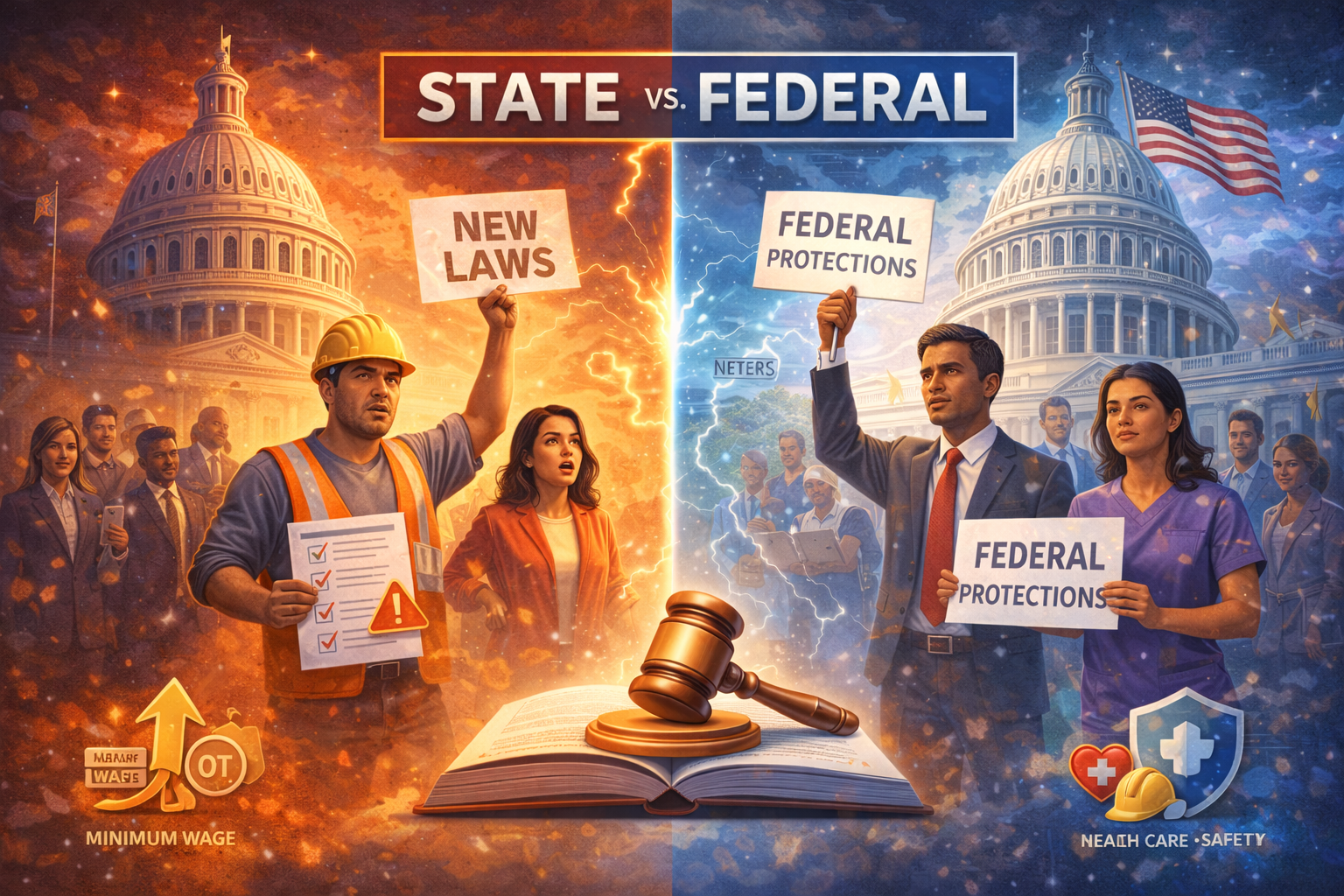
The battlefield has shifted. While Washington remains gridlocked on labor reform, states are rewriting the rules of work—creating a patchwork of regulations that has employers scrambling and workers caught in the crossfire. From California’s audacious power grab to Florida’s $15 wage march, 2026 is shaping up as the year state laboratories of democracy became laboratories of labor warfare.
The stakes couldn’t be higher. With the federal minimum wage stuck at $7.25 since 2009 and the National Labor Relations Board (NLRB) paralyzed by political infighting, states have stepped into the vacuum. The result? A legal civil war over who controls the American workplace.
The California Rebellion: When States Defy Washington
AB 288: The Law That Broke the Dam
On January 1, 2026, California attempted something unprecedented: seizing federal labor enforcement powers for itself. Assembly Bill 288 expanded the California Public Employment Relations Board (PERB)—traditionally limited to public sector disputes—to handle private-sector labor violations when the NLRB fails to act within six months.
This wasn’t subtle. The law specifically targets moments when the NLRB “lacks quorum, loses independence, or experiences processing delays”—precisely the conditions plaguing the federal board throughout 2025. California essentially created a parallel NLRB.
The federal response was swift and brutal. On October 15, 2025, the NLRB sued California, arguing the law violates the Garmon preemption doctrine—a Supreme Court precedent reserving labor conduct regulation exclusively for federal jurisdiction. On December 26, 2025, a federal judge granted a preliminary injunction, blocking most provisions.
But the message was sent: States are no longer waiting for Washington.
The Gig Economy Gambit: AB 5 and Prop 22’s Hybrid Future
California’s worker classification war continues evolving. Six years after AB 5 codified the strict “ABC test” for independent contractors, 2026 brings a new legislative package—AB 1340 and SB 371—that cracks the binary of “employee vs. contractor.”
Here’s the breakthrough: AB 1340 grants Uber and Lyft drivers collective bargaining rights while preserving their independent contractor status. This “hybrid” model, supported by both labor unions and gig companies, represents a potential template for national compromise.
The financial exposure for misclassification remains severe. California employers face:
- Back wages for unpaid minimum wage and overtime
- “Waiting-time” penalties up to 30 days’ pay
- Wage-statement penalties up to $4,000 per employee
- Mandatory business expense reimbursement
- Payroll tax assessments with interest
The Wage Wars: 19 States vs. Federal Stagnation
While Congress hasn’t touched the federal minimum wage since the George W. Bush administration, states are racing ahead with aggressive increases.
2026 Minimum Wage Battle Map
| State/Locality | 2026 Rate | Federal Gap | Effective Date |
|---|---|---|---|
| Washington D.C. | $18.00 | +$10.75 | Jan 1 |
| California | $16.90 | +$9.65 | Jan 1 |
| Florida | $15.00 | +$7.75 | Sept 30 |
| Washington State | $16.66 | +$9.41 | Jan 1 |
| Alaska | $14.00 | +$6.75 | July 1 |
| Federal (Stagnant) | $7.25 | Baseline | Since 2009 |
Source: U.S. Department of Labor, state labor departments
The disparity is staggering. A worker in Washington D.C. earns 148% more than their counterpart in a federal-minimum state. This isn’t just policy divergence—it’s economic balkanization.
The Preemption Strikes Back
Not all states are joining the race to the top. At least 25 states have preemption laws blocking cities from setting higher local wages. Texas, Georgia, and Alabama maintain the federal floor of $7.25, with Alabama having no state minimum wage law at all.
This creates a perverse pattern: progressive states allow local experimentation while conservative states enforce uniformity at the bottom. The result? A worker in Birmingham, Alabama earns $7.25, while a worker in Emeryville, California earns $18.67—a 157% gap within the same country.
The NLRB Crisis: When Federal Enforcement Collapses
The Quorum Catastrophe
The NLRB’s dysfunction in 2025 created the vacuum that states are now filling. When President Trump fired Chair Gwynne Wilcox in January 2025 and delayed nominee confirmations, the board lost its quorum for months. Without three members, the NLRB couldn’t issue decisions or enforce labor rights.
California’s AB 288 explicitly targeted this scenario, allowing state intervention when the NLRB “lacks quorum, loses independence, or experiences processing delays.” New York passed similar legislation (S.8034), prompting parallel federal lawsuits.
The constitutional crisis peaked when the Supreme Court’s Starbucks v. McKinney ruling raised questions about NLRB member removal protections, further destabilizing the agency’s independence.
State-Level Workarounds
While courts block California’s power grab, other states are finding creative ways to bypass federal inaction:
- Unemployment for strikers: Oregon and Washington now provide unemployment benefits to qualified striking workers—filling a gap left by federal law
- Captive audience bans: Rhode Island became the 13th state banning mandatory anti-union meetings, directly challenging employer speech rights
- Card check authorization: Several states are considering legislation to recognize unions based on card check rather than NLRB elections
The Gig Worker Classification Wars
The Hybrid Classification Experiment
The binary employee/contractor distinction is collapsing under 2026’s legislative innovations. The federal Worker Flexibility and Choice Act (HB 8442), introduced in 2025, would create a third category: “worker flexibility agreements” that provide some protections while preserving scheduling autonomy.
This federal proposal would preempt state laws—including California’s ABC test—but faces stiff opposition from unions arguing it would “short-change gig workers from receiving minimum wage and overtime pay.”
Meanwhile, the EU’s Platform Work Directive (effective December 2026) creates a rebuttable presumption of employment for platform workers, adding international pressure for classification crackdowns.
Industry-Specific Exemptions: The Trucking Loophole
California’s AB 5 hit the trucking industry particularly hard. The “B prong” of the ABC test—requiring work “outside the usual course of the hiring entity’s business”—is nearly impossible for trucking companies to satisfy when hiring owner-operators.
After legal challenges and supply chain disruptions, California has granted temporary exemptions, but the underlying tension remains: Can a state effectively regulate interstate commerce through classification rules? The courts are still deciding.
The New Labor Rights Landscape: 2026’s Major Shifts
From Day One: The End of Waiting Periods
A wave of “Day 1” rights is eliminating probationary exclusions:
| Right | Traditional Rule | 2026 Change | States Affected |
|---|---|---|---|
| Paternity Leave | 6-12 months service required | Available immediately | Multiple (UK leads, US states following) |
| Parental Leave | 1 year employment | Unpaid leave from day one | California, expanding |
| Sick Pay | 3-7 day waiting period | Immediate (no waiting days) | UK April 2026, US states considering |
| Unfair Dismissal Protection | 6 months-2 years | 6 months (UK Jan 2027) | UK leading, US debates |
Flexible Working as Default
The UK Employment Rights Act 2025 (implemented April 2026) makes flexible working the default, requiring employers to prove “reasonable” grounds for refusal. This contrasts sharply with U.S. federal law, which has no flexible working mandate.
American states are watching closely. California’s “right to disconnect” proposals and New York’s scheduling laws suggest similar movements stateside.
The Fire and Rehire Crackdown
One of 2026’s most significant developments is the restriction of “fire and rehire” tactics—dismissing employees to re-engage them on worse terms.
The UK’s Employment Rights Act makes such dismissals automatically unfair unless employers prove financial necessity and inability to avoid variation. This takes effect January 2027, with consultations ongoing through 2026.
In the U.S., the NLRB’s 2024 ruling restricting such practices faces reversal under the new administration, creating a patchwork where some states (like California via AB 288 provisions) restrict the practice while federal protection evaporates.
What This Means for Employers and Workers
For Multi-State Employers: The Compliance Nightmare
The divergence creates impossible complexity. A national employer must now navigate:
- 50 different minimum wage schemes (federal floor + state variations + local premiums)
- Conflicting classification tests (ABC test vs. common law vs. hybrid models)
- Dual enforcement risk (NLRB + state board jurisdiction battles)
- Benefit fragmentation (state-mandated sick leave, family leave, scheduling rules)
The cost of compliance is becoming a competitive weapon—favoring large corporations with legal departments over small businesses.
For Workers: Rights Roulette
Your labor rights now depend heavily on your zip code:
Scenario A: You’re a rideshare driver in California. You can unionize (AB 1340), earn minimum wage guarantees (Prop 22), and access state disability insurance.
Scenario B: You’re the same driver in Texas. You’re an independent contractor with no union rights, no minimum wage guarantee, and no state disability coverage.
Same job, different country.
The Road Ahead: 2026-2027 Predictions
Based on current trajectories, expect these developments:
- Q2 2026: Supreme Court ruling on NLRB member removal protections, potentially restructuring the board
- Q3 2026: California AB 288 federal court decision—will either embolden or chill state power grabs
- Q4 2026: EU Platform Work Directive implementation pressure on U.S. multinationals
- 2027: Potential federal “hybrid worker” legislation if bipartisan support materializes
- Ongoing: More states adopting California-style ABC tests or creating their own hybrid categories
Conclusion: The New Labor Federalism
The era of uniform national labor law is ending. In its place emerges a labor federalism where states are the primary innovators—some expanding rights dramatically, others contracting them, and Washington struggling to maintain baseline coherence.
For employers, this means compliance complexity will increase. For workers, it means your rights depend increasingly on state politics. And for the economy, it means labor costs and worker protections will vary wildly based on geography—potentially accelerating the “great sorting” of businesses and workers into like-minded states.
The battlegrounds are drawn. The only question is whether 2026 marks the beginning of a new equilibrium—or just the opening skirmishes in a longer war for control of the American workplace.
References
- U.S. Department of Labor. (2026). State Minimum Wage Laws. https://www.dol.gov/agencies/whd/minimum-wage/state
Official federal data on state minimum wage variations and preemption status.
- CalChamber. (2026, January 9). US Court Largely Suspends California’s New Labor Law. https://calchamberalert.com/2026/01/09/us-court-largely-suspends-californias-new-labor-law/
Analysis of federal court injunction against California AB 288 and NLRB preemption challenges.
- CDF Labor Law LLP. (2025, December 3). Key New 2026 Employment Laws for California Employers. https://www.cdflaborlaw.com/blog/key-new-2026-employment-laws-for-california-employers
Detailed breakdown of AB 288, PERB expansion, and private sector jurisdiction conflicts.
- Ogletree Deakins. (2025, December 12). 2026 State and Major Locality Minimum Wage Updates. https://ogletree.com/insights-resources/blog-posts/2026-state-and-major-locality-minimum-wage-updates/
Comprehensive 2026 minimum wage data for 19 states and major localities.
- Morgan Lewis. (2025, December 22). The Board Is Back: Impact of NLRB’s Restored Quorum and New General Counsel on Employers. https://www.morganlewis.com/pubs/2025/12/the-board-is-back-impact-of-nlrbs-restored-quorum-and-new-general-counsel-on-employers
Analysis of NLRB quorum restoration, state preemption litigation, and AB 288 constitutional challenges.
Disclaimer: This article provides general information on labor law developments and does not constitute legal advice. Labor laws vary by jurisdiction and change frequently. Consult qualified employment counsel for specific compliance guidance.
Tags: Labor Law, State vs Federal, Minimum Wage 2026, NLRB, California AB 288, Gig Economy, Worker Classification, Employment Rights
About the Author
InsightPulseHub Editorial Team creates research-driven content across finance, technology, digital policy, and emerging trends. Our articles focus on practical insights and simplified explanations to help readers make informed decisions.