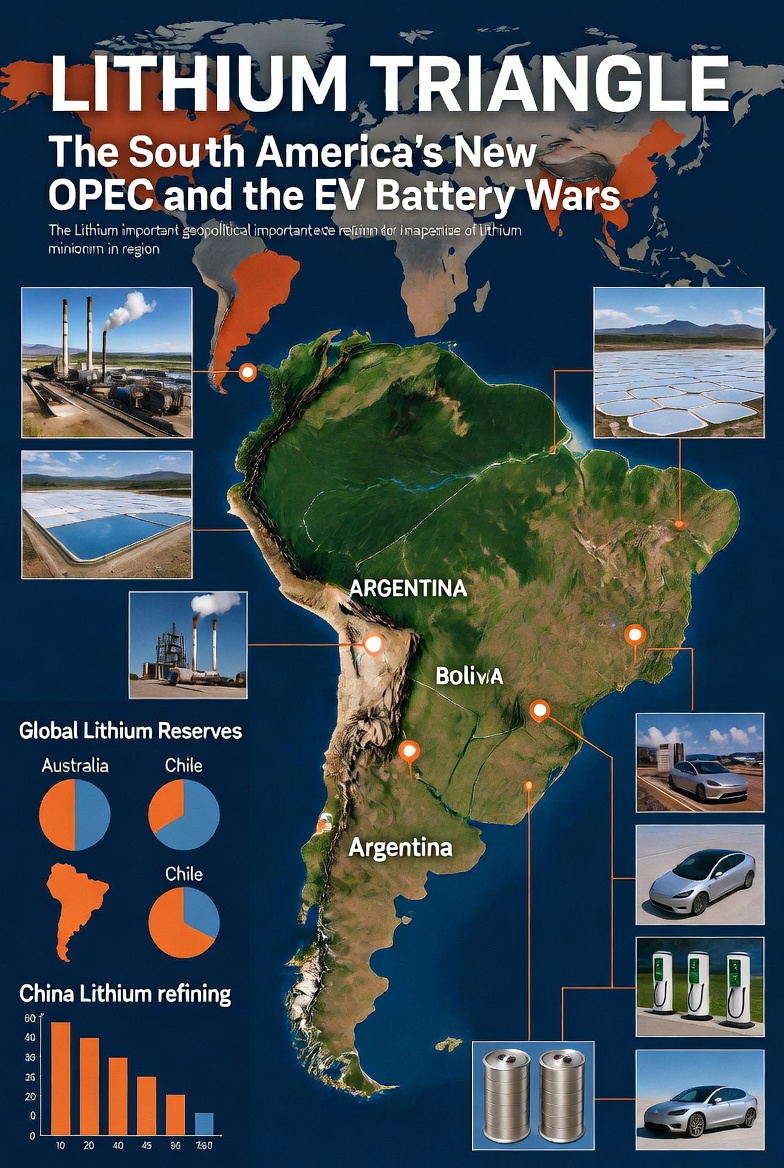
The desert salt flats of the Andes are becoming the world’s most contested real estate. Beneath the blinding white crust of Chile’s Atacama, Argentina’s Hombre Muerto, and Bolivia’s Uyuni lies the fuel of the 21st century: lithium. The three nations—collectively holding 58% of global lithium reserves—are positioning themselves as the Saudi Arabia of the electric age. And like the oil sheikdoms before them, they’re learning that controlling the world’s energy transition means wielding geopolitical power.
2026 is the inflection point. Lithium prices have surged 160% from 2025 lows, crossing $22,000 per ton. The U.S. has opened its first domestic lithium refinery in Texas even as it pours $400 million into Arkansas extraction and negotiates desperately with Bolivia’s new government. China, already processing 75% of global lithium, is locking in South American supply through state-backed giants like CATL and Uranium One. And the Lithium Triangle itself is awakening to its market power—tightening environmental rules, demanding local processing, and flirting with cartel-like coordination.
The EV battery wars aren’t being fought in Detroit or Stuttgart. They’re being fought in the brine pools of the Atacama.
The Geological Jackpot: Understanding the Triangle
The Lithium Triangle’s dominance stems from a unique geological gift. High-altitude salt flats—salars sitting 3,000-4,000 meters above sea level—contain lithium-rich brine that can be pumped to the surface and evaporated in intense Andean sunlight. This “brine extraction” uses less energy than Australia’s hard-rock mining, though it demands massive water resources in the world’s driest desert.
Reserve Dominance by the Numbers
| Country | Reserves (Million Tons) | Global Share | 2026 Production (Est.) | Key Advantage |
|---|---|---|---|---|
| Chile | 9.3 | 36% | ~80,000 tonnes | Mature infrastructure, free-market policies |
| Argentina | 2.7 | 10% | ~42,000 tonnes | Open to foreign investment, DLE technology |
| Bolivia | 23.0 | 23% | ~2,000 tonnes | Largest untapped reserves, state control |
| TOTAL TRIANGLE | 35.0 | 58% | ~124,000 tonnes | Collective market power |
Sources: USGS Mineral Commodity Summaries, company production estimates
The disparity is striking. Bolivia holds the largest reserves but produces the least—trapped by state control, infrastructure gaps, and political instability. Chile dominates production through private giants Albemarle and SQM. Argentina sits in the middle, aggressively courting foreign investment while battling inflation and currency crises.
The Price Shock of 2026: From Glut to Scarcity
The lithium market has whipsawed from crisis to boom in 18 months. After crashing below $8,000/tonne in 2024 amid oversupply fears, prices have exploded:
- January 2026: Lithium carbonate hits $22,300/tonne (CIF China)
- January 2026: Spodumene concentrate exceeds $2,000/tonne (first time since October 2023)
- 2025 lows: Prices up 160% from April 2024 bottom
- Forecast range: $15,000-$28,580/tonne for 2026; bulls see $30,000+
What’s Driving the Surge?
Three forces are converging:
1. Demand Acceleration
Global lithium demand is projected to grow 15-18% in 2026, with EVs accounting for 65% of consumption. But the real story is commercial vehicles:
- China’s electric heavy truck sales hit 183,370 units (Jan-Nov 2025), up 190.6% YoY
- Penetration rate expected to surpass 30% by 2026
- Commercial EVs use 5-10x more lithium per vehicle than passenger cars
Energy storage is the second wave. China’s battery energy storage system (BESS) market is growing 40-60% annually, with global BESS capacity additions forecast at 301 GWh in 2026 (+7.7% YoY).
2. Supply Tightening
Analysts now predict deficits where they saw surpluses:
- Morgan Stanley: 80,000-tonne LCE deficit in 2026
- UBS: 22,000-tonne deficit (vs. 61,000-tonne surplus in 2025)
- Chinese inventories at weakest levels since mid-2024
3. Geopolitical Risk Premium
China’s dominance in processing (75% of global capacity) has created a “debasement trade”—lithium as a strategic asset, not just a commodity. The U.S. and EU are stockpiling, with Washington approving a $10 billion Project Vault to build strategic reserves.
Chile: The Saudi Arabia Model
Chile has embraced the OPEC playbook most explicitly. Under President Gabriel Boric’s “National Lithium Strategy,” the state is asserting control over the world’s most productive lithium fields while partnering with private giants.
The Codelco-SQM Deal
In December 2023, Chile’s state copper giant Codelco struck a deal to take controlling interest in SQM’s lithium operations by 2030. The arrangement:
- State gains majority control of Salar de Atacama production
- Private operators continue technical management
- Revenue flows to Chilean treasury, not just shareholders
- Environmental standards tightened (water usage limits, protected zones)
The model allows Chile to capture more value from its geological endowment without scaring off technical expertise. It’s nationalization-lite: state control, private execution.
Production Constraints as Strategy
Chile’s environmental regulator has rejected expansion permits for Albemarle and SQM, citing water table depletion. While framed as environmental protection, the effect is supply constraint—exactly what a cartel member wants.
Chilean lithium production is capped near 80,000 tonnes annually until new desalination plants come online. In a market facing deficits, these constraints amplify Chile’s pricing power.
Argentina: The Wild West of Lithium
While Chile tightens state control, Argentina is throwing open the doors. The provinces of Jujuy, Salta, and Catamarca are competing to attract foreign investment with tax breaks, streamlined permitting, and promises of infrastructure.
The Investment Boom
Argentina’s lithium sector is seeing unprecedented capital inflows:
- Livent Corporation: Expanding Hombre Muerto operations, targeting sustainability leadership
- Lithium Americas: Cauchari-Olaroz project ramping toward 40,000 tonnes annual capacity
- Posco: Korean giant building processing plants
- Direct Lithium Extraction (DLE): Multiple pilots promising faster production, lower water use
The Argentine model offers what Chile increasingly doesn’t: speed and scale. While Chile debates environmental impact studies, Argentina moves projects forward. The trade-off is political risk—currency controls, inflation at 100%+, and the ever-present threat of Peronist intervention.
The Water Dilemma
Argentina’s lithium boom is colliding with agricultural reality. The same salt flats that contain lithium also feed water tables supporting Andean agriculture. Indigenous communities in Jujuy have protested water diversion, forcing projects to invest in recycling and monitoring.
The sector’s response—DLE technology—promises to extract lithium without massive evaporation ponds, reducing water use by 90%. If scaled, DLE could defuse the environmental conflict while accelerating production.
Bolivia: The Sleeping Giant Awakens
Bolivia should dominate the Lithium Triangle. It holds the world’s largest single reserves—23 million tonnes in the Salar de Uyuni, nearly three times Chile’s endowment. Yet in 2026, it produces just 2,000 tonnes annually, less than 2% of the Triangle’s output.
The reasons are political. Former President Evo Morales (2006-2019) pursued resource nationalism, expelling foreign companies and insisting on state control through Yacimientos de Litios Bolivianos (YLB). The result: decades of missed opportunity while Chile and Argentina built world-class industries.
The Paz Pivot
President Rodrigo Paz, who took office November 2025, is attempting a radical course correction. His government has:
- Denied plans to privatize YLB while signaling openness to public-private partnerships
- Sent Foreign Minister Fernando Aramayo to Washington to discuss US financing and currency swaps
- Reviewed “opaque” lithium contracts with Chinese (CATL) and Russian (Uranium One) partners
- Prioritized reforming fuel subsidies to stabilize finances
The U.S. response has been cautious but positive. The State Department’s February 2026 Critical Minerals Ministerial highlighted Bolivia’s potential, though officials note that “major contracts are tied to Chinese and Russian partners,” complicating American involvement.
The Infrastructure Mountain
Even with political will, Bolivia faces brutal geography. The Salar de Uyuni sits at 3,656 meters elevation, 400+ kilometers from the nearest port (in Chile), with no rail connection and poor roads. The lithium brine has high magnesium content, requiring expensive processing. And the state lacks the technical capacity to develop fields alone.
In a best-case scenario, Bolivia might reach 40,000 tonnes by 2030—still a fraction of its potential. For now, it remains the Triangle’s sleeping giant, dreaming of relevance while others profit.
The Great Powers’ Scramble
China’s Vertical Integration
China isn’t just buying lithium—it’s buying the entire supply chain. Through state-backed companies, Beijing has locked in:
- Chile: Tianqi Lithium owns 24% of SQM; Chinese offtake agreements dominate
- Argentina: Multiple DLE partnerships, processing plant investments
- Bolivia: CATL and Uranium One contracts (under review by Paz government)
By 2035, China is projected to supply 60% of refined lithium, 80% of battery-grade graphite, and 70% of battery-grade manganese—even if it doesn’t own the mines, it controls the processing that turns raw material into battery-grade chemicals.
America’s Desperate Catch-Up
The Trump administration has made lithium independence a national security priority. Projections for 2026 include:
- $10 billion Project Vault: Strategic critical minerals reserve
- $400 million: Lithium extraction in Arkansas
- $350 million: Cobalt/nickel production in Australia
- First US lithium refinery: Opened in Texas January 2026
But the U.S. remains dependent. Even with domestic projects, American manufacturers will rely on Lithium Triangle supply through 2030. The scramble for Bolivian partnerships reflects Washington’s anxiety about Chinese dominance.
Europe’s Dilemma
The EU has selected 60 Strategic Projects under its Critical Raw Materials Act—47 in Europe, 13 externally (including Canada, Kazakhstan, Ukraine, Zambia). But financing lags ambition. The €3 billion REsourceEU target by 2029 is insufficient, and European companies struggle to compete with Chinese state-backed bids.
At the 2026 Future Minerals Forum, the EU co-convened its first EU-Saudi Arabia Business Dialogue on critical minerals—signaling that Europe is looking beyond the Atlantic for supply security.
The OPEC Question: Will They Cartelize?
The inevitable comparison: if Saudi Arabia, Venezuela, and Iran could coordinate oil prices, why not Chile, Argentina, and Bolivia with lithium?
The obstacles are formidable:
- Political divergence: Chile’s social democracy, Argentina’s Peronist chaos, Bolivia’s indigenous nationalism
- Different models: State control (Bolivia) vs. private partnership (Chile) vs. open investment (Argentina)
- Market structure: OPEC controlled 40% of production; the Triangle controls 58% of reserves but less of processing
- Substitution risk: High lithium prices accelerate sodium-ion batteries, recycling, and alternative chemistries
Yet coordination is emerging. The three nations have held trilateral lithium summits, discussing shared environmental standards, technology transfer, and—crucially—price stabilization mechanisms. They share an interest in avoiding the boom-bust cycles that destroy investment.
The more likely outcome: soft coordination through environmental regulations, export licensing, and local content requirements that constrain supply and support prices—OPEC by another name.
The Environmental Paradox
The Lithium Triangle’s boom is creating an uncomfortable reality: saving the planet from carbon emissions requires despoiling one of its most fragile ecosystems.
Brine extraction consumes 500,000 gallons of water per ton of lithium—in the Atacama, the driest desert on Earth. Indigenous communities report drying wells and dying flamingo populations. The “lithium triangle” overlaps with the “water scarcity triangle.”
The industry’s response—DLE technology, solar-powered evaporation, water recycling—promises mitigation but not elimination. And as prices rise, the incentive to cut environmental corners grows.
The EU’s Carbon Border Adjustment Mechanism (CBAM) and American “clean energy” subsidies are starting to reward low-carbon lithium. Chilean and Argentine producers are racing to certify their carbon intensity, knowing that green premiums will determine market access.
Conclusion: The New Energy Order
The Lithium Triangle is becoming what the Persian Gulf was to the 20th century: the chokepoint of global energy transition. Control these salt flats, and you control the pace of electrification.
2026 marks the transition from raw material extraction to strategic resource management. Chile is nationalizing (selectively). Argentina is industrializing (rapidly). Bolivia is awakening (tentatively). And the great powers—China, the U.S., Europe—are scrambling for position.
The EV battery wars will be won or lost in the Atacama, Hombre Muerto, and Uyuni. The Lithium Triangle isn’t just South America’s OPEC—it’s the world’s energy future, crystallized in desert salt.
For investors, the message is clear: lithium is no longer a commodity trade. It’s a geopolitical bet on which great power secures supply, which technology wins, and whether the Triangle’s three nations can transform geological luck into lasting prosperity—or squander it as Bolivia did for two decades.
The desert holds the power. The question is who wields it.
References
- Farmonaut. (2025, October 29). Top Lithium Triangle & North American Mining Companies 2026. https://farmonaut.com/mining/top-lithium-triangle-north-american-mining-companies-2026
Production data for Livent (42,000 tonnes), Albemarle (80,000 tonnes), and Bolivian state firms (26,000 tonnes); market share analysis and 2026 growth outlook.
- S&P Global Commodity Insights. (2026, January 9). COMMODITIES 2026: Lithium carbonate surplus to narrow. https://www.spglobal.com/energy/en/news-research/latest-news/metals/010926-commodities-2026-lithium-carbonate-surplus-to-narrow-energy-storage-to-drive-growth
Analysis of 2026 lithium market: China BESS growth 40-60%, EV heavy truck sales up 190.6%, Morgan Stanley forecasts 80,000-tonne deficit.
- The Oregon Group. (2026, February 9). Can lithium hit $30,000 in 2026? https://theoregongroup.com/commodities/lithium/can-lithium-hit-30000-in-2026/
Lithium price surge analysis: 160% increase from 2025 lows, $22,000/tonne January 2026, price forecast $11,432-$28,580 with potential for $30,000+.
- Mining.com. (2026, January 30). Bolivia’s lithium gamble tests US realignment in Latin America. https://www.mining.com/mining-com-series-mining-power-and-a-new-us-strategy-in-latin-america/
Bolivian President Paz’s pivot to US financing, review of Chinese/Russian contracts, and best-case scenario of 40,000 tonnes by 2030.
- ODI (Overseas Development Institute). (2026, January 27). Critical minerals geopolitics in 2026: risks, supply chains and global power shifts. https://odi.org/en/insights/critical-minerals-geopolitics-in-2026-risks-supply-chains-and-global-power-shifts/
China’s 75% processing dominance, US Project Vault $10 billion strategic reserve, EU 60 Strategic Projects, and 15th Five-Year Plan implications.
Disclaimer: This article analyzes commodity markets and geopolitical trends. Lithium prices are volatile; investments carry risk. Consult qualified advisors before making financial decisions.
Tags: Lithium Triangle, Chile Lithium, Argentina Lithium, Bolivia Lithium, EV Batteries, Critical Minerals, Energy Transition, Commodity Markets, Geopolitics, OPEC
About the Author
InsightPulseHub Editorial Team creates research-driven content across finance, technology, digital policy, and emerging trends. Our articles focus on practical insights and simplified explanations to help readers make informed decisions.