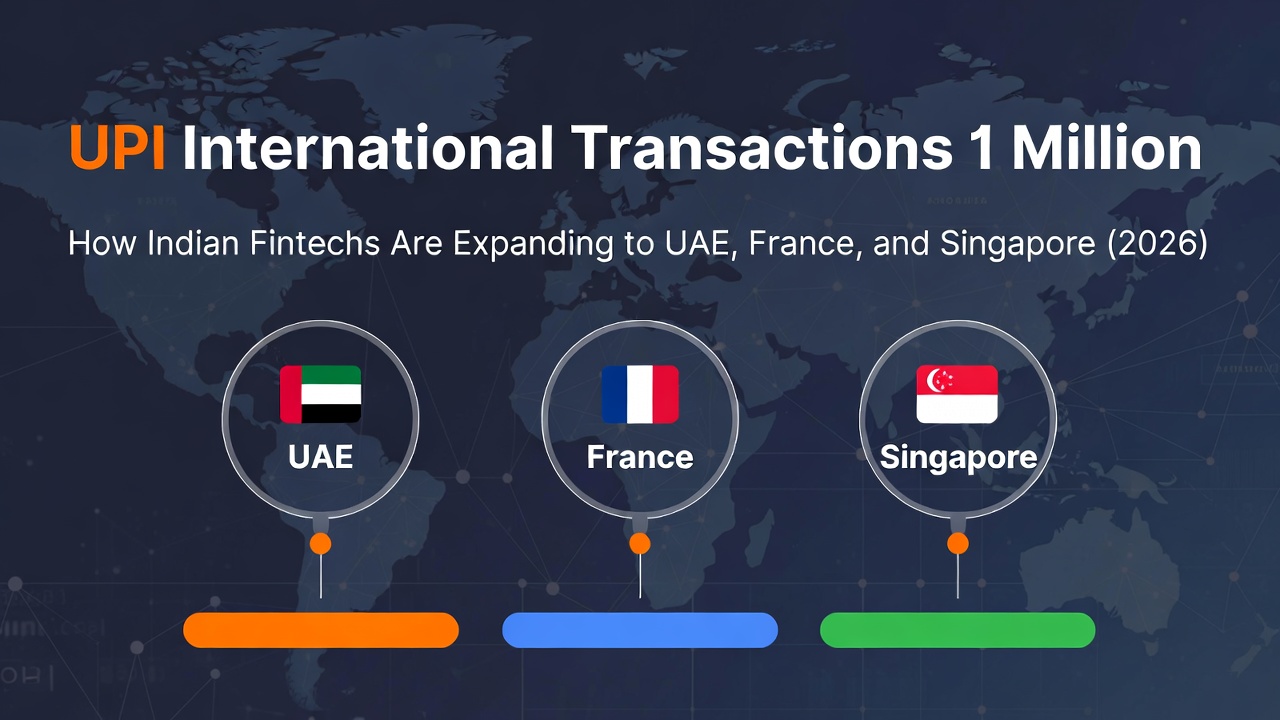
Global Milestone Achieved: India’s Unified Payments Interface (UPI) has shattered international transaction records, crossing the one-million mark for the first time in FY26 with 1.48 million transactions—nearly double the 755,445 recorded in FY25. Transaction value surged to ₹330.43 crore, up from ₹258.53 crore the previous year. This isn’t just a statistic; it’s the culmination of Indian fintechs’ aggressive global expansion. Paytm, PhonePe, and Google Pay are now operational across 8 countries including UAE, France, and Singapore, with over 2 million international merchants onboarded. The IMF has officially recognized UPI as the world’s largest real-time retail payment system. Here’s how Indian fintechs are turning a domestic payment rails into a global financial infrastructure.
The 1 Million Transaction Milestone: A 3,900% Growth Story
The numbers are staggering in their trajectory. In FY24, international UPI transactions stood at a modest 37,060, valued at just ₹19.7 crore. By FY25, this had grown twenty-fold to 755,445 transactions worth ₹258.53 crore. Now, as of December 2025, FY26 has already recorded 1.48 million transactions valued at ₹330.43 crore—with four months remaining in the fiscal year.
This represents a 3,900% growth over two years—a trajectory unmatched by any other payment system globally. For context, India’s domestic UPI processed over 20 billion transactions monthly in 2025, accounting for 84% of the country’s digital retail payments. The international expansion, while currently a fraction of domestic volume, is growing at an exponential rate that suggests UPI is on track to become a genuinely global payment standard.
The significance extends beyond volume. These 1.48 million transactions represent Indian fintechs successfully navigating complex regulatory environments, establishing technical integrations with foreign payment systems, and convincing international merchants to adopt an Indian payment standard. Each transaction is a proof point that UPI’s architecture—built on instant bank-to-bank transfers, QR-code simplicity, and zero transaction fees—has global applicability.
The Three-Pillar Strategy: UAE, France, and Singapore
While UPI is now operational in 8 countries—Bhutan, Nepal, Mauritius, Sri Lanka, Singapore, UAE, France, and Qatar—three markets represent distinct strategic approaches that Indian fintechs are replicating globally.
Pillar 1: UAE—The Merchant Network Approach
The United Arab Emirates represents UPI’s most successful merchant-acquisition story outside India. Launched in July 2024 through a partnership between NPCI International Payments Limited (NIPL) and Network International, UPI is now accepted at over 60,000 merchants across 200,000+ POS terminals.
Strategic Partnership: Network International, a leading digital payments company serving 120,000+ merchants across 50+ countries in the Middle East and Africa, provided the infrastructure backbone. This partnership enabled rapid merchant onboarding without requiring UAE-based acquirers to build UPI capabilities from scratch.
Merchant Coverage: The network spans retail giants including Dubai Mall and Mall of the Emirates, hospitality venues, transport services, supermarkets, and tourist destinations. For the 5.29 million Indian tourists visiting UAE annually, this eliminates forex conversion friction and card transaction fees.
Fintech Execution: Paytm, PhonePe, and Google Pay enabled international UPI functionality through simple app updates. Indian travelers activate “UPI International” within their apps, select activation periods (1-90 days), and scan QR codes at UAE merchants. The apps display real-time foreign exchange rates and conversion fees before payment confirmation, ensuring transparency.
The UAE model demonstrates that UPI expansion succeeds when it targets high-volume tourist corridors with established Indian diaspora presence. The 60% transaction split recommended for UAE travelers—60% UPI for daily expenses, 30% forex cards for large purchases, 10% cash—indicates UPI has achieved primary payment method status for Indian visitors.
Pillar 2: France—The Prestige Brand Strategy
France represents UPI’s breakthrough into developed Western markets, achieved through strategic high-profile partnerships rather than mass merchant acquisition. Launched in February 2024 at the Eiffel Tower—making France the first European country to accept UPI—the expansion strategically targeted iconic venues ahead of the Paris Olympics.
The Eiffel Tower Launch: The initial rollout enabled online ticket booking for the Eiffel Tower through UPI, announced by Ambassador Jawed Ashraf at a Republic Day event in Paris. This wasn’t merely a technical integration; it was a statement that UPI had arrived in Europe’s premier tourist destination.
Galeries Lafayette Expansion: By July 2024, UPI expanded to Galeries Lafayette’s flagship Haussmann store, Europe’s largest department store. The partnership with Lyra Group, a French leader in securing e-commerce and proximity payments, enabled in-store QR code payments. This launch, attended by Galeries Lafayette CEO Nicolas Houzé and Ambassador Ashraf, positioned UPI alongside global luxury retail.
Olympics Catalyst: The July 2024 timing was deliberate. With a 60% surge in Indian visa applications for the Paris Olympics, UPI provided a familiar payment method for an estimated 100,000+ Indian visitors. The strategy worked: Indian tourists could shop at luxury retailers, dine at restaurants, and book experiences using their domestic payment apps.
Reciprocal Expansion: The partnership includes Galeries Lafayette opening physical stores in Mumbai (2025) and Delhi (2026), creating a two-way commercial corridor where payment integration facilitates retail expansion. This demonstrates how UPI internationalization drives broader economic ties beyond pure financial services.
Pillar 3: Singapore—The Real-Time Linkage Model
Singapore represents the most technically sophisticated UPI expansion—a real-time payment system linkage that serves as the template for global interoperability. Launched virtually in February 2023 by Prime Minister Narendra Modi and Singapore PM Lee Hsien Loong, the UPI-PayNow linkage was the world’s first cloud-based, real-time cross-border payment system.
Technical Architecture: The integration connects India’s UPI with Singapore’s PayNow system, enabling instant fund transfers using mobile numbers or Virtual Payment Addresses (VPAs). The cloud-based infrastructure, built on OpenShift containers and Spring Boot technology, processes transactions in seconds with robust security protocols.
Banking Network Expansion: As of July 2025, 19 Indian banks participate in the linkage—Axis Bank, Bank of Baroda, Bank of India, Canara Bank, Central Bank of India, DBS Bank India, Federal Bank, HDFC Bank, ICICI Bank, IDFC FIRST Bank, Indian Bank, Indian Overseas Bank, IndusInd Bank, Karur Vysya Bank, Kotak Mahindra Bank, Punjab National Bank, South Indian Bank, State Bank of India, and UCO Bank. In Singapore, DBS Singapore and Liquid Group provide the receiving infrastructure.
Remittance Impact: The linkage particularly benefits the 650,000+ Indian diaspora members in Singapore, including migrant workers and students who previously relied on expensive traditional remittance channels. Transaction costs dropped significantly compared to SWIFT transfers or money transfer operators, with funds reaching recipients in seconds rather than days.
Merchant Acceptance: Beyond P2P remittances, UPI is accepted via QR codes at over 8,000 merchant outlets in Singapore, enabling Indian tourists and business travelers to pay using familiar apps.
The Singapore model is being replicated: India is in discussions to link UPI with Malaysia’s DuitNow, Thailand’s PromptPay, and the Philippines’ InstaPay under the BIS Project Nexus framework. The goal is an ASEAN-wide real-time payment network with UPI as the connecting hub.
How Indian Fintechs Are Executing Global Expansion
The 1 million transaction milestone wasn’t achieved by NPCI alone. India’s major fintechs—Paytm, PhonePe, and Google Pay—have executed distinct international strategies that leverage their domestic user bases.
Paytm: The International UPI Pioneer
Paytm, through parent company One97 Communications, was the first major Indian fintech to enable international UPI payments, launching the service in September 2025 for UAE, Singapore, France, Mauritius, Bhutan, and Nepal.
Activation Mechanics: Paytm users enable “UPI International” through a one-time setup linked to their bank accounts. The app automatically prompts activation when users scan UPI-enabled QR codes abroad. Users can select activation periods from 1 day to 90 days, with automatic deactivation upon return to India preventing accidental foreign transactions.
NRI Services: Paytm extended UPI access to Non-Resident Indians (NRIs) from 12 countries—USA, Australia, Canada, France, Hong Kong, Malaysia, Oman, Qatar, Saudi Arabia, Singapore, UAE, and UK—using international mobile numbers linked to NRE/NRO accounts. This serves the 32+ million Indian diaspora members globally.
Value Proposition: Paytm emphasizes real-time currency conversion with transparent exchange rates displayed before payment, elimination of forex card fees, and the familiarity of using India’s most recognized payment brand abroad.
PhonePe and Google Pay: The Ecosystem Approach
PhonePe and Google Pay have integrated international UPI functionality into their broader financial services ecosystems. Rather than treating international payments as a standalone feature, they’ve embedded it within travel insurance, forex services, and cross-border commerce offerings.
Technical Integration: Both apps leverage NPCI International’s APIs to enable QR code scanning at international merchants. The user experience mirrors domestic UPI—scan, enter PIN, confirm—minimizing friction for travelers.
Strategic Positioning: These fintechs view international UPI as customer retention tools. Indian travelers using PhonePe or Google Pay abroad are more likely to maintain these as primary apps for domestic use, creating loyalty loops that competitors struggle to break.
The Infrastructure Play: NPCI International’s Merchant Acquisition
Behind the fintech apps lies NPCI International Payments Limited (NIPL), the wholly-owned subsidiary of NPCI responsible for global expansion. NIPL’s strategy focuses on merchant onboarding and technical integration rather than consumer marketing.
2 Million+ Merchants: NIPL has onboarded over 2 million international merchants accepting UPI payments—a network built through partnerships with local acquirers rather than direct merchant relationships. This asset-light model enables rapid scaling without the operational burden of merchant servicing.
Partnership Model: NIPL partners with established payment service providers in target markets:
- France: Lyra Group for retail and hospitality
- UAE: Network International and Magnati for POS terminals
- Singapore: DBS and Liquid Group for banking integration
- Nepal: Fonepay, Nepal’s largest payment network
- Bhutan: Royal Monetary Authority for national system integration
Technical Assistance: Beyond UPI deployment, NIPL offers consulting and technology licensing to countries seeking to build their own real-time payment systems. This “India Stack” diplomacy positions UPI not just as a payment method but as a development model for emerging economies.
The UPI One World Wallet: Inbound Strategy
While Indian fintechs expand outward, NPCI is simultaneously targeting inbound foreign travelers through the UPI One World Wallet. Launched at the India AI Impact Summit 2026 (February 16-20, 2026), this service enables visitors from over 40 countries to make UPI payments in India without Indian bank accounts or mobile numbers.
Mechanism: Foreign visitors download the CheqUPI app by Transcorp, complete KYC using passport and visa, take a selfie for verification, and load the wallet up to ₹50,000 per month using international debit/credit cards. They can then scan UPI QR codes at Indian merchants, experiencing India’s digital payment ecosystem firsthand.
Strategic Significance: This creates a two-way payment corridor. Just as Indian travelers use UPI abroad, foreign visitors use UPI in India, demonstrating the system’s versatility and building demand for reciprocal acceptance in their home countries.
Availability: The wallet is available at New Delhi International Airport and major event venues, targeting the 10+ million foreign tourists visiting India annually.
Transaction Value Analysis: What the Numbers Reveal
The ₹330.43 crore ($40 million USD) transaction value in FY26 provides insights into usage patterns:
| Metric | FY24 | FY25 | FY26 (Dec) | Growth (2-Year) |
|---|---|---|---|---|
| Transaction Volume | 37,060 | 755,445 | 1,486,537 | +3,901% |
| Transaction Value (₹ Crore) | 19.7 | 258.53 | 330.43 | +1,577% |
| Average Transaction Value (₹) | 5,315 | 3,422 | 2,223 | -58% |
| Operational Countries | 3 | 7 | 8 | +167% |
The declining average transaction value—from ₹5,315 in FY24 to ₹2,223 in FY26—is actually a positive indicator. It suggests UPI is moving beyond high-value remittances into everyday retail transactions: coffee purchases, taxi rides, retail shopping. This is the usage pattern that drove UPI’s domestic dominance, and it’s now replicating internationally.
The Roadmap to 2029: 20 Countries and Beyond
India has set an ambitious target: UPI operational in 20+ countries by March 2029. The current pipeline includes:
Confirmed Expansions (2025-2026):
- Malaysia: UPI rollout in progress as part of ASEAN strategy
- Thailand: Strategic expansion underway; talks for PromptPay integration
- Japan: Discussions ongoing for tourism-focused acceptance
- United Kingdom: MoUs signed for phased integration
- Cyprus: Second European nation after France; Eurobank partnership established
Under Discussion:
- Oman, Maldives, and Indonesia for tourism corridors
- Peru, Trinidad and Tobago, and Namibia through technical assistance agreements
- European Central Bank’s TIPS (TARGET Instant Payment Settlement) integration
Alipay+ Integration: India is considering linking UPI with Alipay+, Ant International’s merchant gateway connecting 150+ million merchants across 100+ markets. This would instantly expand UPI acceptance to Southeast Asian, South Asian, Middle Eastern, and Latin American markets without bilateral negotiations.
EU-India Free Trade Agreement: A central pillar of the landmark FTA is payment infrastructure interoperability, potentially connecting UPI with European real-time payment systems.
Strategic Implications: Why This Matters
UPI’s international expansion transcends payment convenience—it represents India’s emergence as a financial infrastructure exporter.
Geopolitical Significance
UPI expansion aligns with India’s “Digital Public Infrastructure” diplomacy. By offering proven, low-cost payment technology to developing nations, India counters China’s Belt and Road Initiative with a soft-power alternative that doesn’t create debt dependency. The 23 MoUs signed for DPI cooperation—including UPI, DigiLocker, and digital identity systems—position India as a technology partner rather than just a market.
Remittance Cost Reduction
India received $135.46 billion in remittances in FY25, the highest globally. Traditional remittance channels charge 3-3.5% in hidden forex markups. UPI-linked corridors could reduce this to under 1%, saving Indian families billions annually while increasing formal remittance flows.
Currency Internationalization
UPI expansion facilitates rupee-denominated transactions abroad, reducing dependency on USD/EUR for Indian travelers and businesses. While full rupee internationalization remains distant, UPI creates infrastructure for incremental currency globalization.
Fintech Competitiveness
Indian fintechs gain global scale without the capital intensity of building foreign banking relationships. Paytm, PhonePe, and Google Pay can serve international users through UPI rails rather than acquiring local licenses in each jurisdiction.
Challenges and Limitations
Despite the milestone, challenges remain:
Merchant Staff Training: Many international merchants display UPI acceptance stickers but staff lack training to process transactions, leading to failed payments and user frustration.
Network Reliability: UPI abroad is more sensitive to network issues than domestic UPI. Hotel WiFi sufficient for messaging may be too slow for payment processing.
Transaction Limits: Most banks maintain ₹100,000 daily limits for international UPI, identical to domestic limits. High-value purchases (luxury goods, hotel bills) may exceed these thresholds.
Refund Complexity: International UPI failures take up to a week to resolve, compared to instant domestic reversals. Customer service for international issues remains underdeveloped.
Merchant Confusion: Some merchants display QR codes for local payment systems that resemble UPI but aren’t compatible, causing transaction failures.
Conclusion: The New Global Payment Standard
UPI’s crossing of 1 million international transactions in FY26 marks an inflection point. What began as a domestic payment innovation is evolving into global financial infrastructure. The 3,900% two-year growth rate, $40 million annual transaction value, and 2 million+ merchant network demonstrate that UPI’s value proposition—instant, free, interoperable payments—transcends borders.
For Indian fintechs, this expansion creates unprecedented global reach without traditional banking partnerships. Paytm, PhonePe, and Google Pay are becoming international payment brands by leveraging UPI’s technical infrastructure.
For the global payments industry, UPI represents a disruptive force. Its zero-transaction-fee model challenges the 2-3% interchange fees that sustain Visa and Mastercard’s profitability. Its real-time settlement eliminates the float that benefits traditional banking. Its QR-code simplicity removes the hardware dependency of card networks.
The 1 million transaction milestone is not the destination—it’s the foundation. With 20 countries targeted by 2029, Alipay+ integration under consideration, and EU interoperability negotiations underway, UPI is positioning itself as the default payment infrastructure for the Global South and a viable alternative in developed markets.
Indian fintechs aren’t just expanding abroad; they’re exporting India’s digital payment revolution. And the world is starting to pay attention.
Key Milestones and Statistics
- 1.48 million international UPI transactions in FY26 (as of Dec 2025)—nearly double FY25’s 755,445
- ₹330.43 crore ($40M USD) transaction value in FY26, up from ₹258.53 crore in FY25
- 3,901% growth in transaction volume over two years (from 37,060 in FY24)
- 8 countries operational: Bhutan, Nepal, Mauritius, Sri Lanka, Singapore, UAE, France, Qatar
- 2 million+ international merchants onboarded via NPCI International
- 19 Indian banks connected to Singapore’s PayNow system
- 60,000+ merchants in UAE accepting UPI via Network International partnership
- 8,000+ merchants in Singapore with UPI QR acceptance
- 20+ countries targeted for UPI expansion by March 2029
References
- Business Standard. “UPI’s global volumes cross 1 mn in FY26, nearly doubling from last year.” February 22, 2026. https://www.business-standard.com/finance/news/upi-s-global-volumes-cross-1-mn-in-fy26-nearly-doubling-from-last-year-126022200489_1.html
- Angel One. “International UPI Transactions Near Double in FY26, Cross 1 Million Mark.” February 23, 2026. https://www.angelone.in/news/market-updates/international-upi-transactions-near-double-in-fy26-cross-1-million-mark
- Paytm. “Paytm Becomes International UPI App: Now Pay with UPI in UAE, France, Mauritius, Singapore, Bhutan and Nepal.” September 16, 2025. https://paytm.com/blog/payments/upi/paytm-goes-international-uae-france-mauritius-singapore-bhutan-nepal/
- Fintech News Singapore. “UPI-PayNow Widens Reach for Remittances Between India and Singapore.” July 21, 2025. https://fintechnews.sg/114184/fintech-india/upi-paynow/
- BCG and NPCI. “UPI – The Global Benchmark for Digital Payments.” October 2025. https://www.bcg.com/publications/2025/india-upi-the-global-benchmark-for-digital-payments
Disclaimer
This blog post is provided for informational and educational purposes only and does not constitute financial, investment, or business advice. The content reflects market data and regulatory information as of February 2026 and may not capture subsequent developments. UPI international expansion involves complex regulatory, technical, and commercial considerations that vary by jurisdiction. Readers should consult with qualified financial advisors and legal counsel before making decisions regarding cross-border payment strategies or international business expansion.
About the Author
InsightPulseHub Editorial Team creates research-driven content across finance, technology, digital policy, and emerging trends. Our articles focus on practical insights and simplified explanations to help readers make informed decisions.