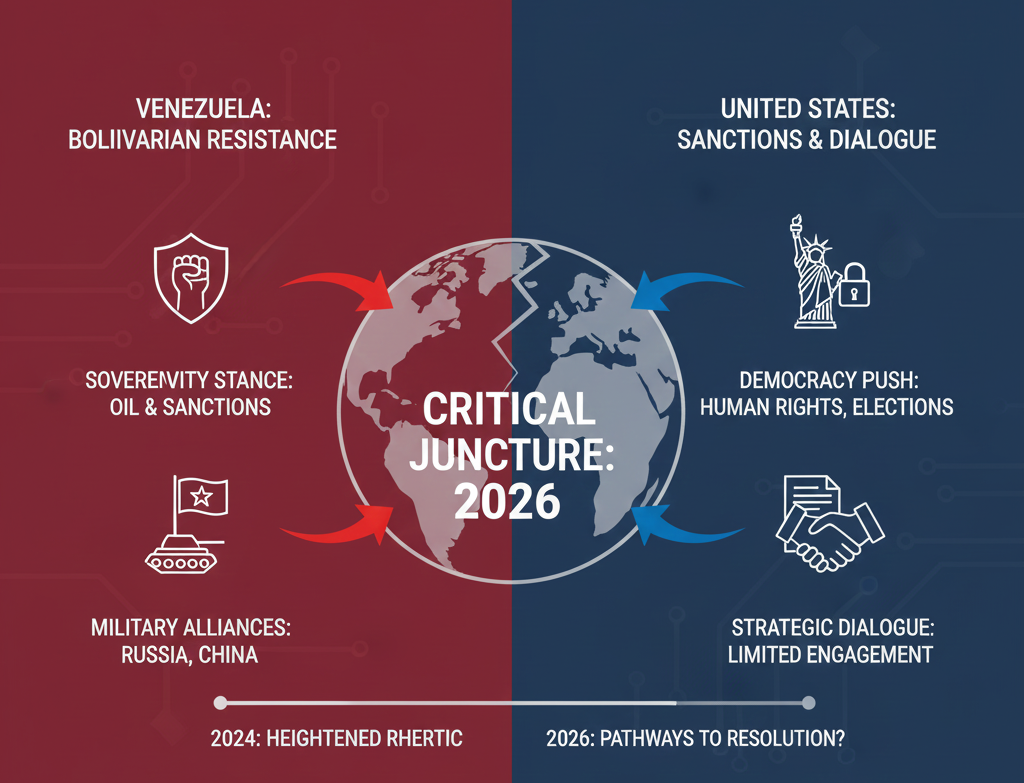
US-Venezuela relations reached a critical flashpoint in early 2026, marked by unprecedented airstrikes, naval blockades, and a war of words over oil reserves and regional security. President Nicolás Maduro’s government faces mounting pressure from the Trump administration’s aggressive measures, including targeted military actions and tightened sanctions, while offering pragmatic concessions on energy cooperation and anti-drug efforts. This escalation unfolds against Venezuela’s protracted humanitarian crisis, with 7.7 million citizens having fled amid hyperinflation, food shortages, and blackouts, testing the limits of diplomacy in Latin America’s most oil-rich nation.wikipedia+1
Historical Roots: From Alliance to Adversaries
US-Venezuela ties, once anchored by oil trade (Venezuela supplied 10% of US imports pre-2019), soured under Hugo Chávez’s socialist reforms and collapsed during Nicolás Maduro’s rule since 2013. Key triggers included Venezuela’s 2017 Constituent Assembly election—widely seen as rigged—and 2018 presidential vote boycotted by opposition. The US responded with sanctions on PDVSA (state oil firm), freezing $7B+ in assets and halting licenses, cratering exports from 2.4M barrels per day (bpd) in 2018 to under 900K bpd by 2025.britannica+1
In 2019, the US and 50+ allies recognized opposition leader Juan Guaidó as interim president, funneling $130M in aid through him. Maduro clung to power via military loyalty, Russian arms, and Chinese loans, while aligning with Iran and Cuba. Partial sanction relief in 2023 (via Barbados Agreement) allowed Chevron operations but collapsed after Maduro’s disputed July 2024 reelection, widely rejected internationally.cnn+1
2026 Escalation: From Blockade to Airstrikes
Tensions boiled over in late 2025 when Trump declared a “total blockade” on Venezuelan oil tankers, interdicting vessels allegedly carrying FARC-linked narcotics worth $2B+. On January 3, 2026, US airstrikes targeted Caracas military barracks, Maracaibo refineries, and FARC camps in Apure state—killing 15 per Venezuelan reports and neutralizing “narco-facilitators,” per the Pentagon. FAA imposed a no-fly zone over Caracas; US embassies issued Level 4 alerts.nytimes+2
Venezuela activated “integral defense zones,” mobilizing 200K troops with Russian S-400 systems and Iranian drones. Maduro accused the US of “imperial resource grab,” vowing UN/OAS appeals. Regional fallout: Brazil/Colombia closed borders; China urged restraint while protecting $60B in loans.moderndiplomacy+1
Maduro’s Pragmatic Oil Diplomacy
Desperation drives Maduro’s outreach: offers include Chevron expansion (already producing 250K bpd under license), $20B US investments in Orinoco Belt heavy oil, and joint anti-drug ops targeting FARC dissidents. He signals distancing from Russia/China/Iran—key sanction triggers—proposing BRICS alternatives if rebuffed. Analysts view this as survival tactics amid 94% poverty, 3,000% inflation (2025 est.), and oil output at 1990s lows.nbcnews+2
Chevron’s role exemplifies hybrid policy: US permits limited production (3% of imports) to stabilize markets, while blocking full PDVSA revival. Maduro leverages Venezuela’s 300B+ barrel reserves—world’s largest—for bargaining, echoing past deals.gordoninstitute.fiu
Strategic Interests at Stake
Both sides pursue high-stakes goals amid layered conflicts.
| Interest | US Priorities | Venezuela’s Leverage/Response |
|---|---|---|
| Energy | Diversify from OPEC+, secure cheap oil | Orinoco upgrades could flood markets gordoninstitute.fiu |
| Security | Dismantle “narco-state,” curb migration | FARC ties as deterrent; blames sanctions for 7.7M exodus |
| Geopolitics | Counter Russia/China/Iran influence | BRICS pivot, Russian S-400 defenses |
| Humanitarian | Pressure for elections, aid access | Blocks aid as “regime change ploy” |
Migration pressures US policy: 800K Venezuelans at southern border (2025). Drugs via “cartel corridor” fuel fentanyl crisis.cfr+1
Economic and Humanitarian Toll
Sanctions amplified Venezuela’s collapse: GDP shrank 75% (2013-2025), malnutrition hit 30%, blackouts crippled industry. Oil-dependent economy (94% exports) starves without revenues; remittances from emigrants sustain basics. US claims sanctions exclude food/medicine, but intermediaries inflate costs. Post-strike, PDVSA halts exports, spiking global prices 5%.orfamerica+1
Global Reactions and Diplomatic Pathways
- Allies: Russia deploys warships; China protects loans; Iran supplies fuel.
- Neighbors: Lula’s Brazil mediates; Colombia hosts 2.8M refugees.
- Institutions: OAS condemns strikes; UN urges talks.dw+1
Outlook favors hybrid pressure—sanctions + targeted ops—over invasion, costing $100B+. Maduro’s offers mirror 2023 thaw (lifted some sanctions), but strikes demand de-escalation. Watch Chevron talks and OAS sessions for breakthroughs amid oil market volatility.moderndiplomacy+1
- https://en.wikipedia.org/wiki/2026_United_States_strikes_in_Venezuela
- https://www.nytimes.com/live/2026/01/03/world/trump-united-states-strikes-venezuela
- https://www.britannica.com/topic/What-Is-Happening-Between-the-United-States-and-Venezuela
- https://orfamerica.org/newresearch/us-venezuela-relations
- https://www.cnn.com/2025/12/31/americas/venezuela-us-history-trump-strike-latam-intl
- https://en.wikipedia.org/wiki/United_States%E2%80%93Venezuela_relations
- https://www.hindustantimes.com/world-news/venezuela-us-tensions-live-updates-donald-trump-airstrikes-caracas-explosions-white-house-january-3-venezuela-news-101767426132035.html
- https://moderndiplomacy.eu/2026/01/02/maduro-signals-willingness-for-talks-with-u-s-offers-cooperation-on-oil-and-drugs/
- https://www.nbcnews.com/world/venezuela/venezuela-nicolas-maduro-donald-trump-us-drug-trafficking-dock-strike-rcna251882
About the Author
InsightPulseHub Editorial Team creates research-driven content across finance, technology, digital policy, and emerging trends. Our articles focus on practical insights and simplified explanations to help readers make informed decisions.