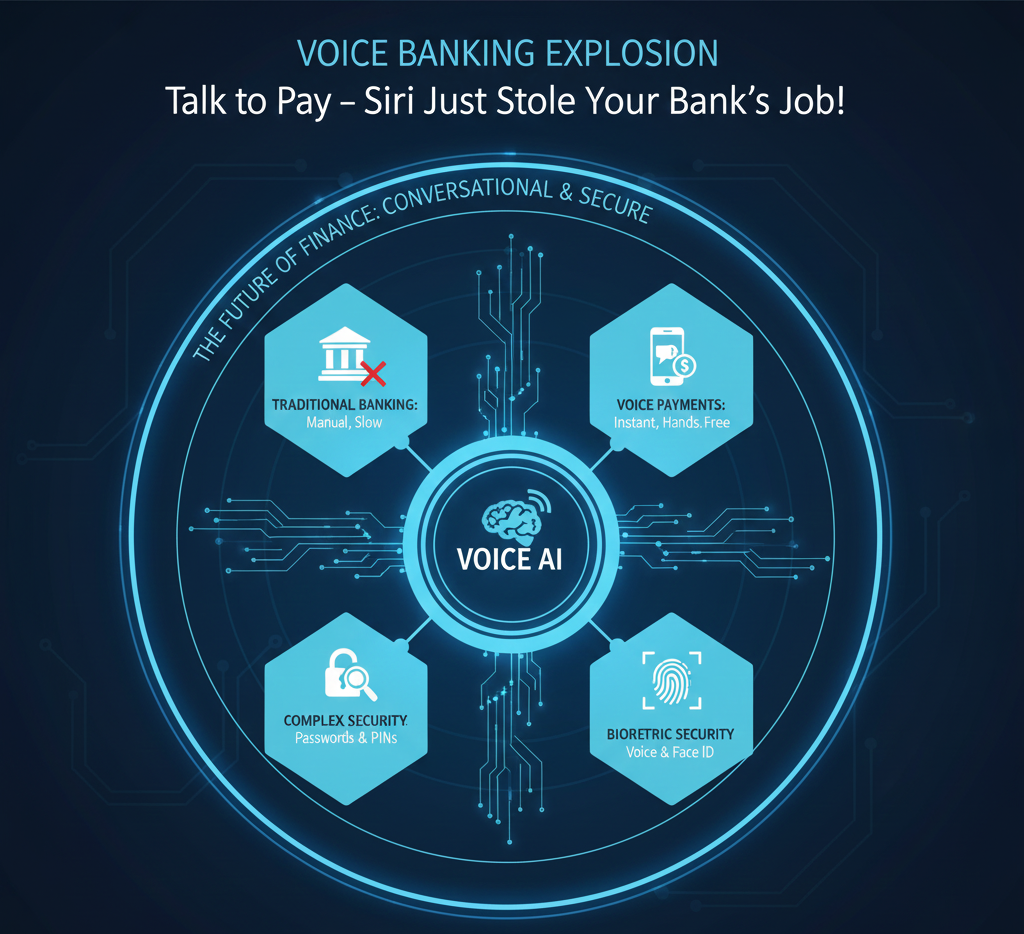
The voice banking market is surging, valued at $1.61 billion in 2024 and forecasted to reach $2.99 billion by 2028 with a 16.8% CAGR, driven by AI-powered virtual assistants and smart device adoption.[1]
What is Voice Banking and Why Now?
Voice banking allows users to handle financial tasks—checking balances, transferring funds, or paying bills—through spoken commands via AI assistants like Siri, Alexa, or Google Assistant. This shift from apps and branches to conversational AI marks a pivotal evolution in fintech. The historic growth from $1.38 billion in 2023 to $1.61 billion in 2024 reflects rising smartphone penetration, IoT devices, and demand for hands-free convenience.[1]
Recent trends show enterprises accelerating voice AI adoption. The conversational AI market, closely tied to voice banking, is projected to hit $14.29 billion in 2025 and $41.39 billion by 2030 at a 23.7% CAGR, with financial services (BFSI) holding a 32.9% share.[2] Banks report 20-30% operational cost reductions through voice agents for fraud detection and transactions.[2]
Market Growth: Numbers Don’t Lie
North America dominates the voice banking market, but Asia-Pacific is the fastest-growing region, fueled by smartphone expansion in countries like China, India, and Japan.[1] Globally, smart home device adoption rose from 42% in 2020 to 47% in 2022, with smart speakers at 30%, boosting voice assistance demand.[1]
By 2026, U.S. voice assistant users will reach 157.1 million, transitioning voice tech from novelty to necessity.[2] In financial services, voice AI handles account services and real-time support, while contact centers see 35% faster call handling, 30% higher satisfaction, and 50% shorter queues.[2]
Key Technologies Powering the Shift
Voice banking relies on machine learning, deep learning, natural language processing, and cloud deployment.[1] Leading innovations include agentic AI systems, which autonomously manage multi-step tasks—one in ten customer interactions fully automated by 2026.[2] Emotional AI, now a $37.1 billion market, detects tones for empathetic responses, cutting escalations by 25%.[2]
Voice biometrics enhance security with unique voiceprints, mainstreaming fraud prevention in banking.[2] Platforms now support 20+ languages with dialect recognition, as 73% of consumers demand accent-friendly AI.[2] Examples include Glia’s April 2023 launch of AI-powered voice assistants on its Interaction Platform, replacing IVR with 24/7 conversational AI for banks.[1]
Real-World Examples: Banks Betting Big
Major players like Hongkong and Shanghai Banking Corporation, NatWest, U.S. Bank, Lloyds, and ICICI Bank lead adoption.[1] In 2026 trends, AI voice agents join banking teams for seamless integration into apps and wearables, enabling ‘invisible banking’ where services activate via voice without apps.
Financial institutions use voice for omnichannel experiences: instant support across phone, smart speakers, and apps. Posh.ai highlights human-centered trends like AI chatbots and core modernization, with voice first in line.[6] Latin America leads invisible banking with 77% AI adoption via voice assistants and wearables.
Benefits: Convenience Meets Cost Savings
Consumers gain frictionless banking—71% use voice assistants for product research, extending to payments.[2] Businesses cut costs: healthcare voice AI saves $150 billion annually by 2026; banking mirrors this with automation.[2]
82% prefer AI over human wait times, boosting satisfaction.[2] For banks, ROI hits within 6-12 months, with 92% of companies investing in generative AI.[2]
Challenges: Security, Accuracy, and Regulation
Despite growth, voice banking faces hurdles. Accuracy nearing human levels reduces errors, but accents and noise persist. Security via biometrics addresses fraud, yet regulated sectors accelerate adoption cautiously.[2]
Privacy concerns loom with voice data, demanding robust compliance. As U.S. neobank use hits 29%, traditional banks must blend voice with policy shifts.[5]
Future Outlook: 2026 and Beyond
Voice banking heads toward autonomous, voice-first solutions. Trends include tokenization, stablecoins, and AI going where users are—like smart homes. Global expansion and personalization will define this explosion.
Conclusion
Voice banking isn’t stealing jobs—it’s redefining them, offering $2.99 billion in opportunities by 2028. Banks embracing AI voice tech will lead the talk-to-pay revolution.[1]
References
- https://www.fintechfutures.com/press-releases/voice-banking-presents-a-2-99-billion-opportunity-by-2028-analysis-of-regional-and-country-market-breakdowns-competitive-landscape-market-shares-trends-strategies-and-more
- https://nextlevel.ai/voice-ai-trends-enterprise-adoption-roi/
- https://www.galileo-ft.com/blog/invisible-banking-latam-adoption-2026/
- https://www.posh.ai/blog/human-centered-banking-technology-top-10-fintech-trends-for-2026-and-beyond
- https://vacuumlabs.com/curcurent-trends-in-banking-industry/
- https://rfi.global/trends-the-challenges-and-opportunities-facing-us-financial-institutions-in-2026/